
The Oldest Hospital Still Active in the City
Founded in 1288, Santa Maria Nuova is the oldest hospital in Florence still in continuous operation. Located in the historic centre, it represents a rare convergence of medieval charity, Renaissance medicine, art, architecture, and institutional innovation. More than a hospital, Santa Maria Nuova is a living archive of Florence’s social history, where faith, finance, and medical science intersected centuries before modern healthcare systems ever emerged.
The hospital was founded on 23 June 1288 by Folco Portinari, a wealthy Florentine merchant and banker. Banking in the thirteenth century was considered morally risky business — lending money at interest was widely associated with sin and usury — so for elite families, philanthropy was never only generosity. It was spiritual investment, a way of balancing accounts that mattered rather more than the ones kept in ledgers. Folco Portinari is remembered today for another reason as well: he was the father of Beatrice Portinari, widely identified as Dante’s muse in The Divine Comedy.
The Role of Monna Tessa
Florentine tradition credits Monna Tessa, the pious nurse of young Beatrice, with inspiring the hospital’s foundation. Though her story is partly legendary, she is historically associated with the creation of the Oblate Sisters, the community of women devoted to hospital care that grew up around Santa Maria Nuova. The Oblates are considered among the earliest structured nursing communities in Europe, active centuries before Florence Nightingale reshaped nursing into a modern profession. Remarkably, the order was only formally recognised in 1953 — a delay that, somewhat paradoxically, allowed the Oblates to survive earlier waves of religious suppression that swept away many other confraternities. Their presence in the hospital has remained continuous since the thirteenth century.
How Santa Maria Nuova Changed Medieval Healthcare
When it opened, the hospital had just twelve beds, often shared by more than one patient at a time. Yet even in this modest earliest form, it introduced innovations that were genuinely ahead of their era: separation of male and female wards, structured nursing roles rather than informal charity, careful administrative record-keeping, and a deliberate integration of spiritual and physical care into a single course of treatment. Unlike many medieval institutions that functioned mainly as shelters for the destitute, Santa Maria Nuova was founded explicitly as a place of cure — a distinction that made it genuinely unusual in fourteenth-century Florence.
The Impact of the Black Death
The Black Death of 1348 devastated Florence, yet paradoxically it strengthened Santa Maria Nuova considerably. Many citizens, facing death themselves, left bequests to the hospital in their wills, and historical records indicate the institution received approximately 25,000 gold florins in this way, funding a major expansion of its facilities. Within a century, Santa Maria Nuova had become one of Italy’s most important medical centres, its fortunes built directly on the very disaster that had devastated everyone around it.
Architecture Designed for Healing
The hospital’s original ward design reflected medieval medical belief as much as practical need. Beds lined the walls of a large hall, all facing a central altar, so that patients could see devotional imagery without leaving their beds — healing was considered inseparable from spiritual reflection, and architecture was built to enforce that connection. High windows were installed specifically to reduce what physicians of the time called miasmas, the corrupted air believed to spread disease, while a large wooden crucifix reminded patients of Christ’s own suffering, encouraging meditation as an active part of recovery rather than mere decoration. This architectural model, born in Florence, went on to influence hospital design across Europe for centuries.
The Spedalingo: A Powerful Hospital Director
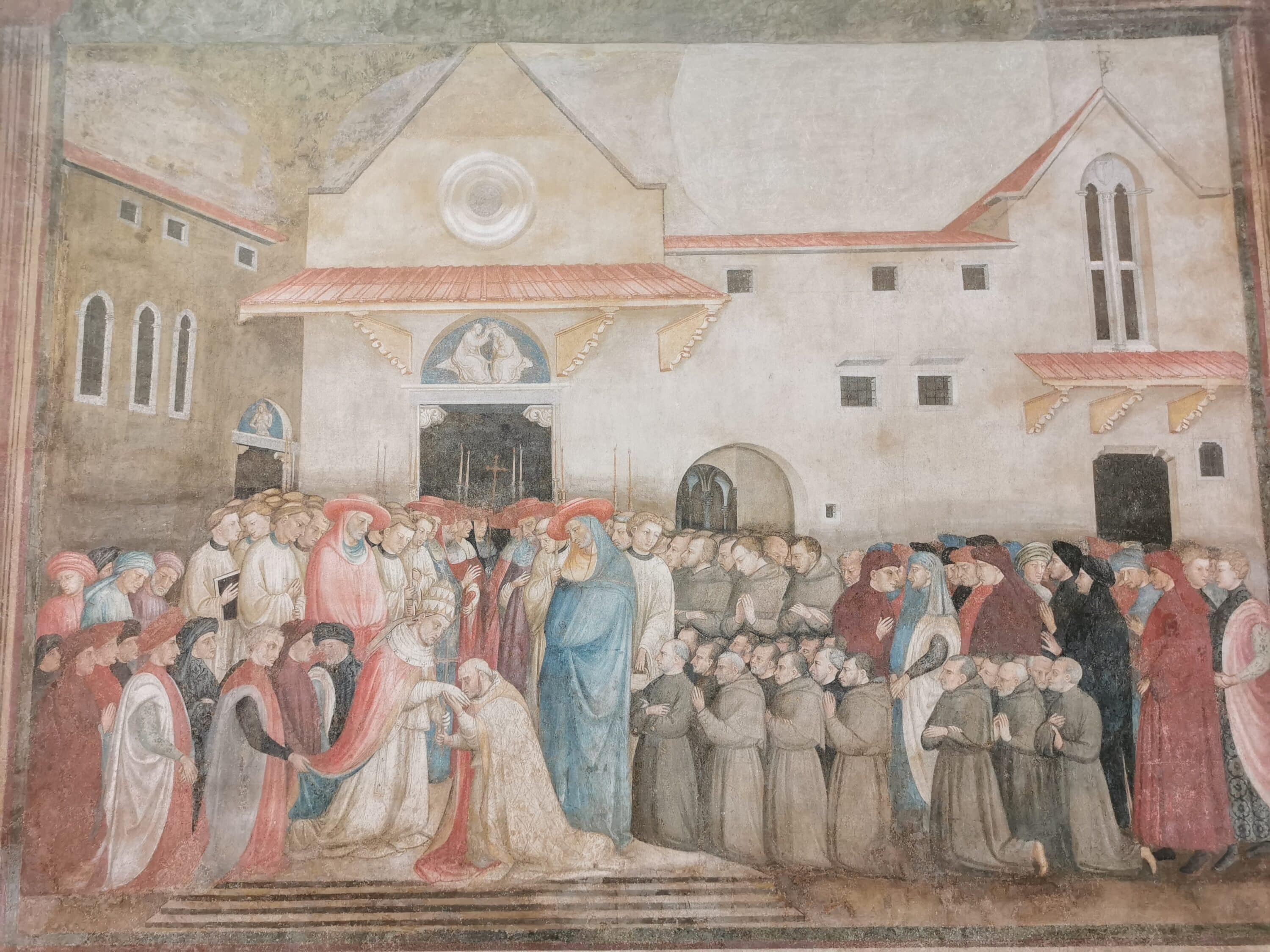
The hospital’s director, known as the spedalingo, held a lifetime appointment and considerable civic authority — running Santa Maria Nuova was, by the fifteenth century, a genuine position of power in Florentine public life. In 1425, Pope Martin V visited the hospital and formally reconsecrated it, publicly reaffirming its privileges before the city. Frescoes by artists including Gherardo di Giovanni commemorate this moment, depicting the spedalingo standing in a position of clear civic importance beside the pope himself.
By this period Santa Maria Nuova operated as a large-scale institution in every practical sense: it owned roughly thirty rural farms, produced and sold agricultural goods, generated a genuine financial surplus, and managed its assets with a level of economic sophistication that closely resembled the practices of Florence’s own banking families.
Renaissance Medicine and Leonardo da Vinci
During the Renaissance, Santa Maria Nuova became an important site for serious medical study. By the fifteenth and sixteenth centuries the hospital employed salaried physicians and surgeons, marking a decisive shift toward professional medicine rather than purely charitable care. Leonardo da Vinci conducted anatomical dissections here, using the hospital’s facilities to deepen the anatomical knowledge that would later inform both his art and his scientific notebooks; he later left 400 ducats to the hospital in his will, a final acknowledgement of what the institution had made possible for him. His anatomical studies represent a genuine turning point in empirical medical observation, and Santa Maria Nuova was where a considerable share of that empirical work actually happened.
The Spezieria: Florence’s Medical and Artistic Laboratory
The hospital’s apothecary, or spezieria, is documented as far back as the fourteenth century, producing herbal preparations, oils and balms, mineral compounds, and, for wealthier patients, remedies incorporating ground gemstones. Because pigments and medicines drew on overlapping raw materials, painters belonged to the same guild as physicians and apothecaries, the Arte dei Medici e Speziali — a genuinely strange-sounding overlap to modern ears, but a practical necessity in an economy where the same suppliers stocked both a painter’s studio and a doctor’s dispensary. The Compagnia di San Luca, an association of artists that included figures such as Lorenzo Ghiberti, maintained close connections to this same environment, and Santa Maria Nuova became, almost by accident, a genuine meeting point between art, science, and commerce.
Medicine, Magic, and the Mandrake
Medieval medicine mixed empirical knowledge freely with superstition, and the hospital’s own herb gardens reflected exactly that blend. Alongside sage, valued for oral health, and rue, used for a range of medicinal purposes, the gardens grew mandrake, believed throughout the period to possess genuinely magical properties. The Florentine iris, cultivated here too, would later find a second life entirely in perfumery. The mandrake root’s uncanny, almost human shape inspired the belief that it contained a spirit of its own; extraction rituals reportedly involved tying the root to a dog and letting the animal pull it free, so that no human had to risk direct contact — a practice documented in medieval herbals well beyond Florence. Such rituals illustrate, in miniature, Florence’s own long transition from superstition toward something closer to scientific method.
Mental Health and Early Psychiatry
In the late eighteenth century, Santa Maria Nuova became linked administratively to the Hospital of San Bonifazio, which treated chronic illness, skin disease, and mental disorder under a single roof. Under the Grand Duchy of Lorraine, Florence became home to one of Europe’s earliest dedicated psychiatric institutions, at a time when individuals with mental illness were far more commonly imprisoned than treated by any medical standard. The connection between dermatology and psychiatry that developed here was shaped significantly by the spread of syphilis, a disease that often began with visible skin symptoms before progressing to neurological and psychiatric decline — an early medical awareness that contributed directly to Florence’s later reputation as a centre for dermatological study.
The Franciscan Tau as a Symbol of Healing
The hospital’s emblem, which resembles a simple crutch at first glance, is in fact a Tau cross, closely associated with the Franciscan order. The symbol represented healing in both its physical and spiritual senses, and would have been immediately recognisable to any medieval Florentine encountering it above the hospital’s doors.
Santa Maria Nuova survived the Black Death of 1348 and the catastrophic flood of 1966 alike, a continuity that very few institutions anywhere in Europe can genuinely claim. It reveals a Florence built not only on art and banking, but on structured care and civic responsibility carried out over more than seven centuries. The Renaissance was not born only in studios and palaces. It was shaped equally in hospital wards, botanical gardens, and apothecaries — the places where the human body itself became, for the first time, worthy of organised, deliberate care.