
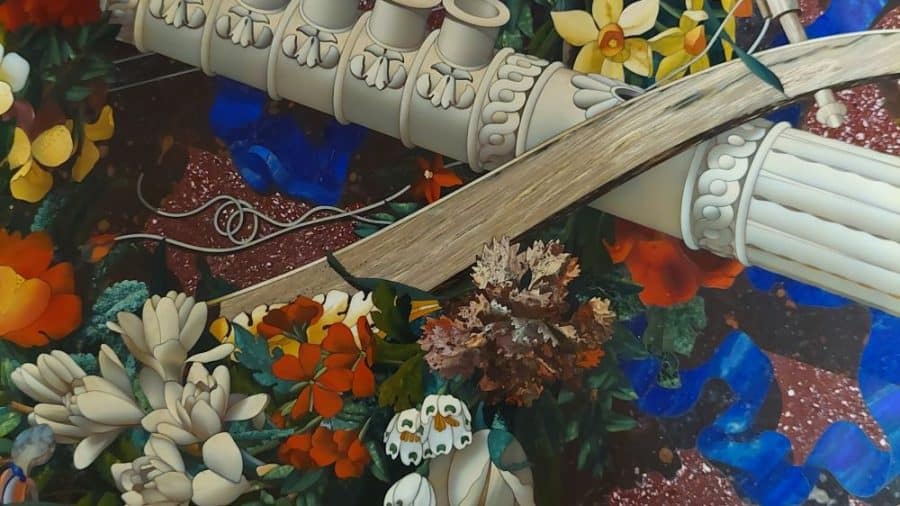
Inside the Basilica of San Lorenzo, past Michelangelo’s New Sacristy, stands a space built for the opposite purpose entirely: not restraint, but overwhelming, deliberate excess. The Chapel of the Princes is an octagonal room where every surface, floor to dome, is covered in inlaid marble and semi-precious stone. It took the Medici the better part of four centuries to build it. They never actually finished.
A Mausoleum Worthy of a Dynasty
The idea belonged first to Cosimo I de’ Medici, the sixteenth-century duke who transformed Florence’s ruling family from powerful bankers into hereditary sovereigns. Cosimo wanted a family mausoleum grand enough to match that transformation, but it fell to his son Ferdinando I, and then to Ferdinando’s own son, the little-known Don Giovanni de’ Medici, to actually design and begin building it. Construction finally started in 1604, financed on a scale that startled even a dynasty accustomed to spending lavishly on self-glorification.
What Ferdinando wanted was not simply a burial chamber, but the most spectacular hardstone monument in the world — a room where six Grand Dukes and their consorts would rest beneath walls encrusted with porphyry, jasper, lapis lazuli, coral, and mother-of-pearl, arranged into vast heraldic displays of the coats of arms of the sixteen Tuscan cities under Medici rule. It was meant to declare, in permanent stone, exactly how far the family had come from its origins as merchants and moneylenders.
A Workshop Built for One Purpose
The technical demands of that ambition were, in 1588, beyond what any existing Florentine workshop could deliver. So Ferdinando founded one specifically for the task: the Opificio delle Pietre Dure, the Workshop of Hardstones, gathering the city’s most skilled craftsmen inside a wing of the Uffizi to develop and refine an exacting technique known as commesso fiorentino, or Florentine mosaic. Unlike conventional mosaic, built from small uniform tesserae, commesso works with larger cut pieces of stone, chosen with obsessive care for their natural colour, opacity, and veining, fitted together edge to edge so precisely that the joins all but disappear — a technique closer to marquetry than to any tile-based craft, executed in materials that do not forgive mistakes.
The workshop’s mission was, quite literally, to invent the pipeline of expertise the Medici needed. Craftsmen trained inside the Opificio for years to master a discipline built almost entirely around patience: sourcing rare stone from across the known world, cutting it with agonising precision, and composing images and heraldic emblems that would need to survive, unchanged, for centuries.
A Project That Outlived Its Patrons
What makes the Chapel of the Princes remarkable is not only its scale, but the sheer duration of its construction. The difficulty and expense of sourcing suitable stone meant the decorative programme dragged on for generations, passing from one Medici Grand Duke to the next, then continuing under the Lorraine dynasty that succeeded the Medici in the eighteenth century, and still receiving major additions well into the 1700s — altar panels commissioned nearly a century after construction began, designed but in some cases never installed.
The Opificio itself outlasted every patron who had commissioned it. It survived the extinction of the Medici line in 1737, the arrival of the Lorraine dynasty, the political upheavals of the nineteenth century, and the unification of Italy — an institution originally built to serve one family’s dynastic vanity, gradually transforming, once that family was gone, into something closer to a permanent civic institution. Today it survives as one of the world’s foremost centres for art conservation and restoration, still occupying its historic premises on Via degli Alfani, its centuries of accumulated stone-cutting expertise now applied to preserving, rather than producing, Florence’s artistic heritage.
Unfinished, On Purpose or Not
The Chapel of the Princes remains, to this day, incomplete. Some of the wall surfaces were never finished in hardstone as originally intended; certain designed elements, including elaborate altar decorations, exist only as drawings and unused decorative fragments preserved in the Opificio’s own collection, never installed in the space they were designed for. Whether this reflects simple exhaustion of resources, shifting priorities across successive rulers, or the sheer scale of an ambition that always outran what any single generation could complete is difficult to say with certainty — likely some combination of all three.
There is something fitting about a monument to dynastic permanence that itself never reached completion. The Medici built the Chapel of the Princes to declare, in the most durable materials available to them, that their power would last forever. The family did not last forever. The building project meant to prove otherwise still hasn’t, technically, ended.
Seeing the Craft Today
Visitors to the Chapel of the Princes today walk through the finished result of that centuries-long ambition — a room whose sheer material density is difficult to absorb in a single visit. A short walk away, the Opificio’s own museum on Via degli Alfani displays tools, unfinished panels, and preparatory designs from the same long project, offering a rarer view: not the polished final product, but the patient, exacting craft that made it possible, still practised today by a handful of workshops carrying forward a technique that has survived every dynasty that ever commissioned it.