
Florence’s Most Daring Tradition Born in Piazza Santa Croce
In Florence, history is not only preserved in stone and fresco. It is lived, reenacted, and fiercely defended. Nowhere is this more evident than in Calcio Storico Fiorentino, the city’s most dramatic and deeply rooted tradition — a ritual of strength, honor, and civic pride that unfolds each year in Piazza Santa Croce, against the monumental backdrop of the Basilica itself. To witness Calcio Storico is to encounter Florence at its most visceral: a city that celebrates beauty and intellect, yet never forgets courage, rivalry, and the power of collective identity.
The Origins of Calcio Storico
Calcio Storico traces its origins back to the Renaissance, when Florence was at the height of its political, cultural, and military power. Unlike modern football, this game was not born as entertainment alone, but as a display of physical prowess and civic virtue, played by young noblemen and soldiers. The earliest documented matches date to the 16th century, though variations of the game existed earlier. Calcio was played in honor of important events, religious festivities, and political celebrations — transforming Florence’s public squares into theatrical arenas where strength and loyalty were tested. Among these spaces, Piazza Santa Croce emerged as the symbolic heart of the tradition.
Piazza Santa Croce: The Stage of Honor
Few settings could rival Piazza Santa Croce for such a spectacle. Framed by the Franciscan basilica — a pantheon of Florentine greatness — the square became the natural stage for Calcio Storico, linking physical combat with spiritual and civic values. The contrast is striking: beneath the serene façade of Santa Croce, players engage in a contest that blends wrestling, rugby, boxing, and football, governed by ancient rules and unwritten codes of honor. This union of sacred space and raw physicality encapsulates Florence’s complex soul — refined yet fearless, intellectual yet unyielding.
Rules, Rituals, and Controlled Chaos
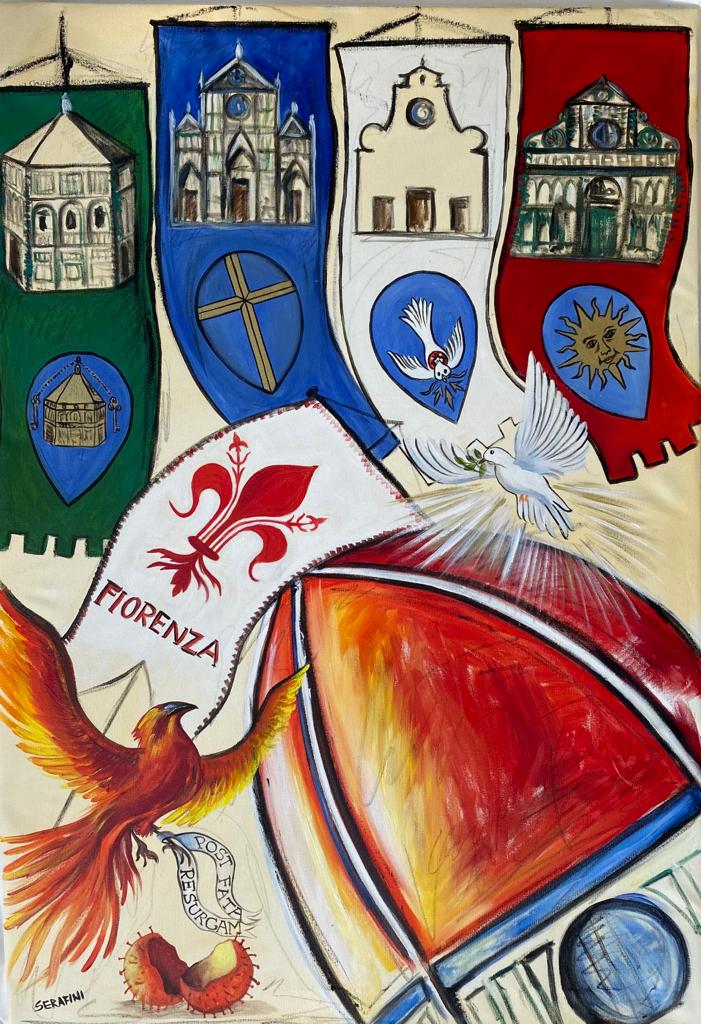
Calcio Storico follows rules that are centuries old and unapologetically brutal. Two teams of 27 players face each other on a sand-covered field, divided by color — Rossi, Azzurri, Bianchi, and Verdi, each representing one of Florence’s historic neighborhoods. The objective is simple: score goals by sending the ball into the opponent’s net. The means, however, are anything but simple. Physical contact is not only allowed; it is expected. Wrestling holds, tackles, and strategic confrontations are all part of the game. Yet Calcio Storico is not chaos. Beneath its ferocity lies discipline, ritual, and respect — values passed down through generations.
The Costumes and the Ceremony
Before the match begins, Florence transforms into a living Renaissance painting. A historic parade precedes the game, with drummers, flag throwers, soldiers, and noble figures in period costume marching through the city. This ceremonial introduction elevates Calcio Storico from sport to spectacle. It reminds spectators that what they are witnessing is not a reenactment for tourists, but a tradition deeply woven into Florentine identity. Every gesture, from the opening cannon shot to the final salute, follows a codified ritual that honors the past while energizing the present.
A Game of Pride, Not Profit
What distinguishes Calcio Storico from modern sports is its absence of commercialism. Players are not professionals seeking fame or fortune. They are Florentines — craftsmen, athletes, professionals — who train rigorously for the honor of representing their neighborhood. Victory brings no monetary reward. Instead, the winning team traditionally receives a symbolic prize, once a Chianina calf, emphasizing that the true reward is pride, recognition, and belonging. In a world dominated by sponsorships and spectacle, Calcio Storico remains defiantly authentic.
Santa Croce and Florentine Identity
The connection between Calcio Storico and Santa Croce runs deeper than location alone. The basilica is the resting place of Florence’s greatest minds — Michelangelo, Galileo, Machiavelli — figures who shaped the city’s intellectual legacy. Calcio Storico complements this heritage by celebrating the physical and communal dimension of Florentine identity. Together, they tell a complete story: Florence as a city of thinkers and fighters, artists and defenders. For those exploring Santa Croce on a private guided tour, understanding this tradition adds a powerful layer of meaning to the square and its monuments.
Why Calcio Storico Still Matters
Today, Calcio Storico continues to ignite fierce loyalty and passionate debate. It is not without controversy, yet its endurance speaks to something essential: Florence’s refusal to dilute its traditions for convenience or comfort. To witness or understand Calcio Storico is to grasp the city’s unapologetic authenticity — a reminder that history here is not passive, but embodied. In the shadow of Santa Croce, where art, memory, and identity converge, Calcio Storico remains one of Florence’s most compelling expressions of continuity and character.