
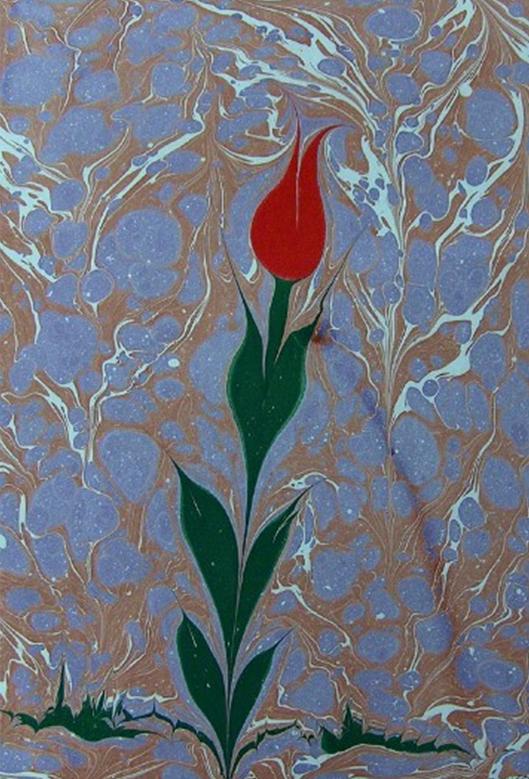
Walk into a Florentine bookbinder’s shop today and the marbled paper on display looks, first and foremost, like decoration: swirling colours, no two sheets quite alike, the kind of pattern people frame and hang on walls. For centuries, though, that unrepeatable, impossible-to-copy quality was not a decorative bonus. It was the entire point.
An Art Invented to Stop Forgers
The technique that would eventually become one of Florence’s signature crafts did not begin in Italy, and it did not begin as art. Its documented roots trace back to the Ottoman Empire of the fifteenth century, where it became known as ebru — a name most historians connect to the Persian word for “cloud,” a fitting description of the drifting, marbled patterns the technique produces. Some form of paper marbling may have existed even earlier in China and Central Asia, but it was in the Ottoman court that the craft reached its full development, refined by dedicated workshops clustered around Istanbul’s Beyazıt and Süleymaniye districts.
What made ebru valuable to the Ottoman state was not its beauty, but its unforgeability. Officials began writing important administrative documents directly onto marbled paper, because the technique’s swirling, non-repeating patterns made alteration or forgery immediately obvious: any attempt to erase or insert text would visibly disturb the surrounding marbling, betraying the tampering at a glance. It was, in effect, a security feature centuries before watermarks or holograms — beauty deployed in the service of bureaucratic integrity.
A Guarded Secret
Because the technique carried this practical value, Ottoman marbling masters treated their methods as closely held trade secrets, passed down through specific workshops rather than published or widely taught. That secrecy became part of the craft’s mystique as it began travelling west. European merchants encountered marbled papers through Mediterranean trade routes as early as the sixteenth century, and their appeal was immediate — printing houses and bookbinders across Europe, riding the explosive growth in book production that followed the invention of the printing press, wanted marbled sheets for endpapers and covers, but had no idea how they were made.
According to craft tradition, it took determined effort — apprentices watching closely, technique smuggled out piece by piece — before European bookbinders finally reconstructed workable versions of the process for themselves. Even once established in Europe, the trade guarded its methods jealously: marbling houses in England, for instance, are recorded as taking on boys from local workhouses as apprentices under agreements to teach them the craft in exchange for years of labour, then deliberately withholding full instruction, keeping each worker responsible for only one isolated step of the process so that no single apprentice could walk away with the complete technique.
Florence Finds Its Own Voice
By the time marbling reached Italy and France, distinct national styles had begun to emerge, each named for the country or craftsman associated with it — French Curl, Old Dutch, Italian Hair Vein among them — variations built on the same underlying method: pigments floated on a thickened liquid bath, then combed, dragged, or otherwise manipulated into pattern before being transferred, in a single motion, onto a waiting sheet of paper.
Florence adopted the craft with particular enthusiasm, and it settled comfortably alongside the city’s other long traditions of fine bookbinding and papermaking. The practical logic that had first made marbling valuable in the Ottoman court — its resistance to tampering — carried over neatly into European binding practice too: books finished with marbled edges or endpapers gained a reputation for security, since removing or altering pages disturbed the continuous pattern running across them, exposing exactly the kind of interference the Ottomans had first designed the technique to prevent.
From Trade Secret to Museum Piece
What began as closely guarded court technology eventually became common knowledge, documented openly enough that Enlightenment encyclopedists, including Diderot in France, felt the craft worth explaining and illustrating for a general readership — workshop tools, baths, and combing implements laid out for anyone curious enough to read. The transformation from state secret to public reference entry took roughly three centuries.
A Living Craft in Florence Today
Florence’s marbling workshops today continue a technique whose lineage runs, in an unbroken if winding line, back to Ottoman scribes protecting state documents from tampering five centuries ago. The city is particularly associated with continuing this heritage through fine bookbinding, where marbled sheets still appear as covers and endpapers, and increasingly through a wide range of decorative stationery, notebooks, and paper goods sold in the same small shops where the paper is made by hand, one sheet at a time, on the surface of a water bath — each pattern, true to the technique’s original purpose, entirely unrepeatable.