
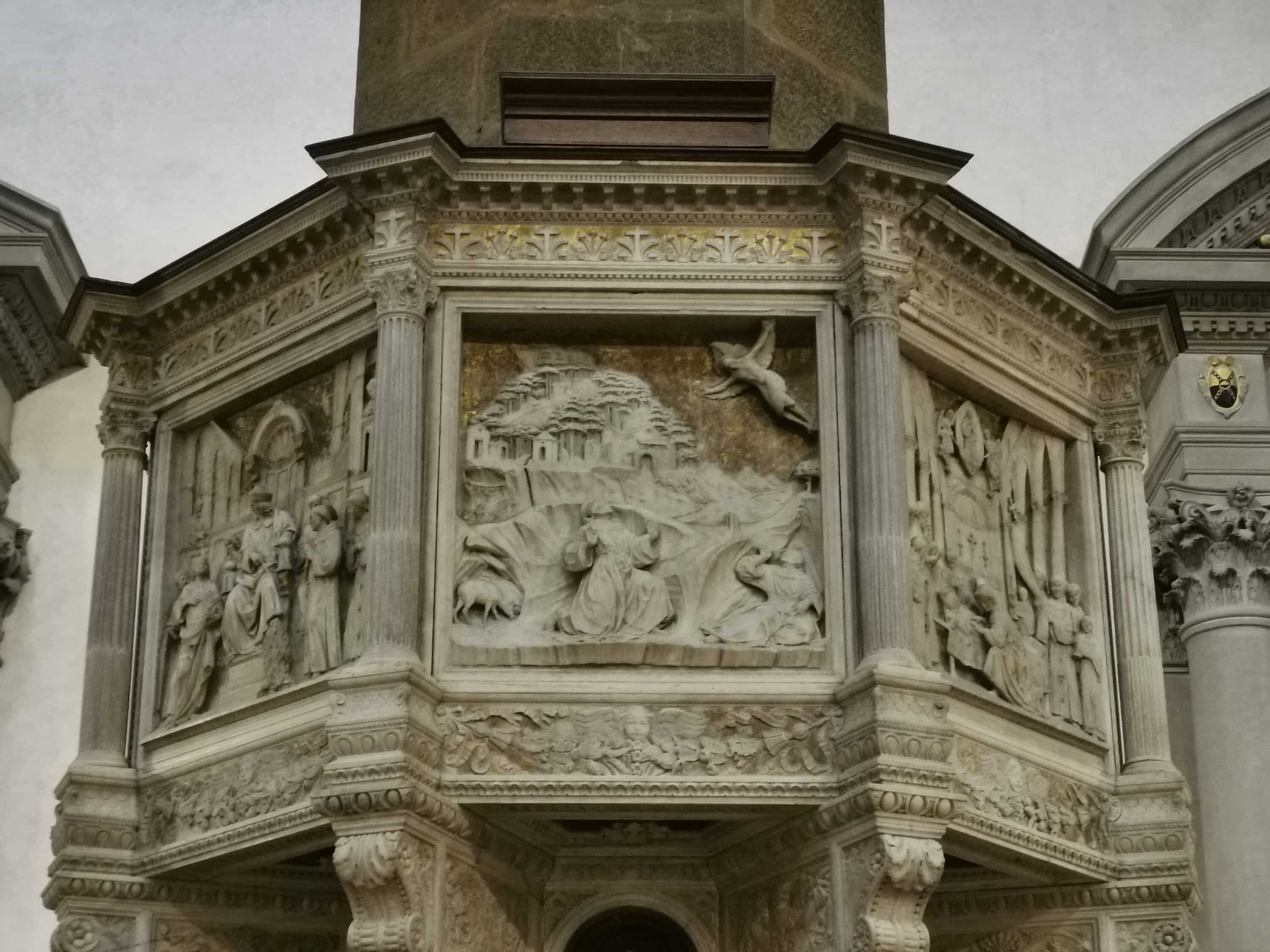
Faith, Humanity, and the Spiritual Roots of the Renaissance
Santa Croce is often introduced as the Pantheon of Florence, a resting place for artists, thinkers, and visionaries. Yet before it became a monument to greatness, it was — above all — a Franciscan church. Its identity, architecture, and spirit were shaped by the ideals of the Franciscan Order, whose presence in Florence transformed not only religious life, but the very way humanity was represented in art and thought. To understand Santa Croce is to understand the Franciscans: their preaching, their revolutionary vision of humanity, and their quiet role in preparing the ground for the Renaissance.
The Rise of the Mendicant Orders in Medieval Florence
In the 13th century, Florence was a rapidly expanding city, driven by commerce, banking, and social change. Traditional monastic institutions, often isolated from urban life, could no longer fully address the spiritual needs of a growing population. The mendicant orders, particularly the Franciscans and Dominicans, emerged as a response. Unlike monks, friars lived among the people. They preached in public spaces, spoke the language of ordinary citizens, and addressed real human concerns — poverty, work, suffering, hope. The Franciscans, inspired by Saint Francis of Assisi, brought to Florence a radical message of humility, compassion, and identification with the marginalized. Santa Croce became their spiritual home — not a secluded monastery, but an open church embedded in the life of the city.
Santa Croce: A Church for the City
Built on a monumental scale, Santa Croce reflects the Franciscan paradox: simplicity of spirit combined with architectural ambition. Its vast nave was designed to welcome large crowds, allowing sermons to reach merchants, artisans, and laborers alike. This was not accidental. Franciscan preaching emphasized direct emotional engagement. Sermons were vivid, moral, and deeply human, encouraging listeners to see themselves within biblical narratives. Santa Croce thus became a civic space as much as a religious one — a place where Florence gathered to listen, reflect, and redefine its values.
Preaching and the Power of the Spoken Word
Franciscan preaching in Florence was transformative. Friars addressed themes of mercy, justice, and personal responsibility, often criticizing greed and excess in a city increasingly defined by wealth. Their words shaped public conscience. They influenced charitable institutions, hospitals, and confraternities. They also encouraged a more empathetic vision of humanity, where spiritual worth was not measured by status or power. This emphasis on lived experience would soon find a powerful ally in visual art.
Giotto and the Franciscan Vision of Humanity
No artist embodies the Franciscan spirit more clearly than Giotto di Bondone, whose work is inseparable from Santa Croce and the broader Franciscan world. Giotto’s figures are revolutionary not because they are idealized, but because they are human. They weep, embrace, hesitate, and suffer. Their emotions are readable, their bodies grounded in space and time. This was a visual translation of Franciscan theology: Christ as a suffering man, saints as relatable figures, and sacred stories rooted in human experience. Giotto’s frescoes — many commissioned for Franciscan contexts — mark a decisive break from the abstract spirituality of medieval art. They anticipate the Renaissance not through classical references, but through empathy.
A New Humanity Before the Renaissance
The Franciscans did not speak of “humanism” as later thinkers would, yet their worldview laid its foundations. By emphasizing Christ’s humanity, the dignity of the poor, and the value of individual experience, they encouraged a new way of seeing the world. Art, theology, and daily life became interconnected. Beauty was no longer distant and symbolic; it was immediate and emotional. Santa Croce stands as a physical manifestation of this shift — a space where faith, art, and civic identity merged into something profoundly modern.
Legacy: Why the Franciscans Still Matter in Santa Croce
Today, visitors often focus on the famous tombs and artworks within Santa Croce. Yet beneath them lies a deeper story: that of a religious order that changed Florence from within. The Franciscans shaped how Florentines understood compassion, responsibility, and the value of the individual. They fostered an environment in which artists like Giotto could redefine visual language, paving the way for the Renaissance long before it had a name. To walk through Santa Croce is to walk through the birthplace of a new sensibility — one that sees holiness in humanity and finds the sacred in lived experience.
Experiencing Santa Croce Today
On a private guided tour of Santa Croce, this Franciscan legacy becomes tangible. The scale of the church, the emotional power of its artworks, and the stories embedded in its walls reveal a Florence not only of geniuses and patrons, but of ideas — quietly radical, deeply human. It is here, among stone and silence, that the Renaissance truly begins.