
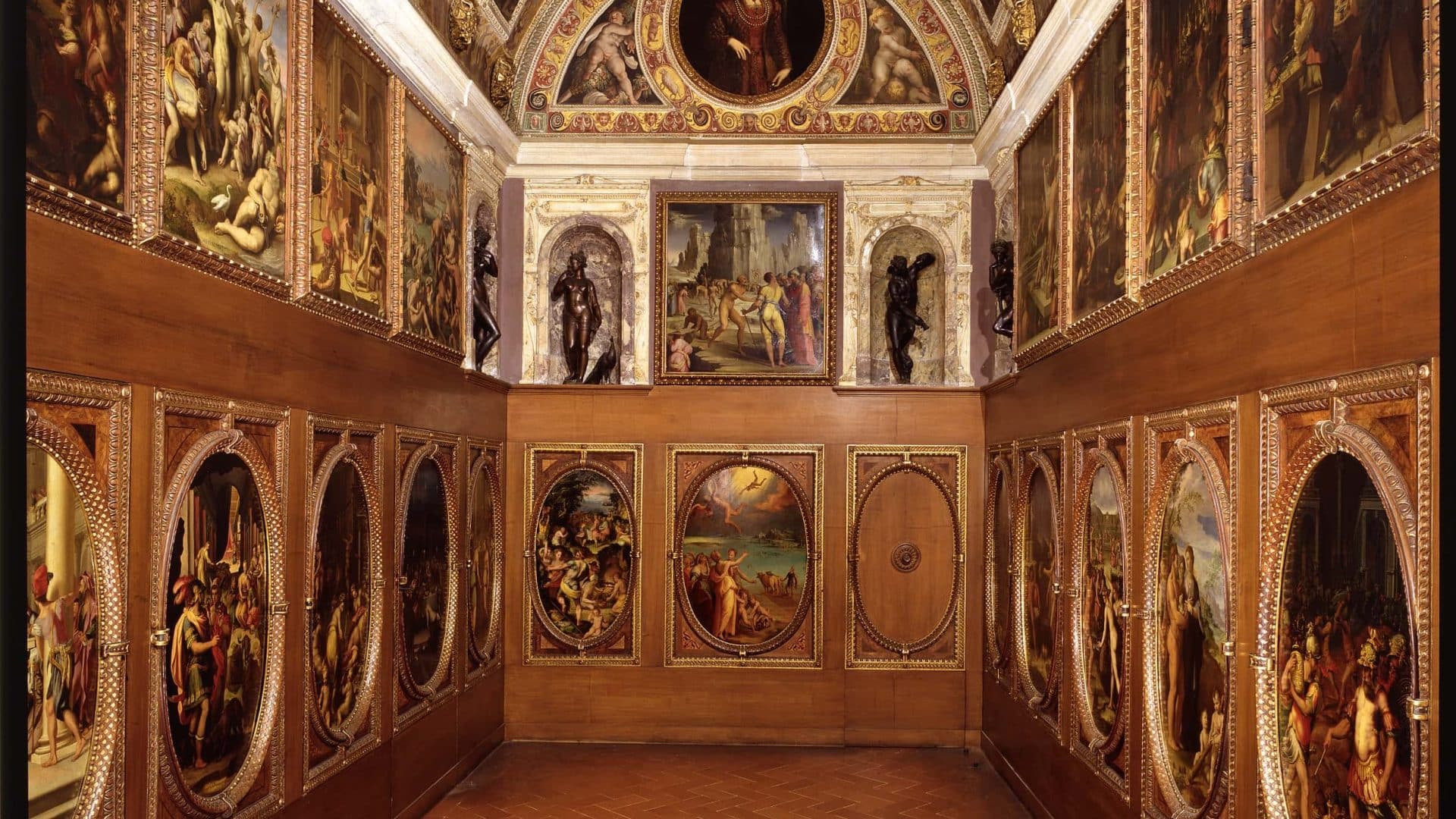
Tucked behind the vast public spectacle of the Salone dei Cinquecento, reachable only through a passage from the Grand Duke’s own bedroom, is a room barely nine metres long and three and a half wide, with no windows at all. Every surface is painted. Almost nothing in it is what it appears to be.
A Prince Who Preferred the Furnace to the Throne
Francesco I de’ Medici became Grand Duke of Tuscany in 1574, inheriting the title from his formidable father, Cosimo I, who had spent his own reign consolidating Medici power through calculated political theatre and architectural spectacle. Francesco was, by almost every contemporary account, temperamentally unsuited to that model of rule. He was withdrawn, melancholic, and by his own evident preference far more interested in the transformation of matter than the management of a state. His passion was alchemy — not, in the Renaissance sense, superstition or charlatanism, but a serious, if ultimately misguided, attempt to understand the fundamental unity of nature through experiment, chemistry, and philosophy.
Rather than adapt himself to his father’s political stagecraft, Francesco built himself a room instead: a private laboratory and treasure cabinet where he could vanish entirely from the demands of rule, sealed away from the court just a few steps beyond the very hall built to project Medici power to the world.
A Room Built Like a Locked Box
Construction ran from 1570 to 1572, overseen by Giorgio Vasari together with the scholars Vincenzo Borghini and Giovanni Battista Adriani, who devised the room’s elaborate intellectual scheme, and executed by a team of more than two dozen of the finest Florentine Mannerist painters and sculptors of the era — Bronzino, Alessandro Allori, and Giambologna among them. The result, known as the Studiolo, is barrel-vaulted, entirely windowless by design, and organised with obsessive precision around the four classical elements: Earth, Water, Air, and Fire, each governing one wall of the room.
Every painted panel that lines the lower register of the walls conceals a hidden cupboard set directly into the thickness of the masonry behind it. A painting of Poseidon and the sea creatures of Water conceals the cabinet where Francesco kept his collection of shells. A painting of Danaë receiving Jupiter’s golden rain conceals the cabinet reserved for gold and precious metals. Nothing on display in the room is decoration in the ordinary sense; every image is simultaneously a label and a door, an index to the treasures hidden directly behind it. Even the room’s two genuine windows were sealed and painted over — Francesco, by every account, preferred to work entirely by candlelight, sealed off from daylight and from the world outside.
The Alchemist at Work
Francesco appears within his own Studiolo, quite deliberately, as a participant rather than merely a patron. In Giovanni Stradano’s panel The Alchemist’s Workshop, painted for the wall governed by Fire, a young man in a white apron works at a furnace under the supervision of a master alchemist, mixing substances with careful concentration while, in the background, assistants pour liquids into stills through the night. The apprentice is Francesco himself — the Grand Duke of Tuscany, painted into his own private laboratory not as a ruler observing science from a comfortable distance, but as a hands-on practitioner of it.
According to accounts of the room’s use that have circulated for centuries, Francesco’s experiments went well beyond the collecting of minerals and curiosities. He is said to have pursued the creation of both lethal poisons and their antidotes, in one documented case distilling a compound from the venom of some ten thousand scorpions, testing its effects — and the effectiveness of its antidote — on prisoners already condemned to death. Whether every detail of this tradition survives intact from Francesco’s own century or accumulated embellishment over later ones, the Studiolo’s own decorative programme leaves little doubt about the genuine, serious nature of the work it was built to house: this was equal parts study, laboratory, and shrine to a prince’s most private obsession.
A Passage No One Else Was Meant to Use
Access to the Studiolo was tightly, deliberately restricted. The room could be reached only through Francesco’s own private chambers, via a hidden staircase built specifically to keep the route concealed from the public rooms of the palace, and — through one further concealed door among the many false panels lining its walls — connected directly back into a private passage from the Salone dei Cinquecento itself, allowing the Grand Duke to slip from the most publicly visible hall in his entire palace into the most completely private, unseen by the courtiers, ambassadors, and petitioners filling the grand spaces just beyond the wall.
That architecture of concealment was the entire point. Cosimo I had built the Salone dei Cinquecento and its surrounding halls as a stage for Medici authority, engineered for maximum visibility and impact. Francesco built the Studiolo as its precise opposite: a stage with no audience at all, designed around a single visitor, who happened to also be the most powerful man in Tuscany.
Neglect, and a Slow Return
The Studiolo’s intensity did not survive its creator. After Francesco’s death in 1587, the room and its collections gradually fell out of use; over the following centuries its contents were dispersed, sold, or absorbed into other Medici holdings, and the chamber itself slipped into a kind of quiet obscurity within the vast complex of Palazzo Vecchio. It was only in the twentieth century that restoration work returned the room to something resembling its original unity, reassembling where possible the relationship between painted panel and hidden cabinet that had defined its entire logic.
Visiting the Unwitnessed Room Today
The Studiolo is accessible today only as part of specific guided visits to Palazzo Vecchio’s hidden and private spaces, entered through the same concealed staircase Francesco once used to disappear from his own court. Standing inside it now, surrounded by painted panels that still look, at a glance, like nothing more than elegant Mannerist decoration, it takes a genuine effort of imagination to see what the room actually was: not a gallery meant to be admired, but a locked cabinet built around one man’s mind — the single most private room the Medici family ever built, in the middle of the palace built to make everything else about them as visible as possible.