
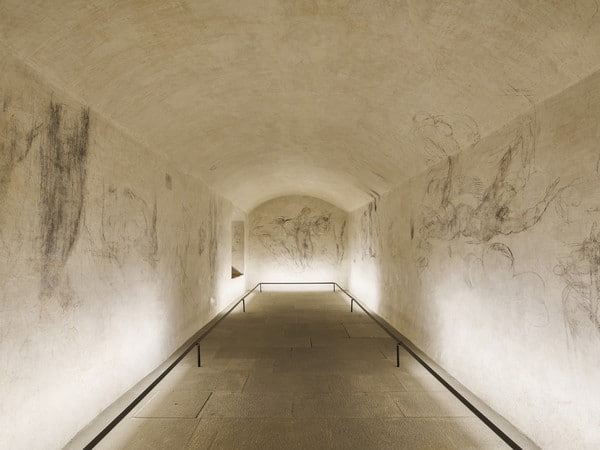
Beneath the New Sacristy of the Medici Chapels, hidden under a trapdoor for nearly four centuries, there is a narrow room ten metres long and barely three wide. Its walls are covered in charcoal sketches — hurried, overlapping, some abandoned mid-line. For decades it was used to store coal. Almost no one knew it existed. Then, in 1975, a museum director looking for a new fire exit found it by accident, and Florence discovered that Michelangelo may have hidden there while running for his life.
A Sculptor Turned Soldier
To understand why, it helps to remember that Michelangelo’s relationship with the Medici was never simple loyalty. He had grown up half-adopted into their household as a teenager, trained under their patronage, shaped by their court. But in 1527, when a wave of anti-Medici sentiment swept through Florence and the family was driven out of the city for the second time, Michelangelo did not hesitate. He sided with the restored Republic.
For the next three years, the man who had spent his career carving marble put his engineering mind to a very different task: fortifying Florence against the army that would inevitably come to take it back. He designed bastions, reinforced towers, and organised defences around San Miniato al Monte, the hilltop church that overlooked the city’s most vulnerable approach. It was serious, technical, unglamorous work, and it made him, in the eyes of the Medici, a traitor.
The City Falls
In 1530, backed by the armies of the Holy Roman Emperor Charles V, the Medici retook Florence after a brutal ten-month siege. The Republic collapsed. And the pope who now held the fate of the city’s rebels in his hands was, inconveniently for Michelangelo, a Medici himself: Clement VII, who had every reason to remember exactly who had spent three years helping to keep his family out of power.
Accounts differ on how close Michelangelo actually came to execution, but the fear was evidently real enough that he went into hiding. According to a long-standing tradition tied to the room’s discovery, the prior of the Basilica of San Lorenzo sheltered him in this cramped space beneath the very sacristy Michelangelo himself had designed — for the very family that now wanted him dead. He is thought to have stayed there for weeks, perhaps close to two months, before Clement’s anger cooled enough to negotiate a pardon.
Sketching in the Dark
What makes the room extraordinary is not just the hiding, but what was apparently left behind. The walls are dense with drawings in charcoal and red chalk: legs, torsos, a horse, a head that some scholars connect to the ancient Laocoön, studies that echo figures Michelangelo was developing for the New Sacristy’s tombs directly above. Whether every mark belongs to his hand is still debated by art historians — attribution in a space like this is inevitably uncertain — but the pattern is striking. A man hiding from a death sentence, in the dark, beneath a building he had designed, apparently kept working anyway, using the only surface available to him: the walls of his own hiding place.
It is hard to imagine a more direct expression of an artist’s compulsion. Denied marble, denied his workshop, denied even the certainty that he would survive the month, Michelangelo appears to have simply kept drawing.
The Bitter Return
Eventually, Clement VII agreed to forgive him — on one condition. Michelangelo would return to work, immediately, on the Medici Chapels: the very mausoleum, for the very family, he had just spent three years trying to keep out of Florence. He resumed the commission, carving the allegorical figures of Day, Night, Dusk, and Dawn that still recline over the tombs above the room where he once hid, until his final departure for Rome in 1534, when he left the sacristy — like so much of his Florentine work — officially unfinished.
There is something almost unbearably direct about the arrangement: the artist forced to spend his final Florentine years glorifying, in marble, the dynasty he had risked his life to resist, working literally on top of the room where he had once hidden from them. Whatever Michelangelo felt standing in that sacristy each day, chisel in hand, he left no letter explaining it. He left the tombs instead — and, as it turned out, the room beneath them.
Visiting the Room Today
The chamber remained sealed to the public for almost fifty years after its rediscovery, opened only to scholars and, occasionally, restorers. Since 2023 it has welcomed small groups for brief, carefully lit visits — a concession to both the fragility of the drawings and the sheer intensity of the space itself. Walking down into it today, visitors step into one of the few places in Florence where the distance between Michelangelo the monumental genius and Michelangelo the frightened, hunted man all but disappears.