
Florence’s Secret Eden, Hidden Behind an Unassuming Wall
Behind an ordinary stretch of wall along Via de’ Serragli, in the heart of Florence’s Oltrarno, lies seven hectares of woodland, temples, and winding paths that few visitors ever suspect exist. The Giardino Torrigiani is, by most measures, the largest privately owned garden inside the historic centre of any European city — nearly seventeen acres, hidden almost entirely from public view behind ochre façades that give absolutely nothing away.
From Botanical Plot to Romantic Vision
The land had been used as a botanical garden since the sixteenth century, but its transformation into something far more ambitious began in 1813, when Marchese Pietro Torrigiani inherited the property and set about enlarging it dramatically, extending its boundaries all the way to Via dei Serragli and Piazza Tasso. Torrigiani commissioned the architect Luigi de Cambray Digny — a Florence-born neoclassicist who would go on to design theatres, customs houses, and churches across Tuscany — to lay out an entirely new landscape in the fashionable English Romantic style then sweeping European aristocratic gardens.
The result deliberately abandoned the rigid geometry of Florence’s older Renaissance gardens. Winding paths replaced straight avenues; artificial rolling hills replaced flat terraces; sudden, half-hidden views replaced the predictable symmetry of a Medici parterre. A guidebook to the garden was even published in 1824, modelled on similar literature already produced for England’s great landscape gardens at Stowe decades earlier — a sign of just how self-consciously international Torrigiani’s ambitions were.
A Tower Built for Freemasons
Both Torrigiani and his architect were members of the Freemasonry, and the garden’s symbolic programme makes little effort to hide it. Visitors are still greeted at the entrance by a statue of Osiris, the Egyptian god of death and resurrection, holding a tablet inscribed with rules of conduct — dogs, horses, and carriages are, notably, still forbidden.
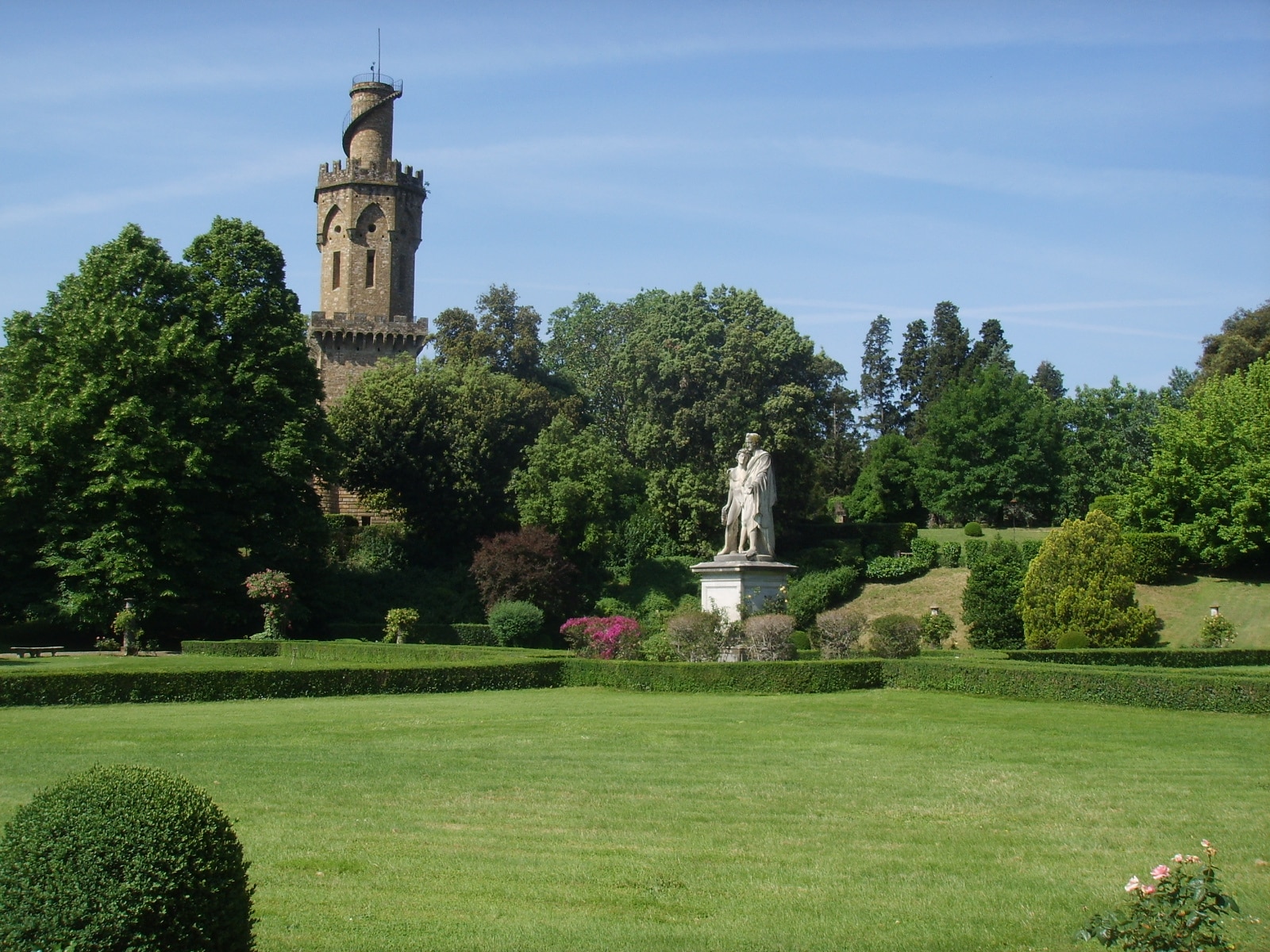
The garden’s‘s most striking landmark is its neo-Gothic tower, built not by Cambray Digny but by a second architect, Gaetano Baccani — the same architect responsible for the bell tower of the Basilica of Santa Croce. Standing almost twenty-two metres tall and decorated with the Torrigiani family crest, the tower originally housed a working collection of astronomical instruments, a private library, and a terrace built specifically for studying the night sky, along with a mechanical chair engineered to carry visitors quickly to the top. Its levels are traditionally read as a symbolic journey of Masonic initiation, rising literally as well as figuratively toward enlightenment.
An Old Medici Wall, Repurposed for Contemplation
Scattered through the grounds are the garden’s other Romantic set-pieces: artificial ruins, small temples, and architectural follies designed to evoke the passage of time rather than to serve any practical function. One of the garden’s oldest surviving features predates the Romantic landscaping entirely — a stretch of defensive wall built under Cosimo I de’ Medici, absorbed into the nineteenth-century garden design as a kind of found ruin, repurposed from military architecture into contemplative scenery.
A Garden That Has Never Belonged to the Public
Unlike Florence’s grand public gardens, the Giardino Torrigiani has remained in private hands since its creation, and remains so today, divided between two branches of the family, the Torrigiani di Santa Cristina and the Torrigiani Malaspina, each maintaining a residence within the grounds. Visits are possible only by appointment and typically in small groups, accompanied by a member of the family — an arrangement that has, if anything, preserved the garden’s original atmosphere of aristocratic retreat far more effectively than public ownership might have.
Visiting Today
A visit to the Giardino Torrigiani today unfolds much as it would have for a nineteenth-century guest: through groves of rare and exotic trees planted alongside centuries-old native species, past sham ruins and Masonic statuary, toward Baccani’s tower rising above the greenery, and finally, often, to a drink with the family in their private lounge. In a city where nearly every garden — Boboli, the Bardini, the Giardino delle Rose — is now public property, the Torrigiani Garden remains something rarer: a private Eden that has simply chosen, for over two centuries, not to become anything else.