
How Florence Turned Justice Into Spectacle — and a Prison Into a Temple of Sculpture
Before it became one of the most important sculpture museums in the world, the Bargello was something far more severe. It was a fortress of civic authority.
Its walls were not originally designed to cradle masterpieces by Donatello or Michelangelo. They were built to enforce law, administer punishment, and defend a fragile republic constantly negotiating power, loyalty, and survival. To walk into the Bargello today is to enter a paradox: what appears as a serene museum was once a theatre of justice — and, for over five centuries, of fear.
The Palazzo del Podestà: Architecture of Authority
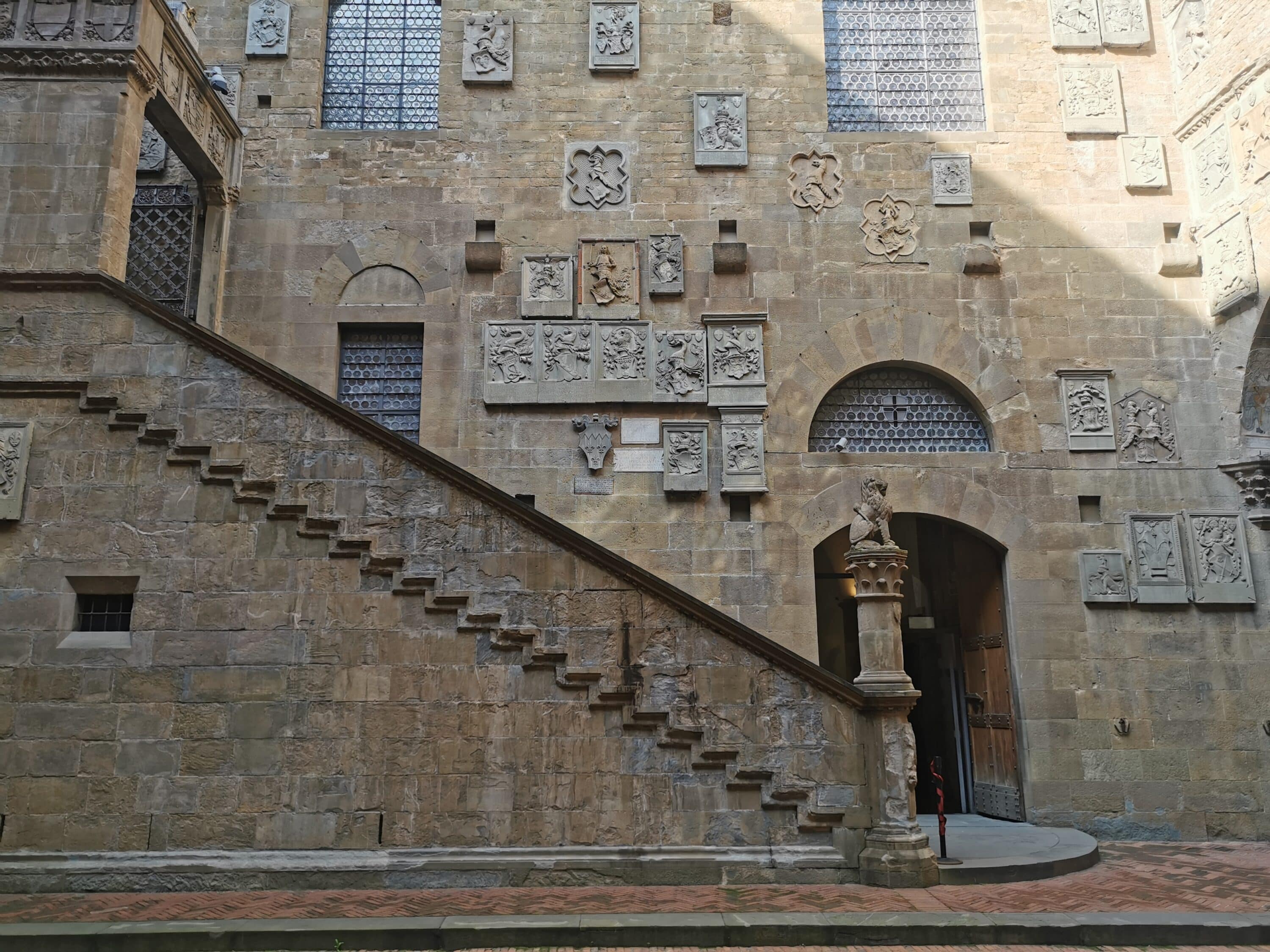
Construction began in 1255, when the architect Lapo Tedesco was commissioned to build a new seat for Florence’s chief magistrate, incorporating an existing medieval tower belonging to the Boscoli family into the new structure. That tower — now known as the Volognana Tower, fifty-seven metres tall — took its name from one of its earliest recorded prisoners, Geri da Volognano. At its summit hung a bell Florentines nicknamed la Montanina, whose ringing once summoned citizens to arms, announced executions, or warned the city of riots and insurrection.
The building’s architecture was intentionally austere: thick stone walls, narrow windows, a defensive silhouette designed for control rather than comfort. Its first resident, the podestà, was by law an outsider — brought in from another city, on a term limited to a single year, specifically to avoid the bias that came with belonging to any one Florentine family. In a city this politically volatile, neutrality was survival, even if the arrangement rarely worked as cleanly as intended: barely forty years after construction began, working-class Florentines stormed the palace itself in protest against the injustices administered inside it.
This building was not merely administrative. It was symbolic — the republic’s own attempt to discipline itself, built in stone.
Guelphs and Ghibellines: A City Divided
To understand why such a structure was necessary, it helps to recall the violent fractures of medieval Florence. The city was torn between Guelphs, aligned with papal authority, and Ghibellines, loyal to the Holy Roman Emperor — not abstract political factions, but family alliances and street-level rivalries, bloodlines divided by ideology. Victory shifted with alarming frequency. Exile was common. Confiscation of property was routine. Public humiliation became political currency.
The Bargello operated inside this climate of tension, where justice was rarely just moral — it was factional. Law became architecture, and architecture became a message: Florence would not, whatever its internal fractures, dissolve into open chaos.
Justice as Public Performance
Medieval justice in Florence was never hidden. It was staged. Executions took place in the Bargello’s own courtyard, on a purpose-built platform Florentines called the Palco dei Supplizi — the scaffold of torments — and the bodies of the condemned were sometimes displayed hanging from the building’s windows, upside down, as a deliberate warning to anyone passing below. From 1574 onward, once the palace had become the residence of the city’s Captain of Justice — known in Florentine dialect as the bargello, the name the building still carries — interrogation, torture, and execution were all administered within the same walls that today display some of the gentlest sculpture in Florence.
But perhaps the most psychologically sophisticated instrument of civic discipline was not physical punishment at all. It was image.
The Pitture Infamanti: Shame Painted on Stone
Among Florence’s most striking practices was the commissioning of pitture infamanti — “shameful portraits”: life-size public paintings of traitors, debtors, and fugitives, shown hanging upside down by one foot, the free leg left dangling, painted directly onto the exterior walls of the Palazzo del Podestà for the whole city to see. In a society this conscious of honour, reputation was currency, and to lose one’s public image was, in practical terms, to lose almost everything else along with it.
The city did not entrust this work to minor hands. In 1440, following the Florentine victory at the Battle of Anghiari, the painter Andrea del Castagno was commissioned to paint the fled members of the defeated Albizzi and Peruzzi families hanging on the Bargello’s facade. He executed the commission with such disturbing skill that Florence gave him a nickname he could never quite shake: Andreino degli Impiccati, “little Andrew of the hanged men.”
Thirty-eight years later, the city turned to an even more famous painter. After the Pazzi conspiracy of April 1478 — the failed plot that left Giuliano de’ Medici dead and Lorenzo wounded, and that ended with dozens of conspirators hanged, some from the windows of the Palazzo della Signoria itself — Sandro Botticelli was commissioned to paint the eight conspirators who had escaped capture, depicted hanging in effigy on the wall above the city’s customs office. His shame paintings remained on public view until 1494, when the Medici were themselves briefly driven from Florence and the images, inconveniently tied to a family suddenly out of favour, were erased.
There is a strange, unintentional symmetry to what happened alongside these commissions. Leonardo da Vinci, still establishing himself in Florence at the time, never received a pitture infamanti commission of his own — but one of his surviving sketchbook drawings depicts, with clinical precision, the real hanged body of Bernardo Baroncelli, one of the Pazzi conspirators who was actually caught, executed, and displayed from a Bargello window. Botticelli painted the punishment of the men Florence couldn’t catch. Leonardo, almost in passing, sketched from life the fate of the one they did.
From Prison to Museum: The Reinvention of Memory
Florence’s relationship with punishment did not end quietly. In 1782, the instruments of torture kept inside the Bargello were gathered and publicly burned in its own courtyard — a deliberate, symbolic act of reform. Four years later, on 30 November 1786, Grand Duke Pietro Leopoldo signed the Leopoldine Code, formally abolishing both torture and the death penalty across the Grand Duchy of Tuscany. It was the first state anywhere in the world to do so, a distinction still commemorated across the region every year on that date. From that moment forward, the courtyard that had staged Florence’s executions for centuries never hosted another one.
The Bargello continued for decades afterward as the headquarters of the Florentine police, until 1859, when the exile of the last Grand Duke and the political upheaval of Italian unification left the building without its old purpose. Rather than remain a jail under a new government, it was restored — deliberately stripped of the cramped cells and later additions that recalled its darker function — and reopened in 1865 as Italy’s first national museum dedicated to sculpture and the decorative arts.
The transformation was not accidental. It was ideological. The newly unified Kingdom of Italy wanted to define its identity through the Renaissance rather than through medieval faction and punishment, and converting the Bargello into a museum reframed Florence’s own story — from a city of factional violence into the cradle of artistic genius. The prison was not erased from that story. It was absorbed into it.
Sculpture and the Memory of Power
Today the Bargello houses masterpieces — Donatello’s David, Michelangelo’s Bacchus, Verrocchio’s bronzes — inside a building that spent five centuries administering torture, executions, and painted public humiliation before it ever hung a single artwork for pleasure. Donatello’s David, a symbol of Florentine republican triumph, stands within walls that once upheld the same republic’s harshest instruments of control. Michelangelo’s Bacchus, sensuous and deliberately destabilising, occupies rooms that once confined actual bodies awaiting judgment.
The republic that once disciplined through public spectacle now celebrates, in the same rooms, mastery of form. But the echo of everything that happened here first — the tower named for a prisoner, the bell that once announced hangings, the wall where Botticelli painted the Pazzi conspirators swinging by one foot — remains, quite literally, in the stone.