
Stand outside Florence’s Duomo long enough and, sooner or later, you will see them: figures in long black robes and hoods, faces almost entirely concealed, moving with quiet urgency between an ambulance and a doorway. Tourists occasionally mistake them for something ceremonial, a piece of theatre staged for the piazza’s benefit. They are, in fact, volunteers of the Misericordia di Firenze — an institution that has been carrying Florence’s sick, injured, and dying through these same streets for roughly 780 years, making it, by most historical accounts, the oldest voluntary organisation for the care of the ill still continuously active anywhere in the world.
A Sermon That Became an Institution
The Misericordia’s origins trace back to 1244, when the Dominican friar Pietro da Verona — later canonised as Saint Peter Martyr — arrived in Florence to preach against the Patarine heresy then spreading through the city’s social classes. His sermons were passionate enough to inspire a wave of lay religious associations built around devotion to the Virgin Mary, and among them was the Compagnia di Santa Maria della Misericordia, founded specifically to carry out what its members called the evangelical works of mercy: caring for the sick, and burying the dead.
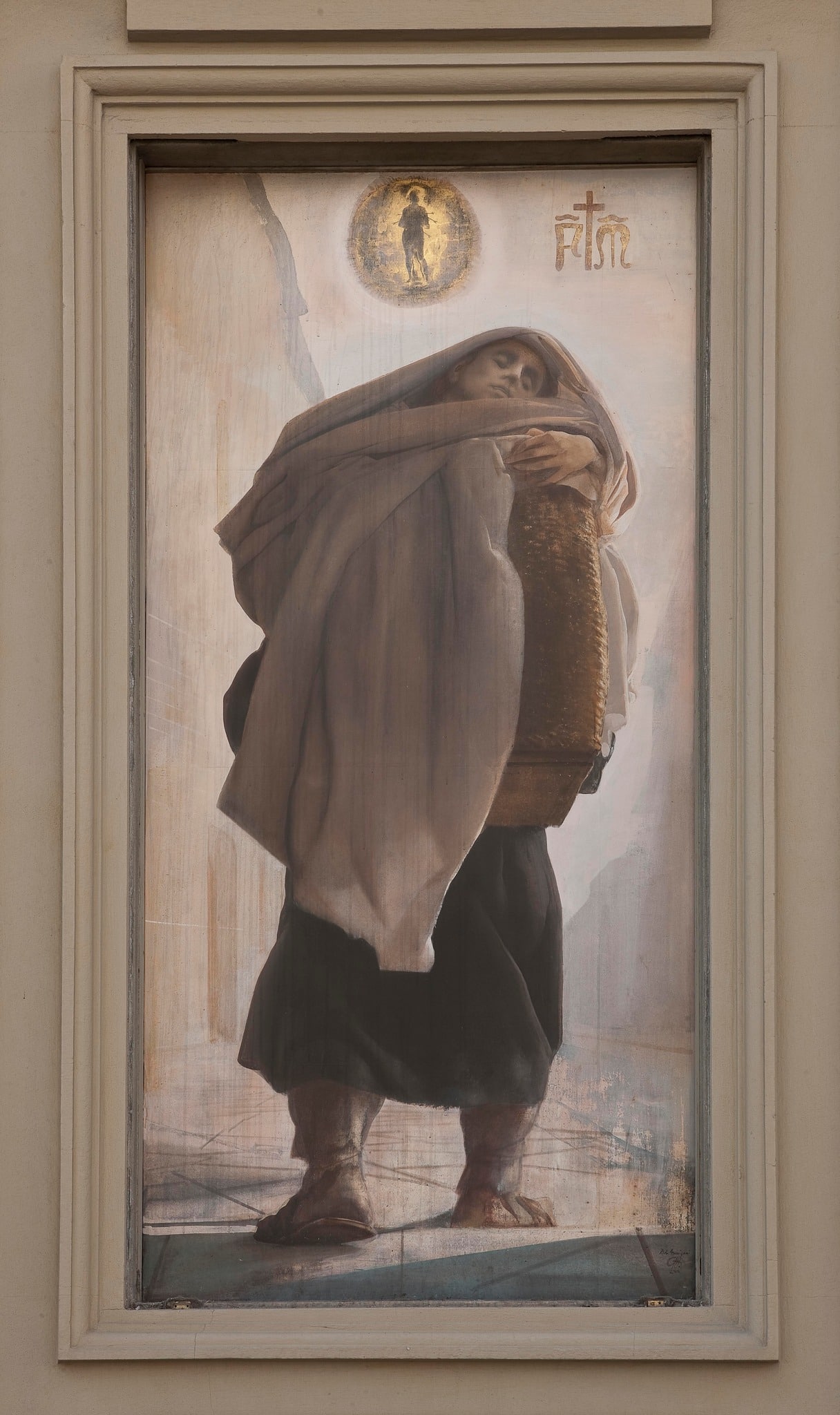
Florentine tradition offers a livelier, if historically unverifiable, origin story of its own. According to popular legend, the real founder was not a friar but a porter named Piero di Luca Borsi, who worked for the powerful Arte della Lana, Florence’s wool guild, hauling bolts of cloth between workshops near the cathedral. Borsi and his fellow porters liked to unwind after work at the Buca degli Adimari, a wine cellar near the Duomo, where the conversation reportedly turned to blasphemy more often than Borsi, a devout man, could tolerate. His solution was practical rather than pious: he proposed that anyone caught swearing should pay a small fine into a collective purse. The habit caught on, the purse grew, and — so the story goes — the accumulated fines eventually paid for six woven baskets, or zane, sturdy enough to carry a sick, wounded, or dead body through the streets. Whether or not Borsi ever existed exactly as described, the legend captures something true about the Misericordia’s character from the start: charity organised not from above, by clergy or nobility, but from below, by working Florentines improvising a solution to a problem no one else was solving.
Records Lost to Flood, Records Recovered from Stone
Much of what might have settled the question conclusively no longer exists. The Misericordia’s earliest founding documents are believed to have been destroyed in a catastrophic flood of the Arno in 1557 — a grim irony, given how many later floods the Confraternity itself would help the city survive. What survives instead is indirect evidence: a 1321 record showing the Compagnia had accumulated enough capital to purchase a house near the Baptistery, and a 1329 decree from the Florentine government granting the group the right to elect its own leaders, known as capitani, formally recognising it as a public institution rather than a private devotion.
The Buffa: A Hood Built for Invisible Charity
For its first three centuries, Misericordia members wore a long crimson tunic with a gold medallion, as still visible today in a 1386 fresco by Niccolò Gerini and Ambrogio Baldese, preserved in the Museo del Bigallo. Sometime in the sixteenth century, the crimson gave way to the black robe most associated with the Confraternity today, completed by a hood called the buffa — pierced with only two small holes for the eyes, entirely concealing the wearer’s identity.
The anonymity was the entire point. Misericordia doctrine held that acts of mercy performed for public recognition lost their spiritual value; charity, to count, had to be given without the giver’s face or name attached to it. Volunteers who removed their hoods to be recognised, seeking gratitude or credit, were once mockingly nicknamed sfacciati — those who had shown their face, a term that in Italian still carries a whiff of shamelessness. For centuries, a Florentine could be pulled from a burning building, carried to hospital, or buried with dignity by neighbours whose faces they would never see and whose names they would never learn.
Plague, Union, and a Better Stretcher
The Misericordia’s defining moments arrived, unsurprisingly, during Florence’s repeated public health disasters. Beginning with the outbreaks that struck the city from 1325 onward, and reaching a horrific peak with the Black Death of 1348, the Confraternity’s hooded volunteers became a fixture of plague-era Florence, moving through infected neighbourhoods that many others fled.
In 1425, the Florentine government ordered the Misericordia to merge with a similar charitable body, the Compagnia del Bigallo, forcing the smaller group to relocate into the Misericordia’s own headquarters near the Baptistery. A door built during renovations in 1452 still bears both companies’ combined coats of arms — the Bigallo’s rooster alongside the Misericordia’s cross — a small piece of bureaucratic reconciliation carved directly into stone. Practical innovation kept pace with institutional change: in 1478, the Confraternity introduced the cataletto, an enclosed litter that represented a considerable improvement in dignity and safety over the open woven baskets its volunteers had relied on for over two centuries.
Surviving the Medici, and Surviving Their Successors
Not every century was kind to Florence’s confraternities, but the Misericordia repeatedly found ways to endure where others did not. In 1576, Grand Duke Francesco I de’ Medici granted the Confraternity the premises it still occupies today, in a palazzo facing Giotto’s bell tower on Piazza del Duomo. Two centuries later, when Grand Duke Pietro Leopoldo of the Habsburg-Lorraine dynasty carried out a sweeping Enlightenment-era reform in 1785, dissolving most of Tuscany’s religious confraternities as redundant relics of an earlier age, the Misericordia was one of the very few explicitly spared — considered too indispensable to the city’s welfare to be swept away with the rest. Pietro Leopoldo had, in fact, personally accepted the ceremonial role of the Confraternity’s Capo di Guardia a decade earlier, in 1775, and backed its expansion with funds from both the public treasury and his own private income.
A Constant Presence Through Modern Catastrophe
The twentieth century tested the Misericordia as thoroughly as any plague. Its volunteers transported wounded soldiers during the First World War, then turned immediately to combating the 1919 influenza pandemic that swept through Florence in the war’s aftermath. During the Second World War, Misericordia ambulances raced to bombed neighbourhoods, and its first-aid posts reportedly continued operating even amid gunfire during the chaotic days of the city’s liberation.
Its most widely remembered modern moment came on 4 November 1966, when the Arno burst its banks and flooded Florence, destroying or damaging thousands of artworks and paralysing the city. While much of Florence remained underwater, the Misericordia reopened its medical clinic within forty-eight hours of the disaster, and within four days had organised a citywide vaccination campaign against typhoid and tetanus — the same institution that had once buried plague victims by hand, now running emergency public health logistics for a modern European city.
What Remains Today
The Misericordia’s black-robed volunteers no longer wear the buffa as daily uniform — a 2006 change, prompted largely by modern road-safety regulations governing ambulance crews, reduced the traditional habit to ceremonial occasions only. But the institution itself remains very much alive: alongside patient transport, it now runs home care services for the elderly, a telemedicine alarm system called Telesoccorso, medical equipment loans, and blood donation drives, folding eight centuries of tradition into the practical infrastructure of a modern city’s welfare system.
Its historic headquarters on Piazza del Duomo, directly opposite the cathedral’s flank, now also houses the Museo della Misericordia, telling the Confraternity’s nearly eight-hundred-year story through the paintings, documents, and vestments its members have accumulated since 1244 — visible, fittingly, from windows that look straight out onto the same piazza its hooded volunteers have walked, unrecognised, since the Middle Ages. Florence has always been generous with fame for its artists, architects, and dynasties. The Misericordia represents something rarer: a form of civic greatness built entirely on the deliberate refusal to be recognised at all.