
Where Coffee, Chocolate, and Conversation Shaped Modern Florence
Florence did not invent coffee, but it perfected what happens around it. In this city, a cup of coffee has never really been just a pause in the day. It is a small, deliberate ritual, one more expression of a Renaissance conviction that culture lives in how people gather, speak, and share space with one another. The historic cafés scattered across the centre of Florence are not simply elegant interiors or picturesque stops on a walking tour. They are the city’s living rooms, the places where modern Florence was imagined, argued over, and quietly performed, one marble tabletop at a time.
The Birth of the Florentine Coffee Ritual
Coffee reached Europe in the seventeenth century and had woven itself into the rhythm of Italian urban life by the eighteenth. In Florence, though, the habit evolved into something more structured than elsewhere, almost theatrical in its restraint. One stood at the counter with a certain posture. One sat at a marble table with a certain deliberateness. The tone of conversation mattered as much as the coffee itself, and neither was left to chance.
That discipline had deep roots in the city’s own history. Florence had already codified the art of graceful behaviour centuries earlier, in texts such as Giovanni Della Casa’s Galateo, the sixteenth-century guide to manners that went on to shape Italian ideas of civility for generations. When cafés eventually arrived, they became a kind of daily rehearsal of that inherited discipline, proof that in Florence even something as ordinary as behaviour at a counter could be treated, quite seriously, as a form of art.
Piazza della Repubblica: The Salotto of Modern Florence
Florence’s café culture found its true stage during the city’s brief spell as capital of the newly unified Italy, between 1865 and 1871. To mark that transformation, city planners tore down the old medieval market quarter at the city’s centre and laid out a grand new square in its place: Piazza della Repubblica. Around its edges rose the cafés that would go on to define an entirely new, distinctly Florentine idea of modernity.
The oldest of them, Caffè Gilli, did not actually begin on this square at all. It opened in 1733 as a modest pastry shop called the Bottega dei Pani Dolci, tucked away on Via dei Calzaiuoli near the Duomo, founded by the Swiss Gilli family while Florence was still under Medici rule. Over the following century and a half it moved through several addresses across the city before finally settling, in 1917, into the building it still occupies today on what had by then become Piazza della Repubblica, just as the arrival of the espresso machine was quietly transforming café culture across the whole of Italy. Its crystal chandeliers and gilded Art Nouveau mirrors turned the simple act of drinking coffee into something closer to ceremony, and its tables drew in the young Futurist circle of Marinetti, Soffici, Boccioni, and Carrà for evenings of heated philosophical argument that still feel, in the room’s surviving decor, entirely plausible. Gilli’s most famous modern moment arrived decades later, in 1951, when the photographer Ruth Orkin chose its facade as the backdrop for what would become one of the twentieth century’s most reproduced photographs, American Girl in Italy.
Directly across the square stood its great rival and companion, Caffè Concerto Paszkowski, founded in 1846 as a Viennese-style beer hall before evolving into a concert café and intellectual salon in its own right. Writers, musicians, and politicians filled its tables across the decades, blending live music with heated debate into a single evening ritual. Together, Gilli and Paszkowski turned this new, deliberately modern square into Florence’s drawing room, a secular continuation of the sociability the Renaissance had once cultivated in private courtyards and loggias, now conducted in public, over coffee, for anyone willing to sit down.
Chocolate and the Culture of Refinement
Long before espresso became shorthand for Italian identity, it was hot chocolate that held the more prestigious place on Florentine tables, an exotic, imported, expensive drink, and therefore a genuine marker of taste rather than mere refreshment. Enrico Rivoire understood this better than most. Official chocolatier to the royal House of Savoy in Turin, he followed the Italian court to Florence when the city briefly became the nation’s capital, opening his so-called Chocolate Steam Factory in Piazza della Signoria in 1872. His dense, velvety hot chocolate, still made from a closely guarded recipe passed down within the family, became a genuine Florentine institution over the following century, drawing figures as varied as the poet Gabriele D’Annunzio and the actress Eleonora Duse to its tables.
To sip that same chocolate today, in the shadow of Palazzo Vecchio, is to draw a fairly direct line back to the Medici court itself, and to the same family whose 1600 wedding banquet for Maria de’ Medici once astonished guests with entire sculptures pressed from sugar. In Florence, sweetness has rarely been just about flavour. It has almost always carried an additional layer of meaning about wealth, taste, and belonging.
Le Giubbe Rosse: Futurists and Intellectual Fire
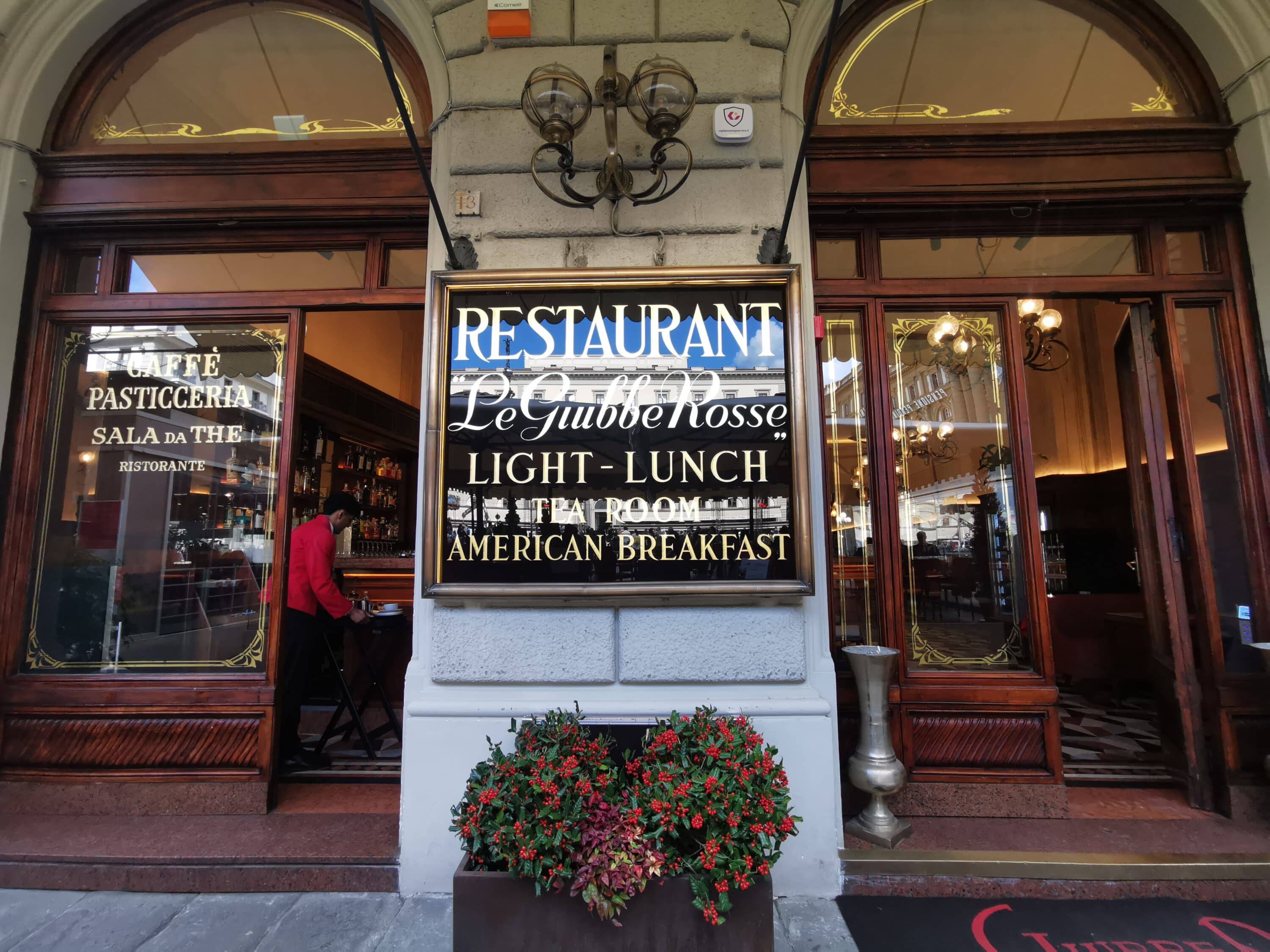
Where Gilli represented elegance, Le Giubbe Rosse represented something closer to provocation. Founded in 1897 and named for the red jackets worn by its waiters, it became, in the early twentieth century, the true literary and artistic epicentre of the Futurist movement, the place where Filippo Tommaso Marinetti and his circle argued over speed, technology, and their violent rejection of everything Florence itself had historically stood for.
There is an obvious irony in a movement built on rejecting the past finding its loudest voice inside the very heart of Renaissance Florence, but that irony is also precisely what makes the city’s café culture so distinctive. Even revolution here required a table, and a waiter in a red jacket to bring the coffee. These cafés were never neutral backdrops to Florentine life. They were the arenas where competing versions of modern Italian identity were quietly argued into existence, cup by cup.
The Negroni: A Florentine Icon Born in 1919
No account of Florence’s historic cafés would be complete without the Negroni. According to the story passed down through generations of Florentine bartenders, in 1919 Count Camillo Negroni asked the bartender at Caffè Casoni, on Via de’ Tornabuoni, to fortify his usual Americano by replacing the soda water with gin instead. The café itself later evolved into what is today known as Caffè Giacosa, still standing nearby, still serving the drink that ended up carrying the Count’s name into cocktail bars around the world.
The Negroni’s ingredients read almost like a small map of Italy assembled in a single glass: gin rooted in an English tradition, vermouth from Turin, Campari from Milan, balanced in a precise and largely unchanging proportion. Its deep red colour echoes the velvet interiors of the early twentieth-century cafés where it first spread from table to table, and its bittersweet character favours restraint over excess in exactly the way Florentine taste generally does. It is, in the end, Florentine balance distilled into a single glass.
Gran Caffè Doney: Cosmopolitan Florence
Founded in the nineteenth century by Gasparo Doney on Via Tornabuoni, Gran Caffè Doney became a favoured meeting place for aristocrats and the city’s substantial community of British expatriates, embodying a more international, cosmopolitan strand of Florentine café life than its more provincial rivals. During the 1930s its tables became an unlikely stage for real political friction, as British patrons openly criticised Fascist Italy’s colonial campaign in Ethiopia within earshot of other guests, turning an elegant café into an informal arena of dissent. The café was later immortalised in Franco Zeffirelli’s film Tea with Mussolini, a fitting tribute to a place that had, in its own time, embodied Florence’s layered and sometimes contradictory relationship with the wider world beyond Tuscany. Doney closed its doors for good in 1986, but its imprint on the city’s cultural memory has proven considerably harder to erase.