
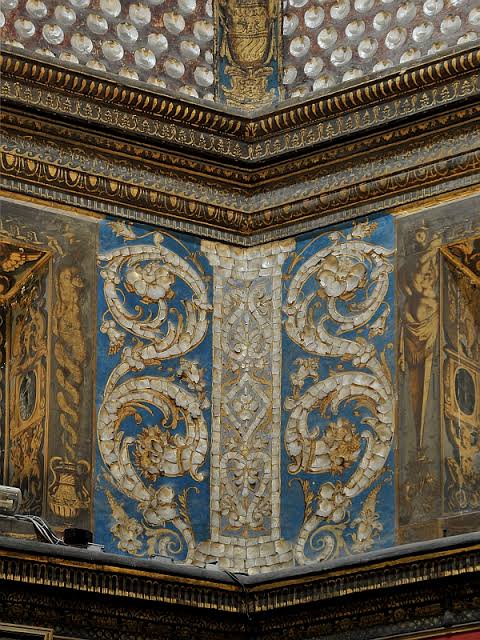
There is a room at the Uffizi that most visitors cross in a hurry, distracted by the pull of Botticelli or Michelangelo just ahead. And yet this octagonal chamber — known as the Tribuna — was never conceived as a mere passageway. It was designed as a genuine cosmological statement: a microcosm built specifically to stage the order of the universe, and, at the same time, the grandeur of the dynasty that had commissioned it.
Anyone who truly pauses here, looking up toward the dome, is not simply admiring an elegant interior. They are stepping inside what art historians consider Europe’s first modern museum — and, simultaneously, one of the most refined pieces of dynastic propaganda the Medici ever conceived.
Francesco I’s Vision
The Tribuna was designed between 1581 and 1584 by the architect Bernardo Buontalenti, commissioned by Grand Duke Francesco I de’ Medici, son of Cosimo I. Unlike his father, a man of statecraft and war, Francesco I was a more reserved figure, fascinated by alchemy, natural science, and the collecting of wonders. Until then, the Medici family had displayed its paintings at Palazzo Vecchio, where it resided; with the Tribuna, for the first time, Francesco decided to gather in a single dedicated space the works and objects considered most precious in the collection — not only paintings and sculptures, but rare stones, extraordinary natural specimens, and curiosities gathered from every corner of the known world.
It was, in essence, a Wunderkammer — a cabinet of wonders — but executed with a geometric and symbolic rigor that goes well beyond the encyclopedic collecting typical of the era.
A Geometry That Speaks the Language of the Cosmos
Every element of the Tribuna was conceived to represent the four classical elements of the universe, following an iconographic program devised directly by Francesco I, who personally dabbled in alchemy. The floor, executed in a radial inlay of polychrome marbles — North African alabaster, Turkish green porphyry, Egyptian red porphyry — represents Earth. The walls, covered in precious crimson velvet, evoke Fire. The dome, once decorated with thousands of mother-of-pearl shells, recalls Water. And the lantern at its summit, connected to an external weathervane whose movements are mirrored inside on a painted wind rose, represents Air.
This is no incidental decorative detail: it is an entire miniature cosmos, built around the visitor. And the lantern itself hides a further layer of technical sophistication — it functions as a genuine sundial, capable of precisely marking the solstices and equinoxes through an aperture that lets sunlight fall on calculated points within the room, a detail almost no visitor notices, yet one that reveals just how tightly Renaissance science was woven into the art of power.
Why an Octagon?
Even the choice of an octagonal plan was no accident. In Christian tradition, the number eight symbolically evokes resurrection and proximity to the divine — it is no coincidence that this is the recurring form of baptisteries and early basilicas. By building the Tribuna according to this geometry, Buontalenti effectively transformed the room into a kind of secular temple dedicated to art: a space that, while housing profane objects — pagan statues, mythological paintings, precious stones — spoke in the architectural language reserved for the sacred.
It is an exquisitely Florentine paradox: borrowing the grammar of religious devotion to celebrate not a god, but an art collection — and, indirectly, the power of the family that had assembled it.
More Than Aesthetics: A Statement of Power
It’s worth remembering that the Tribuna was not conceived as a museum space in the modern sense, open indiscriminately to all. It was designed to astonish a select audience — ambassadors, visiting sovereigns, distinguished guests — demonstrating to them, in a single glance, the wealth, culture, and intellectual refinement of the Medici dynasty. Every single element of the room, from the marble of the floor to the mother-of-pearl of the dome, was meant to communicate a precise message: the Medici were not merely wealthy merchants, but the legitimate custodians of cosmic order itself, on earth as in heaven.
This is beauty deployed as a tool of political legitimation — a lesson in Renaissance soft power that anticipates, by centuries, concepts we now take for granted.
A Florence Unveiled Curiosity: A Cosmos Built for One Man
A detail rarely told: despite its symbolic richness and its representative function, the Tribuna was originally conceived not as a public space but almost as an extension of Francesco I’s private studiolo at Palazzo Vecchio. The Grand Duke personally transferred the contents of his own cabinet of curiosities here, reorganizing them according to new criteria of display. In other words: before becoming the beating heart of Europe’s first modern museum, this room-as-cosmos was, for a time, the most intimate and personal space of a solitary man — fascinated by the secrets of nature, and eager to possess, at least symbolically, every element of it.
Why It’s Worth Stopping
Many visitors walk through the Tribuna without realizing they are standing in one of the conceptually densest rooms in the entire museum. Yet understanding its geometry — the floor as earth, the walls as fire, the dome as water, the lantern as air — radically changes the experience of the visit: no longer just an elegant setting for precious works, but a genuine philosophical and political manifesto, carved into stone and mother-of-pearl.
It is precisely this kind of reading — capable of turning an apparently marginal architectural detail into a key to interpreting the entire Medici collection — that makes a guided visit genuinely different from a standard walk-through. During our Uffizi Gallery Guided Tour, the Tribuna is never simply a passage toward the more famous rooms: it is where we reveal the cosmological design the Medici built around their own image.