
Florence’s “Sistine of the Early Renaissance”
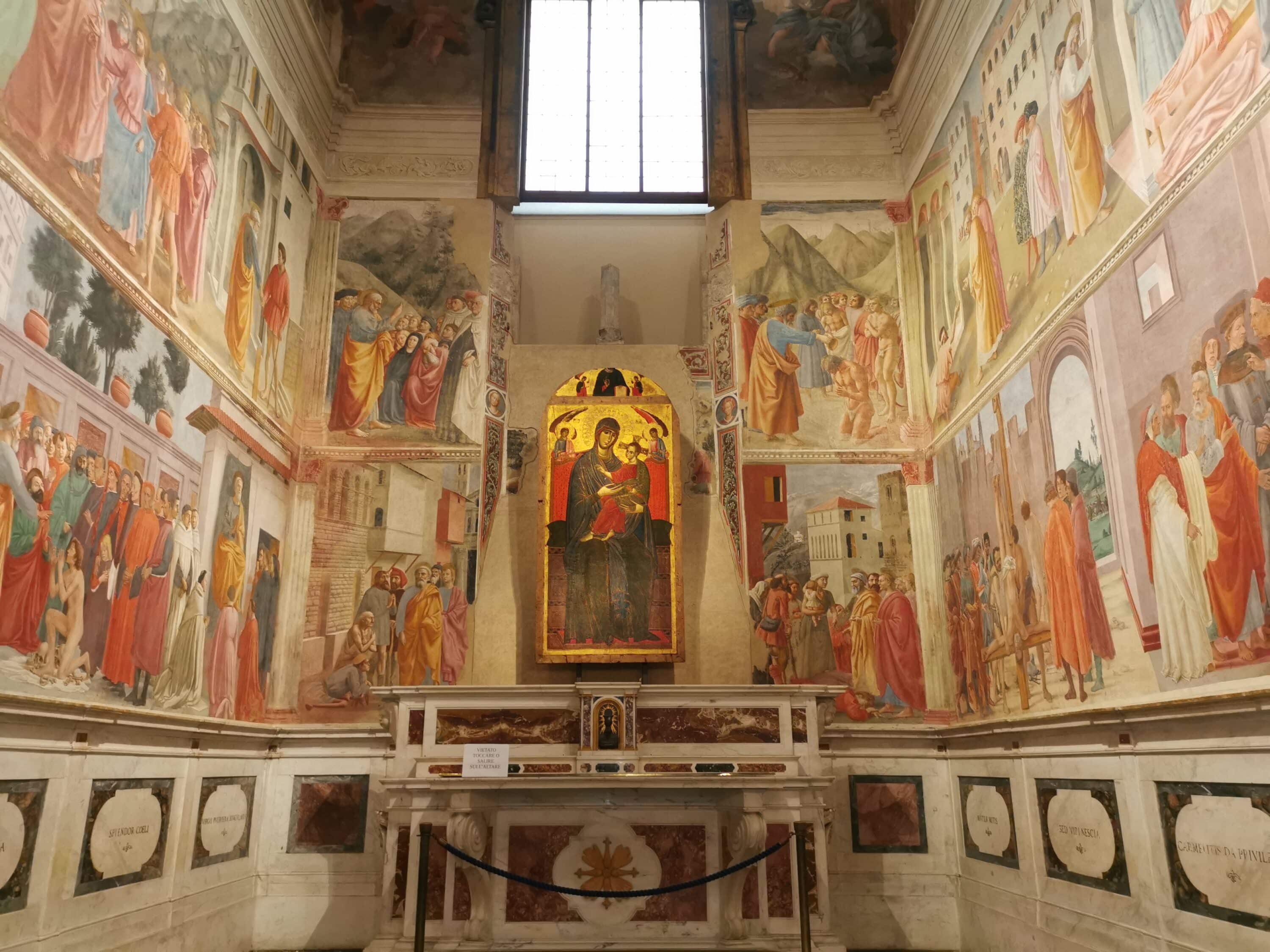
Inside the church of Santa Maria del Carmine, on the quieter side of the Arno, is a chapel the neoclassical painter Jean-Auguste-Dominique Ingres once called “the true cradle of painting.” It took three separate artists, spanning nearly sixty years, one political disgrace, and one very sudden death to complete it — and the finished result still bears the scars of all three.
A Merchant’s Commission for His Family Chapel
The chapel takes its name from Felice Brancacci, a wealthy silk merchant and prominent figure in Florentine political life, whose family had held rights to the space inside Santa Maria del Carmine since the fourteenth century. In 1423, Brancacci commissioned a fresco cycle depicting the life of Saint Peter, the family’s patron saint, and hired two artists to execute it: the established painter Masolino da Panicale and his younger, far less experienced assistant, Masaccio.
A Partnership Cut Short by Death
The two painters worked side by side for several years, and it shows: their contributions to the chapel are stylistically distinct enough that visitors can trace, fresco by fresco, the handoff between an artist still working in the ornamental Gothic tradition and one actively inventing something new. Masolino’s figures are graceful, decorative, and gently modelled. Masaccio’s are heavy, solid, and startlingly three-dimensional, built using a command of linear perspective, directional light, and shadow that had no real precedent in Florentine painting. In the Tribute Money, he arranges an entire narrative — Christ instructing Peter, Peter retrieving a coin from a fish’s mouth, Peter paying the tax collector — across a single continuous landscape, guiding the eye through three moments at once with an authority no other painter of the period could match. In the Expulsion of Adam and Eve from Eden, Adam’s face is hidden entirely by his own hands, while Eve’s contorted, wailing grief is rendered with a rawness that had simply never appeared in devotional art before.
The partnership ended abruptly. In 1428, Masaccio travelled to Rome, likely for a separate commission, and died there before the year was out. He was twenty-seven years old. The cause remains unknown, and the loss to Florentine painting was immediate and permanent — Masaccio left behind almost no other major surviving work, which makes the Brancacci Chapel not simply his masterpiece, but very nearly his entire artistic legacy.
A Patron’s Disgrace Leaves the Work Unfinished
Masaccio’s death alone might have left the cycle merely delayed rather than abandoned. What sealed its fate was politics. In 1436, Felice Brancacci was formally exiled from Florence, accused of opposing the rising power of the Medici family in the years following Cosimo the Elder’s return from his own brief exile. With its patron banished and stripped of standing, the chapel lost both its funding and, for a time, its right to exist under the Brancacci name at all: Carmelite authorities rededicated the space to the Madonna del Popolo, and had the painted portraits of Brancacci family members and their known associates deliberately erased from the walls — a physical act of political erasure, carried out directly on top of some of the most important paintings in Florence.
The chapel remained in this half-finished, partially defaced state for decades. No one is entirely sure why the gap stretched on so long — surviving funds for the project may simply have run out, or reverted to the Carmelite order itself — but the walls sat incomplete for roughly half a century, an open wound in one of Florence’s most important religious spaces.
Filippino Lippi Finishes What Two Other Men Started
It was not until the early 1480s that the painter Filippino Lippi, son of the celebrated Fra Filippo Lippi, was brought in to complete the missing scenes, working directly from wherever Masaccio and Masolino had left off decades earlier. Lippi’s sections are recognisably his own, more elaborate and decoratively self-conscious than Masaccio’s stark naturalism, yet close enough in composition to complete the visual narrative without an obvious seam. The result is, as more than one modern scholar has put it, something close to a painted palimpsest: three distinct artistic generations, three different visual languages, layered into a single continuous cycle telling one continuous story.
Fire, Neglect, and Slow Rediscovery
The chapel survived a catastrophic fire that gutted much of Santa Maria del Carmine in 1771, sustaining only minor damage to the frescoes themselves while the rest of the church around it was largely destroyed and rebuilt. Ownership passed from the Brancacci family, whose connection to the chapel had formally ended with the 1436 exile, to the Riccardi family in 1780. The frescoes then spent most of the nineteenth century neglected and obscured by centuries of grime, before a first cleaning in 1904 began the slow process of recovery. A major conservation project between 1981 and 1990 finally stripped away later overpainting and accumulated dirt, revealing the frescoes’ original colour and brightness — and confirming, with far greater confidence than before, exactly which sections belonged to Masolino, which to Masaccio, and which to Lippi.
Why the Chapel Still Matters
The Brancacci Chapel’s influence on later Renaissance art is difficult to overstate. Vasari records that Florentine painters treated the chapel as a working classroom for generations after its completion, coming to study and copy Masaccio’s figures directly from the wall. Michelangelo himself is traditionally said to have sketched from these frescoes as a young artist — a detail that, whether or not it happened exactly as legend describes, reflects how quickly Masaccio’s innovations became the shared foundation for everything that followed in Florentine painting.
Visiting the Chapel Today
Access to the chapel today is through a separate, timed entrance ticket, a reflection of both its fragility and its enduring importance. Standing inside it now means standing inside nearly sixty years of Florentine history at once: a merchant’s private devotion, a genius cut short at twenty-seven, a family’s public disgrace carved directly into the plaster, and one later painter’s quiet, careful work to make the wound look, as much as possible, like it had never happened.