
The Renaissance Duchess Who Bought Herself a Palace
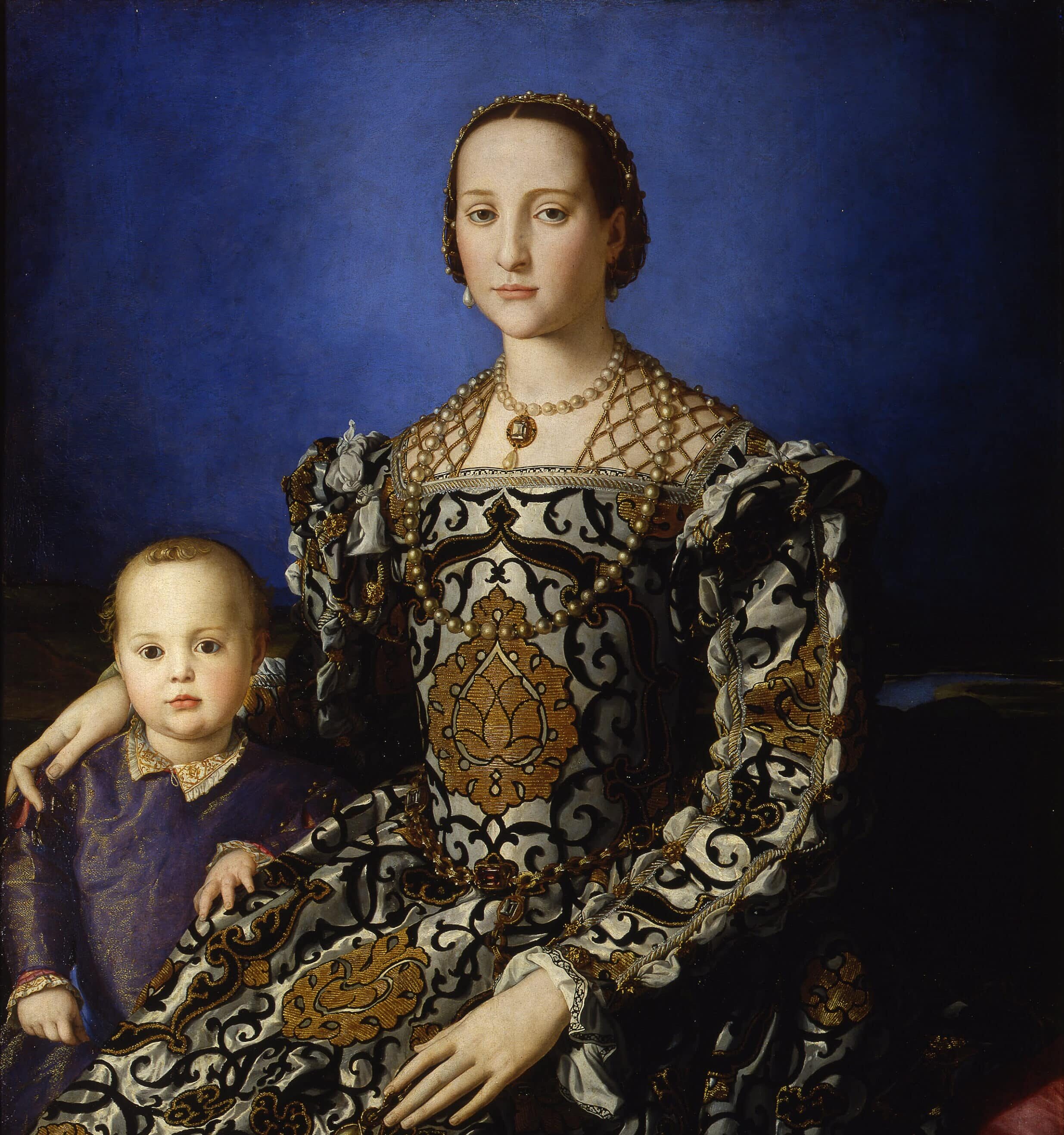
Portraits of Eleonora di Toledo tend to show the same thing: a woman sitting perfectly still, wrapped in stiff brocade, her expression giving away nothing at all. It is a pose designed to communicate wealth and dynastic stability, and for centuries it worked exactly as intended — reducing one of the sharpest political operators of the Medici court to a well-dressed footnote. The reality behind the portraits is considerably more interesting: a woman who financed her husband’s wars, governed Florence in his absence, and personally purchased the palace that still bears her family’s imprint today.
A Spanish Bride for a New Duke
Born in 1522, Eleonora was the daughter of Don Pedro Álvarez de Toledo, the Spanish viceroy of Naples — a position that placed her, from birth, inside one of the most powerful administrative networks in Habsburg Europe. She married Cosimo I de’ Medici by proxy on 29 March 1539, at seventeen, joining a duke whose own position was still far from secure. Cosimo had become ruler of Florence only two years earlier, at eighteen, following the assassination of his cousin Alessandro — an inheritance built more on convenient bloodline than on any guarantee of loyalty from the city he now governed. The marriage bound Florence’s ruling family directly to Spanish imperial power, at a moment when that alliance mattered more than any dowry.
The Businesswoman Behind the Duke
Eleonora’s finances were her own, and she used them accordingly. Contemporary records describe her as a sharp, hands-on administrator of her personal estates, producing and selling agricultural goods, managing property, and directly financing several of Cosimo’s military campaigns out of her own income — an arrangement unusual enough to draw comment even at the time. She was, in the most literal sense, invested in Medici power remaining exactly where it was.
That trust translated directly into political authority. Cosimo made Eleonora regent of Florence on several separate occasions: during his military campaigns in Genoa in 1541 and 1543, throughout an illness that sidelined him from 1544 to 1545, and repeatedly during the long war for the conquest of Siena between 1551 and 1554. For a Renaissance consort, formal regency was a rare degree of institutional trust — not simply informal influence exercised behind a curtain, but genuine legal authority to govern the state in the duke’s name.
The Palace She Bought Herself
Eleonora’s most lasting monument was, quite literally, a real estate transaction. By 1549, she and Cosimo had seven of their children sharing cramped quarters with them inside Palazzo Vecchio, itself still functioning as the seat of government rather than a family home. Rather than wait for a solution to present itself, Eleonora purchased the answer directly: that same year, using her own funds, she bought the decaying, half-finished Palazzo Pitti from Buonaccorso Pitti, a descendant of the merchant Luca Pitti who had begun building it a century earlier and died before its completion.
It was not a passive acquisition. Eleonora commissioned the sculptor and garden designer Niccolò Pericoli, known as Il Tribolo, to lay out the grounds behind the palace in 1550, creating what would become the Boboli Gardens — still, today, one of the most influential garden designs in European history, copied by royal courts across the continent for generations. The purchase transformed the Pitti family’s failed private residence into the ceremonial heart of a Medici Grand Duchy still in the process of inventing itself.
Eleven Children, and a Family Line Secured
Eleonora bore eleven children, ten of whom survived infancy — an extraordinary rate of survival for the period, and one that secured the Medici succession for generations after her own death. Her son Francesco I would succeed his father as Grand Duke; her daughter Isabella would become one of the most celebrated intellectual figures of the later Medici court. Motherhood, for Eleonora, was never separate from statecraft: it was the other half of the same project, securing the dynasty’s future on two fronts simultaneously, financial and biological.
Fashion, Foreignness, and a Fatal Journey
Eleonora’s Spanish origins made her a natural target for resentment as much as admiration. Florentine chroniclers of the period frequently criticised her as foreign, extravagant, and overly attached to imported luxury — criticism that says as much about Florence’s suspicion of outsiders as it does about Eleonora herself. She did, without apology, bring Spanish court fashion and etiquette into Florentine life, reshaping standards of dress and ceremony at the Medici court in ways that outlasted her by decades.
That same willingness to accompany her husband everywhere ultimately cost Eleonora her life. She travelled with Cosimo into the Tuscan Maremma, then a marshland notorious for malaria, during one of his campaigns connected to the war for Siena. She contracted the disease and died in Pisa on 17 December 1562, at forty years old. Her funeral gown survives today in the Galleria del Costume, housed, fittingly, inside the very palace she had bought thirteen years earlier.
Rediscovering the Woman Behind the Portrait
For centuries after her death, Eleonora’s historical reputation shrank to match her portraits: a beautifully dressed consort, remembered chiefly for her wardrobe rather than her judgment. Recent scholarship, and recent exhibitions at Palazzo Pitti itself, have worked to reverse that flattening, restoring the fuller picture of a woman sometimes described by historians as the earliest modern “first lady” of a European court — banker, regent, landowner, and the person whose personal fortune quite literally built the palace that still carries her decisions in its stones and gardens.
Visiting Her Legacy Today
Walking through Palazzo Pitti and the Boboli Gardens today means walking through Eleonora’s own decisions, made independently of her husband’s court and paid for with her own money. Bronzino’s portraits of her, on view within the same palace, remain magnificent precisely because they were never meant to reveal what she actually did with her time — governing a Renaissance state, and building, quite deliberately, the grandest address in Florence.