
How a Florentine Humanist Shaped Renaissance Etiquette — and Why It Still Matters in Florence Today
In Renaissance Florence, greatness was not measured only in marble and fresco. It was measured in conduct — in how one spoke, how one listened, how one shared a table. Among the many Florentines who shaped European culture, Giovanni Della Casa (1503–1556) occupies a genuinely unique place. Not as a painter or a banker, but as the author of Galateo overo de’ costumi, the 1558 treatise that would go on to define the very concept of etiquette across Europe.
The word galateo itself entered the Italian language as a synonym for good manners, and its influence spread with remarkable speed: the book was translated into French by 1562, English by 1576, Latin by 1580, Spanish by 1585, and German by 1587. Few Renaissance texts on the simple business of daily life travelled so widely, or so fast. Yet its roots remain profoundly Florentine.
A Florentine Mind in a Renaissance World
Giovanni Della Casa was born into a distinguished Florentine family in 1503. Educated in Bologna and Rome, he became a poet, diplomat, and churchman, eventually serving as papal nuncio in Venice and later as Archbishop of Benevento, moving throughout his career within the highest intellectual and political circles of his time. Yet Galateo, written in his later years and published posthumously in 1558, was not a work about theology or politics at all. It was about something far more subtle: the art of living well among other people.
Unlike Baldassare Castiglione’s Book of the Courtier, which addressed the rarefied world of aristocratic courts, Della Casa’s Galateo focused instead on everyday social interaction. It spoke to ordinary urban society — to citizens navigating conversation, dining, gesture, and reputation in the crowded, watchful streets of a Renaissance city. This was, in every sense, a distinctly Florentine perspective.
Florence and the Birth of Social Refinement
Sixteenth-century Florence was a dense and socially complex city, where public life unfolded constantly in piazzas, markets, workshops, and dining rooms. Reputation mattered. Words mattered. Gestures mattered. In this context, etiquette was never merely superficial polish; it was civic infrastructure, every bit as real as the city’s guilds or its laws.
Della Casa’s core principle was remarkably modern for its time: true courtesy, he argued, consists above all in avoiding behaviour that displeases others. This idea reflects Renaissance humanism at its most practical. Civility, in Della Casa’s vision, was not a matter of rigid hierarchy or inherited rank. It was a matter of social harmony, in which the self was continually shaped and reshaped in relation to everyone around it.
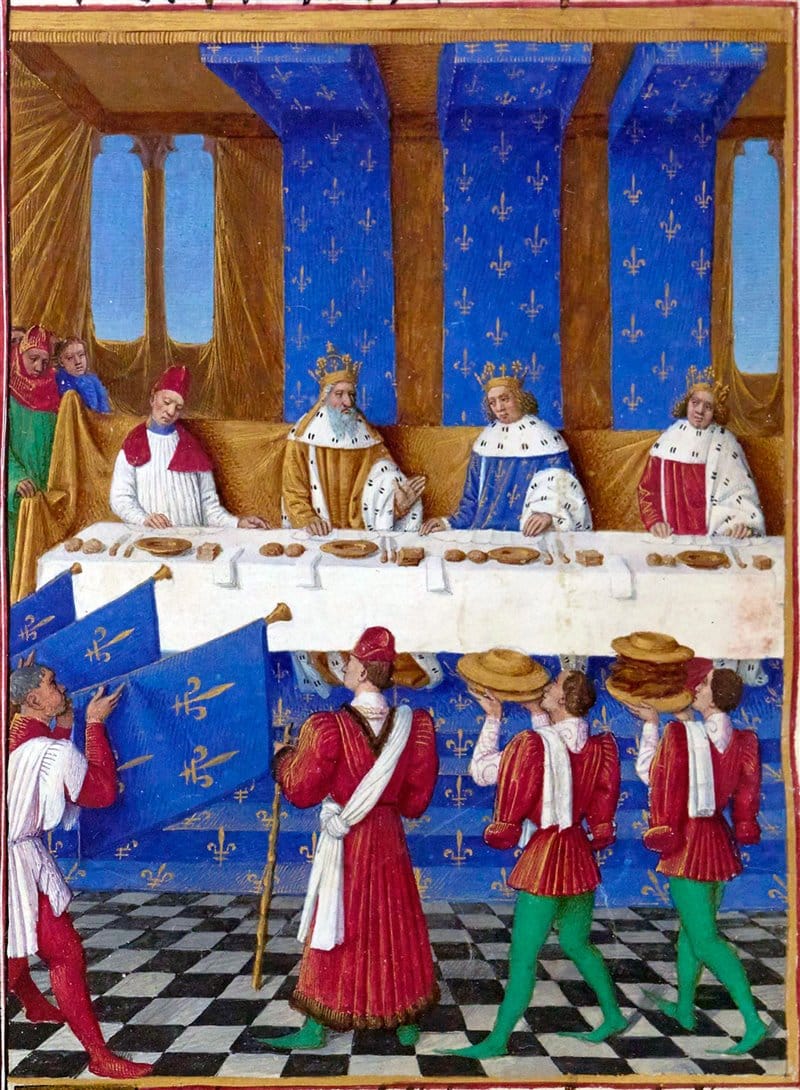
The Table as Cultural Theatre
One of the most vivid sections of Galateo concerns table behaviour. Della Casa offers detailed advice on how to eat without giving offence, how to avoid dominating a conversation, and why restraint reads as elegance while excess reads as vulgarity. He warns specifically against speaking with a full mouth, discourages any public display of bodily functions, and criticises tedious storytelling of every kind — including, memorably, the recounting of one’s own dreams, which he dismisses outright as tedious and unworthy of polite company.
These concerns may sound almost comic to modern ears, but in Renaissance Florence, dining was never merely a meal. It was a space of genuine social negotiation, where alliances formed, reputations solidified, and the wider culture of the city was quietly performed course by course. It is no coincidence that etiquette literature flourished precisely in cities like Florence, where gastronomy, commerce, and conversation were already so tightly intertwined.
The Evolution of Galateo Across Europe
After its publication in 1558, Galateo became one of the most widely circulated social manuals of the entire Renaissance, and its appeal rested largely on its accessibility. Della Casa wrote it not in Latin, the language of scholars, but in Italian vernacular, making it legible to a far wider readership than most treatises of its kind. The book went on to influence the courtesy literature that followed across the continent, contributing directly to the development of early modern civility codes; in England, France, and Spain alike, translators adapted its underlying principles to fit their own local courts and urban societies.
Curiosities and Cultural Context
The title itself has a small, almost accidental history behind it. “Galateo” derives from the Latinised name of Galeazzo Florimonte, a friend of Della Casa’s to whom the work was dedicated. Over time, that private dedication drifted entirely away from its original meaning: the proper name gradually ceased to refer to a person at all, becoming instead the ordinary Italian noun for etiquette itself — a personal tribute that somehow outgrew the friendship that inspired it.
Della Casa’s approach is also notable for what it deliberately avoided. Rather than proposing an abstract moral philosophy of virtue, he offered something closer to social technology: practical tools designed to reduce friction in daily life. Courtesy, in his hands, was never about asserting superiority over others. It was about ease — smoothing the countless small frictions of shared urban existence.
That concern with conduct also served a deeper civic purpose. In a city whose government shifted repeatedly between republic and Medici ducal rule, public conduct offered ordinary Florentines something political change could not easily disrupt: a stable, shared identity built on shared manners. Florence, in this sense, exported considerably more than art and banking systems to the rest of Europe. It exported behavioural codes as well, carried abroad in translation within a few short decades of Della Casa’s death.
Why Galateo Still Speaks to Modern Travellers
Today, Florence is experienced largely through walking, observing, and tasting — but travel, like Renaissance society before it, remains fundamentally relational. It involves shared space, shared tables, and a shared rhythm with the people around you. The principles at the heart of Galateo — moderation, attentiveness, a basic awareness of the people sharing your table — remain genuinely relevant to how a visitor moves through a city like Florence today. In its markets, its cafés, its historic wine windows, and its traditional trattorias, conduct still quietly shapes experience. To taste Florence well is, in a real sense, still to take part in its long-running social choreography.
The Renaissance Table and the Florence Tasting Experience
Experiencing a private Florence tasting tour is never simply about sampling local specialities. It is about understanding how food actually functions within Florentine culture — a lesson Della Casa’s own treatise offers almost as clearly as any menu could. Renaissance etiquette literature reminds us that dining is dialogue, that flavour is shared memory, and that moderation, far from limiting pleasure, tends instead to enhance it considerably.