
The Painter Who Renounced Himself
There is a moment in the history of Florentine art when beauty itself was put to the flame. And among the hands that, according to tradition, threw their own masterpieces into the fire, were those of Sandro Botticelli — the man who had painted the most beautiful woman ever rendered in the Renaissance, the Venus who today dominates one of the most photographed rooms of the Uffizi.
It is a story rarely told in front of the painting itself. Visitors stop before the Birth of Venus and the Primavera, admiring the grace of the lines, the Neoplatonic harmony, the golden light of an era that seems suspended in perfection. Few know that the man who painted them lived, only a few years later, through a spiritual crisis so profound that he renounced — at least in part — his own artistic language.
Florence in Flames: 1497 and the Preaching of Savonarola
To understand Botticelli, one must first understand Florence in the 1490s: a city in turmoil. In 1494 the Medici, the very patrons who had made the century’s artistic flowering possible, were driven out of the city. Into the power vacuum stepped Girolamo Savonarola, a Dominican friar with a fiery voice, who preached from the pulpit of the Duomo that the end was near and that total purification was required.
On 7 February 1497, in Piazza della Signoria — just steps from the Uffizi — his followers, nicknamed the “piagnoni” (“the weepers”), built an enormous pyramid of “sinful” objects: mirrors, cosmetics, sumptuous clothing, profane books, and, according to several sources, paintings. This was the famous Bonfire of the Vanities. An entire apparatus of material beauty — the very same beauty that had nourished Medici patronage — was reduced to ash in the name of the soul’s salvation.
What Vasari Actually Says
The principal source linking Botticelli to this episode is Giorgio Vasari, the first historian of art, who wrote his Lives roughly sixty years after the events. Vasari describes Botticelli as a fervent follower of Savonarola, one of the “piagnoni,” to the point of nearly abandoning painting altogether and falling into poverty.
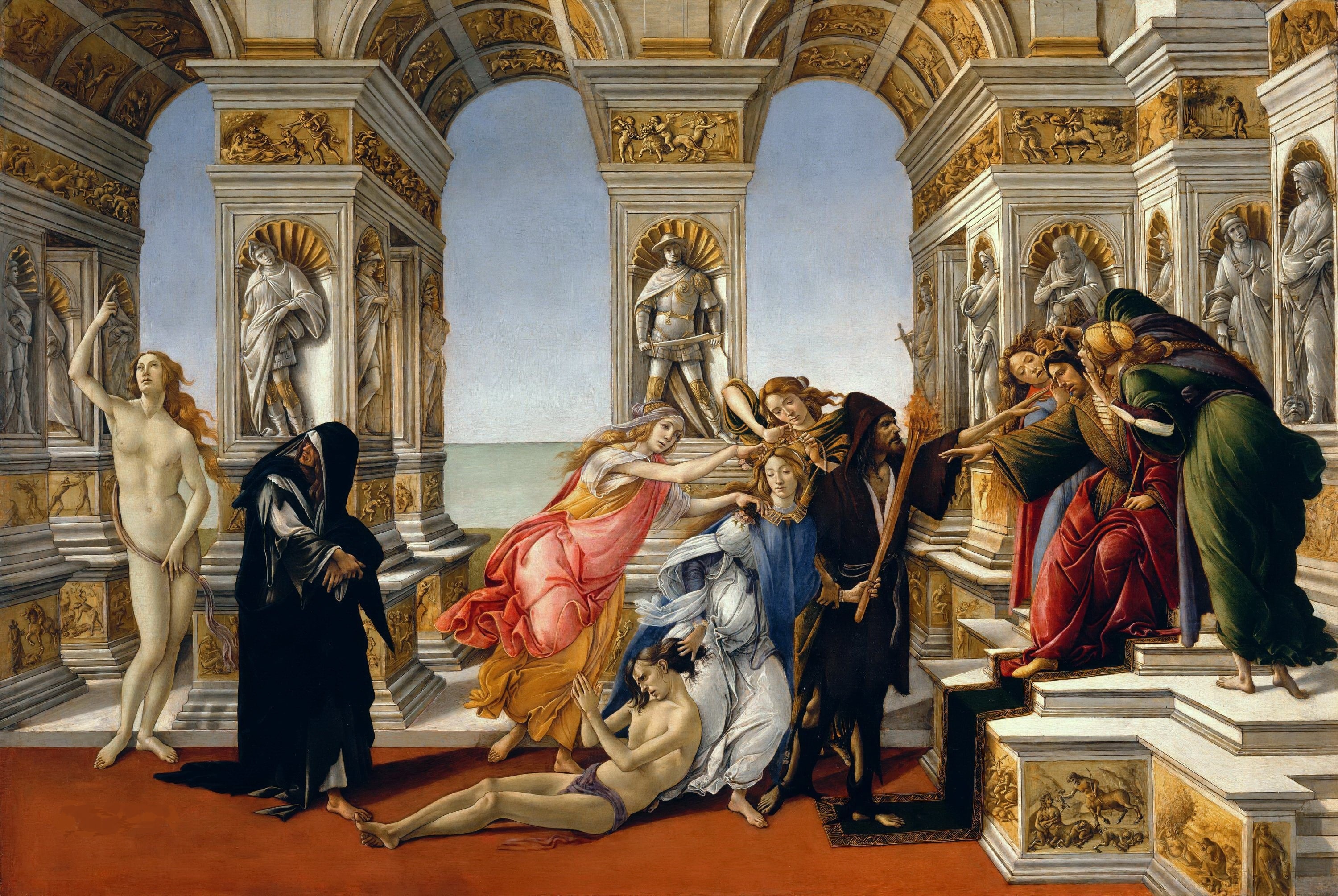
It is worth being rigorous on a point that is often romanticized: there is no contemporary documentary proof that Botticelli personally threw his own works into the flames. It was later writers who interpreted Vasari’s words this way. What is historically solid, however, is the undeniable shift in his pictorial language: after 1497 Botticelli never again painted pagan, sensual subjects such as Venus or the mythological Graces. His later works became more severe, more dramatic, almost apocalyptic in tone.
A Painting as Evidence of Inner Crisis: The Mystic Nativity
The most eloquent proof of this inner transformation is not found at the Uffizi, but at the National Gallery in London: the Mystic Nativity, cryptically dated to 1500 and accompanied by a Greek inscription of prophetic, anguished tone. Art historian Rab Hatfield has proposed that the work is built directly on the imagery of one of Savonarola’s Christmas sermons. It is a painting worlds apart, in spirit, from the luminous grace of the Primavera: a work written in the language of fear, no longer that of myth.
This contrast — between the “pagan” Botticelli of the Uffizi and the “penitent” Botticelli of his later years — is perhaps the most fascinating key to reading the artist’s entire body of work. Not one painter, but two conflicting sensibilities within the same man.
A Florence Unveiled Curiosity: The Venus That Nearly Didn’t Survive
One detail rarely mentioned in popular accounts: during the years of Savonarola’s preaching, the Birth of Venus and Primavera were not on public display, but kept at the Medici villa at Castello, outside Florence — physically and symbolically removed from the iconoclastic fervor gripping the city. It may be, in part, thanks to this very distance — as much as to fate — that two of the most celebrated images ever painted survive today. An irony worth sharing in front of the painting itself: Venus was saved because, quite simply, she wasn’t there.
A Legacy Rediscovered Three Centuries Later
There is one final chapter, often overlooked, that makes this story even more poignant. For nearly three centuries after his death in 1510, Botticelli was a largely forgotten painter. The portrait sketched by Vasari — that of an old, failed follower of a heretical friar — did him no favors with subsequent centuries, which were far more interested in the giants of the High Renaissance: Leonardo, Michelangelo, Raphael. Only in the nineteenth century, thanks largely to a critical rediscovery that took place in England, did Botticelli come to be recognized once again as one of the absolute pinnacles of Florentine painting.
Why This Story Changes the Way You Look
Knowing this story is not mere anecdotal enrichment. It changes the way one looks at the entire room dedicated to Botticelli at the Uffizi. No longer just ideal beauty and classical harmony, but also the mark of a deeply human crisis: an artist torn between the allure of ancient myth and the terror of damnation, between Neoplatonic sensuality and the long shadow of Savonarola’s preaching.
It is precisely this kind of reading — one that weaves together art history, politics, religion, and the psychology of the artist — that builds a visit truly different from a standard guided tour. During our Uffizi Gallery Guided Tour, the Botticelli room is never simply a photo stop: it is the place where we tell the story of the tension between beauty and faith that ran through all of Renaissance Florence.