
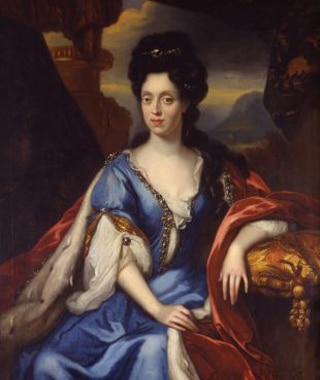
Some legacies are measured in money, and some are measured in centuries. The one Anna Maria Luisa de’ Medici left to Florence belongs to the second category: without her act, Botticelli’s Venus might today hang in a museum in Vienna, Paris, or St. Petersburg, and the Uffizi as we know it — with its unbroken succession of masterpieces — simply would not exist.
It is one of the least-told stories of Renaissance Florence, precisely because it involves no artist, no warrior prince, no pope — only a solitary, aging woman who, as her dynasty faced extinction, chose not to let the patrimony it represented disappear along with it.
A Nearly Three-Century Legacy Hanging in the Balance
To grasp the significance of this decision, one must understand what typically happened in eighteenth-century Europe when a ruling house died out. Art collections, jewels, and libraries were not considered public heritage: they were family property, and as such passed by right to the new ruling dynasty, which was free to sell them, disperse them, or move them elsewhere — often as diplomatic bargaining chips or as ornaments for its own residences.
In 1737, this was precisely the risk Florence faced. With the death of Gian Gastone de’ Medici, the last male Grand Duke of the family, the direct Medici line came to an end after nearly three hundred years of almost uninterrupted rule over the city. Under international agreements already established among the European powers, the Grand Duchy of Tuscany passed to the House of Lorraine. With it would have passed the entire Medici collection: paintings, sculptures, jewels, furnishings, libraries — the fruit of nearly three centuries of patronage, political ambition, and genuine love of beauty.
Anna Maria Luisa: The Last Heir
Anna Maria Luisa de’ Medici, Gian Gastone’s older sister and daughter of Grand Duke Cosimo III, suddenly found herself the sole legitimate heir to an immense patrimony: not only the art housed at Palazzo Pitti and the Uffizi, but also the Medici villas, the family jewels, and considerable sums of liquid cash. Widow of the Elector Palatine Johann Wilhelm of Wittelsbach, she had returned to Florence years earlier after a life spent at court in Germany, devoting herself to musical and artistic patronage with the same sensibility that had defined her family for generations.
She, and she alone, recognized that this patrimony was in real danger. And it was she who, on 31 October 1737, signed the document that would forever change the fate of Florence: the Family Pact, or Patto di Famiglia.
The Family Pact: A Clause Against Dispersal
The agreement, signed with the new Lorraine rulers, established a condition as simple as it was radical for its time: the entire Medici collection — galleries, jewels, statues, libraries, and every other precious object — would remain bound in perpetuity to the city of Florence, “as an ornament of the State, for the benefit of the public, and to attract the curiosity of foreigners.” No part of it could be removed, sold, or transferred outside the boundaries of the Grand Duchy’s capital.
This was no simple testamentary bequest: it was, in effect, a permanent legal binding, designed to withstand the whims of every future sovereign. The pact became fully operative upon Anna Maria Luisa’s death on 18 February 1743, six years after it was signed — the last heir of the dynasty passed away knowing she had secured, forever, the legacy of her ancestors.
A Political Act, and a Deeply Human One
There is something quietly moving about this gesture, seen up close. Anna Maria Luisa had no direct heirs. Her dynasty was fading into extinction; her name would soon vanish from the books of dynastic succession. And yet, in the final years of her life, she chose to secure not the survival of her own bloodline, but the survival of what that bloodline had built: an irreplaceable artistic patrimony, the fruit of work by Botticelli, Michelangelo, Raphael, Titian, and generations of Medici craftsmen, architects, and collectors.
American scholar Cynthia Miller Lawrence has observed that, through this gesture, Anna Maria Luisa anticipated — perhaps unknowingly — Tuscany’s future economic dependence on cultural tourism: a striking insight for an eighteenth-century woman, yet fully consistent with the political foresight that had always defined the Medici, even in their moments of greatest vulnerability.
A Florence Unveiled Curiosity: A Gift, Not an Obligation
A detail often overlooked: the Family Pact was not imposed by any higher authority, nor requested by the new Lorraine rulers. It was Anna Maria Luisa’s own voluntary choice, at a time when no international law required a ruling family to “return” its artistic patrimony to the public. The very concept of public cultural heritage, which we take for granted today, did not yet exist within the legal sensibility of the era — it would only be formalized centuries later. Anna Maria Luisa simply practiced it, out of love for her city, decades before the world even had the words to define it.
Why This Story Should Accompany Every Visit to the Uffizi
When a visitor today walks into the Uffizi and stands before the Birth of Venus, Michelangelo’s Doni Tondo, or Leonardo’s Annunciation, they are, in fact, walking through the fulfilment of a promise made nearly three hundred years ago by a woman no standard guidebook mentions. Not a patron, not a prince, but the last of a dynasty, who chose permanence over possession.
It is precisely this kind of narrative thread — weaving together politics, love for one’s city, and historical foresight — that makes a visit genuinely different from a simple stroll among masterpieces. During our Uffizi Gallery Guided Tour, we tell the story of the collection not only through the artists who created it, but through the woman who made its survival to this day possible.