
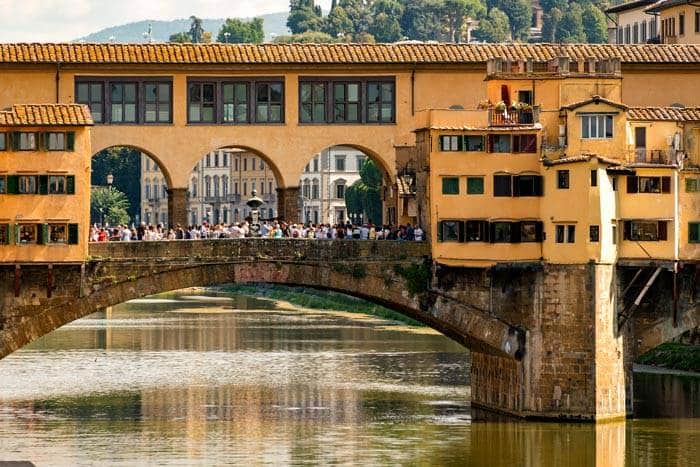
In August 1944, as German forces retreated north through Florence, they mined every bridge across the Arno. Six historic crossings, some standing since the Middle Ages, were reduced to rubble in a matter of nights. One bridge was left standing: the Ponte Vecchio.
By most accounts, the reason traces back six years earlier, to a private tour along the very corridor Florence Unveiled guests walk today.
A Dictator’s View
In May 1938, Adolf Hitler visited Florence as Benito Mussolini’s guest, part of a state visit meant to display the strength of the new Axis alliance. Mussolini, eager to impress, arranged for Hitler to be shown the Vasari Corridor — the same elevated, secretive passageway Cosimo I de’ Medici had built nearly four centuries earlier so that the rulers of Florence could move unseen between their palace and their seat of government.
Somewhere along that walk, above the goldsmiths’ shops of the Ponte Vecchio, Mussolini had three large rectangular windows cut into the corridor’s wall — replacing the small, round portholes the Medici had used to watch the city below without being watched themselves. The new windows framed a wide, unobstructed view of the Arno. They remain there today, distinct from the corridor’s older openings, a physical record of one afternoon’s diplomacy.
Hitler, by tradition, lingered at that view for a long time.
Six Years Later
What happened in 1944 is where the story turns dark, and where the historical record gives way to tradition rather than certainty. As Allied forces advanced and German troops prepared to abandon the city, orders came to destroy Florence’s bridges to slow the pursuit. Every bridge over the Arno was mined — except one. Instead, German engineers demolished the medieval buildings clustered at both ends of the Ponte Vecchio, rendering it impassable to vehicles and heavy equipment without destroying the bridge itself.
The popular explanation, repeated by guides and historians for decades, is that the order to spare the bridge came from Hitler personally — a fragment of memory from that 1938 visit, when he stood at Mussolini’s new windows and looked down at the same crossing. Whether the order truly originated with Hitler, or with a German commander unwilling to erase one of Europe’s most recognizable landmarks, remains debated. What is certain is that the bridge survived, while the streets around it, some of Florence’s oldest, did not.
An Unlikely Lifeline
The Germans’ plan had an unintended flaw. In demolishing the streets around the Ponte Vecchio, they meant to seal off any route between the two halves of the city — the northern bank, still under German occupation, and the Oltrarno to the south, already reached by Allied troops. What they seem not to have accounted for was the passage running directly above their heads.
Within days, two young partisans, Enrico Fischer and Orazio Barbieri, discovered that the Vasari Corridor itself was still passable, its elevated route bypassing the rubble entirely. Because the Germans had no knowledge of this aerial passage, it became, briefly, the only working connection between occupied Florence and the liberated Oltrarno. Partisans strung a telephone line the length of the corridor, linking the resistance command hidden south of the river to the Comitato Toscano di Liberazione Nazionale on the northern bank — allowing the two to coordinate what would become the insurrection of 11 August 1944 that finally drove German forces from the city.
The corridor built four centuries earlier so a duke could move unseen through his own city ended up doing exactly that once more, only this time for the people trying to take it back.
A Passage Built for Secrecy, Witness to Tyranny
There is a particular unease in walking that stretch of the corridor today, knowing what it saw. A passage designed in the sixteenth century so that a Medici duke could move through his city unseen became, four centuries later, an elevated viewing platform for two of the twentieth century’s most destructive men. The same architecture of privacy and power that once served Cosimo I’s political theater was repurposed, briefly, for a very different kind of spectacle.
And yet the windows themselves are almost unremarkable to look at — three rectangles of glass, slightly wider than the ones around them, easy to walk past without a second glance. Guides who know the story tend to slow down there. It is one of the few places in Florence where Renaissance ambition and twentieth-century catastrophe occupy exactly the same few square meters of stone.
Crossing the Arno through the Vasari Corridor today, visitors pass beneath those same windows — a small, deliberate pause in an itinerary otherwise devoted to Medici power and Renaissance grandeur, and a reminder that this corridor’s history did not end with the family that built it.