
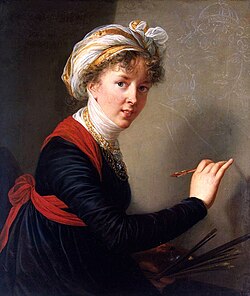
In October 1789, as revolutionary crowds marched on Versailles, a celebrated portrait painter slipped out of Paris in disguise, under cover of darkness, with her young daughter in tow. She would not see France again for more than a decade. Within two years, that same painter would be standing before the Uffizi’s most exclusive gallery, being personally invited to add her own face to a collection that had, by then, been growing for over a century.
The Queen’s Favourite Painter
Élisabeth Vigée Le Brun had, by 1789, reached the summit of a career few women of her era could have imagined for themselves. The daughter of a pastelist and a hairdresser, entirely self-taught beyond what her father showed her in his own studio, she had risen to become the favoured portraitist of Queen Marie Antoinette, admitted to the Académie Royale de Peinture et de Sculpture only through the king and queen’s direct intervention — women were otherwise barred from membership. She had painted the queen more than thirty times, in styles ranging from formal state portraiture to the softer, more intimate poses that scandalised as often as they charmed the French court.
That closeness to the throne, which had built her reputation, became the very thing that endangered her when the Revolution began. As a slanderous press campaign turned public sentiment against anyone associated with the monarchy, Vigée Le Brun found herself directly in the line of fire — not for anything she had done politically, but simply for whose face she had spent a decade painting.
A Decade Without a Home
What followed was one of the longest and most geographically sprawling exiles of any major artist of the period. Vigée Le Brun would not return to Paris until 1802, more than a decade later, working her way through Italy, Austria, and eventually Russia, painting portraits of aristocrats and royalty in each city that hosted her, rebuilding a version of her Parisian career again and again in cities where she arrived, each time, essentially as a refugee with a reputation and little else.
Italy came first. She settled for a time in Rome, one of the earliest stops on a decade of near-constant movement, and it was during this period — passing through Florence on her way south — that she encountered something that would connect her exile directly to the city’s own artistic history.
A Gallery Built for Faces Like Hers
While in Florence, Vigée Le Brun visited the Pitti Palace and the Uffizi, where she saw the self-portrait collection first inaugurated over a century earlier by Cardinal Leopoldo de’ Medici — the same extraordinary gallery of artists’ self-portraits that had grown, by then, to include masters across two centuries. She was particularly struck by the self-portrait of a contemporary she knew well by reputation, the Swiss painter Angelica Kauffman, whose own work already hung among the collection.
The Uffizi’s director at the time, Giuseppe Bencivenni Pelli, recognised an opportunity. He asked Vigée Le Brun, directly, whether she would contribute her own self-portrait to the gallery. She accepted immediately and enthusiastically — an invitation that placed her, while still a refugee with an uncertain future, among a select company of artists the Medici’s own collecting tradition had judged worthy of permanent inclusion.
A Portrait Within a Portrait
She completed the painting in Rome, working quickly — by her own account, in about a month and a half. The result was not a simple likeness. Vigée Le Brun depicted herself seated at her easel, palette and brushes in hand, in the act of painting another portrait entirely: an outlined image of Marie Antoinette, sketched in white chalk on the canvas within the canvas. “I have portrayed myself with palette in hand,” she later wrote, “before a canvas on which I am drawing the queen in white chalk.”
It was, unmistakably, a deliberate act of loyalty. While her own queen was being stripped of power an ocean of political upheaval away, and would be executed within the queen’s remaining years, Vigée Le Brun chose to use her one contribution to the Uffizi’s prestigious self-portrait gallery not simply to represent herself, but to represent her enduring devotion to the monarch whose patronage had shaped her entire career — and whose fall had just cost her everything she had built in Paris. The painting’s mood, remarkably, gives little away: alert, composed, faintly serene, betraying almost nothing of the disguise-and-darkness escape that had brought her to Italy in the first place.
A Masterpiece Too Good to Judge
The painting reached Florence on 26 August 1791 to an enthusiastic reception. In Rome, it had already earned praise from the Academy of San Luca; in Florence, Grand Duke Ferdinand III of Tuscany reportedly judged it so accomplished that he declined to submit it to the usual review process of the Royal Academy of Fine Arts professors, a formality he normally observed for new additions to the grand-ducal collections. It was accepted, in effect, on sight.
Two Refugees, One Gallery Wall
There is a quiet symmetry worth noticing in the collection Vigée Le Brun joined. Angelica Kauffman, whose self-portrait had first caught her attention, was herself an outsider who had built an international career against considerable odds, one of only two women among the founding members of Britain’s Royal Academy. Decades later, Nadezhda — the Nubian girl freed from slavery and buried nearby in Florence’s English Cemetery — would be laid to rest under the only Orthodox cross in an otherwise uniform burial ground. Florence, across several centuries, kept finding room for people whose lives did not fit neatly into the categories the world tried to assign them: a queen’s exiled portraitist, a self-taught convent painter, a freed Nubian girl. The Uffizi’s self-portrait gallery, born from one cardinal’s curiosity about how artists saw themselves, became one particular place where several of those stories intersected.
Seeing It Today
Vigée Le Brun’s self-portrait remains part of the Uffizi’s collection today, still carrying, in every brushstroke of that faintly sketched royal profile, the specific circumstances of its making: a painter with no home, no certainty about her future, and no France to return to, choosing to spend her one contribution to art history’s most exclusive gallery of self-portraits honouring the queen whose friendship had cost her everything.