
How One Collector’s Devotion Gave Florence One of Its Most Refined Treasures
Not all masterpieces are born from the hands of artists. Some are shaped by the discipline of a discerning eye.
Within the stone walls of the Bargello — beyond the celebrated Davids of Donatello and Verrocchio — rests one of Florence’s most quietly extraordinary legacies: the Carrand Collection.
It does not command attention through scale. It reveals itself through intimacy.
In its rooms lives the cultivated intelligence of a man who understood that beauty is not only sculpted in marble or cast in bronze — it is gathered patiently, studied deeply, and preserved with intention.
Louis Carrand did not collect objects. He collected refinement.
Through an eclectic yet rigorously coherent vision, he assembled a constellation of medieval ivories, enamels, goldsmith works, textiles, and devotional artifacts. In his hands, detail became destiny, and intimacy became grandeur.
Who Was Louis Carrand?
Louis Carrand’s decision to leave his precious collection of medieval and Renaissance decorative arts to Florence in 1887 was not merely an act of generosity — it was a deliberate choice shaped by conviction. Disillusioned with the political climate of contemporary France, which he reportedly described as an “unfortunate country,” Carrand harbored deep mistrust toward the republican and revolutionary forces that defined his era.
In his will, he expressed open disdain for what he perceived as the instability and ideological turmoil of his homeland. He described his bequest as the legacy of an unfortunate man in an ‘unfortunate country’ — a strikingly personal declaration. Despite being French, Carrand considered Italy a more fitting guardian for the works he had spent a lifetime assembling.
Florence, with its reverence for craftsmanship and historical continuity, represented for him a place where art would be preserved rather than politicized. The Bargello, newly established as Italy’s first national museum, offered the ideal setting. His donation not only enriched the institution — it transformed it, elevating the museum into one of the world’s most important centers for medieval and Renaissance decorative arts.
A Vision Ahead of Its Time
In the 19th century, medieval art was not yet universally revered. Gothic was still misunderstood. Intimacy was overshadowed by monumentality.
Carrand’s taste was radical in its subtlety.
He was drawn to:
- Medieval ivories
- Limoges enamels
- Goldsmith masterpieces
- Textiles of refined craftsmanship
- Small-scale sculpture
- Liturgical and devotional objects
He recognized the intellectual density compressed within small dimensions. He valued refinement over spectacle, narrative over scale.
Where others sought canvases that filled walls, Carrand sought objects that filled the hand.
This sensibility resonates profoundly with Florence itself — a city that has always understood craftsmanship as a form of genius.
The Ivory Collection: Theology in the Palm of the Hand
At the heart of the Carrand Collection lies one of Europe’s most important ensembles of medieval ivories.
Many date from the 11th to 14th centuries — centuries in which devotion, trade, and artistic excellence converged.
Ivory, carved from elephant tusk imported through intricate Mediterranean trade routes, was both rare and symbolically charged. Its luminous surface carried associations of purity and sacredness.
Within the Carrand rooms, one encounters:
- Gothic diptychs and triptychs used for private devotion
- Madonna and Child figures carved with astonishing delicacy
- Passion panels rich in narrative detail
- Secular objects reflecting courtly life
Each piece reveals a mastery of restraint.
Ivory demands control. It fractures under excess pressure. It requires patience, rhythm, precision.
The result is sculpture distilled to its most intimate form — theology carved into stillness.
In a museum dominated by bronze and marble, these works slow the visitor’s breath. They invite proximity. They reward contemplation.
Medieval Radiance: Gold, Enamel, and Sacred Engineering
Beyond ivory, the Carrand Collection contains an extraordinary array of medieval goldsmith works and Limoges enamels.
Reliquaries, processional crosses, liturgical vessels — objects created not merely for beauty, but for belief.
Medieval goldsmiths were engineers of transcendence. They transformed faith into radiance. Gold did not symbolize wealth alone; it evoked divine light.
The Limoges enamels, with their deep cobalt blues and gilded accents, testify to a Europe connected through artistic exchange long before the Renaissance proclaimed cultural rebirth.
Carrand understood that Florence’s greatness did not emerge in isolation. It was part of a larger continental network of craftsmanship and devotion.
By installing these works in the Bargello, he placed Florence within a broader European conversation.
The Mediterranean Dialogue: Islamic Art and Cultural Exchange
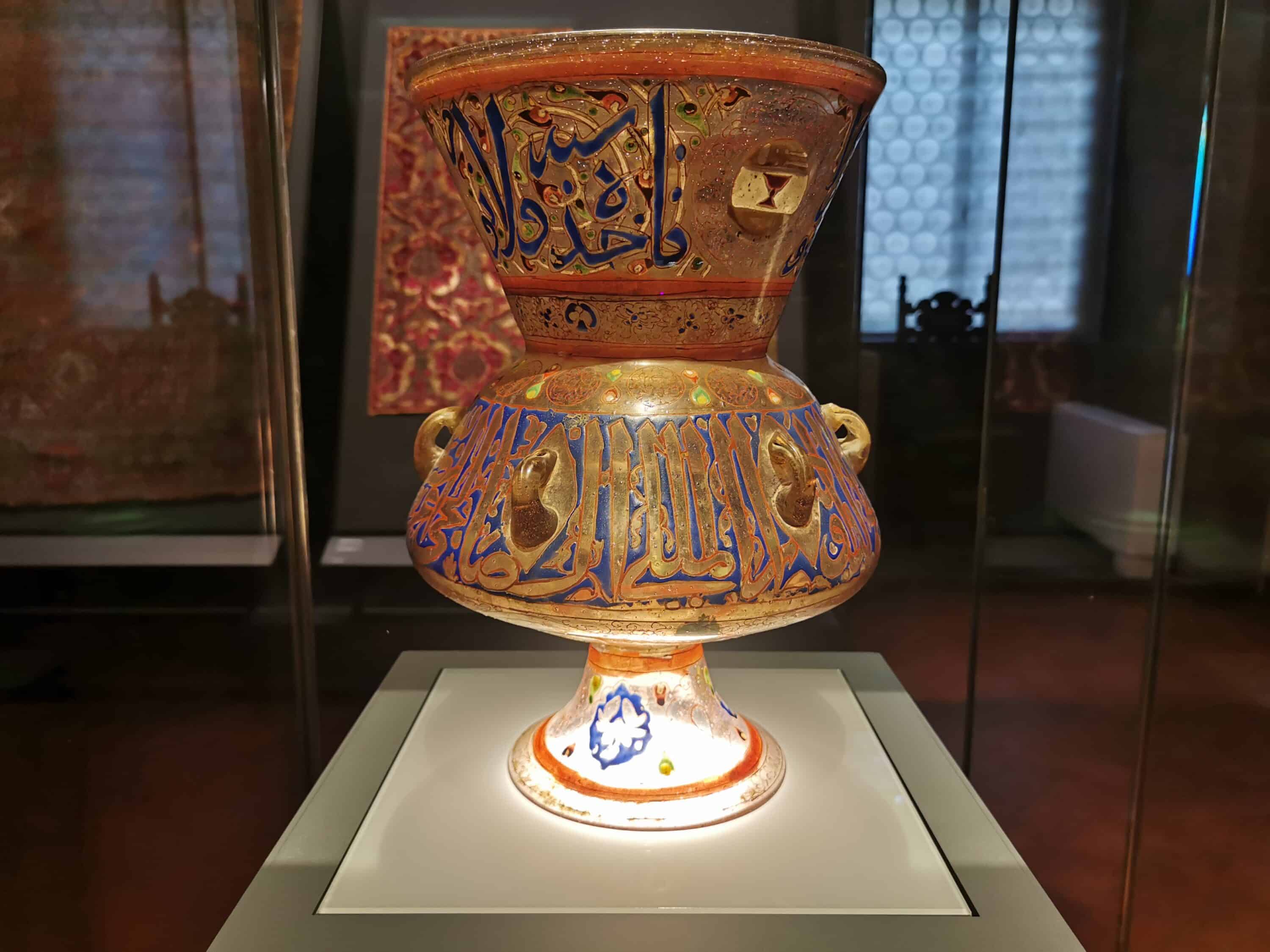
One of the most intellectually sophisticated aspects of the Carrand Collection is its inclusion of Islamic metalwork and textiles — among the most important such collections in Italy for quality and refinement. Some pieces were once displayed among the most precious treasures in the Tribune of the Uffizi.
These works illuminate a Mediterranean world defined not by separation, but by exchange.
Florence’s late medieval prosperity was deeply intertwined with trade routes linking East and West. Textiles, pigments, metals, and luxury goods circulated across cultures.
The presence of Islamic art within the Bargello reminds us that Renaissance Florence was built upon networks of interaction and dialogue.
Carrand grasped this before it became a standard narrative in art history.
Through his collection, the Bargello transcends local identity and acquires international prestige in the field of decorative arts.
Why Carrand Still Matters to Florence
Louis Carrand did not design domes. He did not cast bronzes. He did not govern republics.
Yet his contribution to Florence is enduring.
Without Carrand, the Bargello would remain primarily a museum of sculpture.
With Carrand, it becomes a microcosm of medieval and Renaissance Europe — a museum of refinement, trade, devotion, and cross-cultural artistry.
His gift arrived at a pivotal moment. In 1865, the Bargello had been transformed into Italy’s first national museum. The institutional framework existed. Carrand supplied depth.
He gave Florence a collection that demands slow looking — and intellectual humility.
The Counterpoint to Monumentality
Florence is often experienced through magnitude — the Duomo’s dome, Palazzo Vecchio’s tower, Michelangelo’s David.
The Carrand Collection proposes another rhythm.
It asks: What happens when power is miniaturized? When devotion is scaled to the human hand? When beauty lies in the curve of ivory rather than the force of marble?
In these quieter rooms, Florence reveals its second identity — not as a city of spectacle, but as a city of precision.
Carrand perceived this duality. He understood that greatness can reside in restraint.
Experiencing the Collection Today
The Carrand rooms are often calmer than the surrounding galleries.
They require attentiveness.
Ivory reveals its depth only when approached closely. Enamel glows under careful light. Goldsmith works unfold through patient observation.
This is not theatrical art. It is connoisseurship.
For the culturally curious traveler, these rooms offer a revelation distinct from Renaissance heroism. They unveil Florence’s subtler language — the language of detail, devotion, and design.
A Private Encounter with Florence’s Hidden Refinement
To explore the Carrand Collection within the Bargello is to encounter Florence at an intimate scale.
A curated, guided experience reveals the invisible threads: Mediterranean trade routes behind ivory, theological symbolism embedded in enamel, political prestige encoded in gold.
The Bargello is not only about sculpture. It is about discernment.
Through Louis Carrand’s devotion, Florence inherited not simply objects, but a way of seeing — a refined lens through which the city’s cultural depth becomes clearer.
Because sometimes the most powerful masterpieces are not the largest. They are the ones that invite you closer.
The ivories require close proximity. The enamels reveal their brilliance only in careful light. The goldsmith pieces unfold slowly.
This is not spectacle. It is connoisseurship.
For the culturally sophisticated traveler, this collection offers a different kind of revelation — one that deepens understanding of Florence beyond Renaissance heroics.
A Private Encounter With Florence’s Hidden Refinement
To explore the Carrand Collection within the Bargello is to encounter Florence at a more intimate scale.
A guided experience reveals connections that casual viewing misses: trade networks behind ivory, theological symbolism in enamel, political meaning embedded in craftsmanship.
The Bargello is not only about sculpture. It is about collecting. It is about how taste shapes legacy.
And through Louis Carrand’s devotion, Florence inherited not just objects — but a refined lens through which to see itself.
A thoughtfully curated visit to the Bargello Museum allows these quieter masterpieces to emerge from shadow, transforming admiration into insight.
Because sometimes the most powerful works are not the largest. They are the ones held close.

