
Somewhere inside the Salone dei Cinquecento, behind one of Giorgio Vasari’s own sprawling battle frescoes, there may be a small gap of trapped air — no more than a few centimetres wide — that has separated the public from one of the greatest lost masterpieces in Western art for over four hundred years.
A Commission Meant to Outshine Everyone
In 1503, the Florentine Republic set out to decorate its new council hall with the two greatest artists alive. Leonardo da Vinci was commissioned to paint The Battle of Anghiari, commemorating Florence’s 1440 victory over Milan; on the opposite wall, a young Michelangelo was assigned The Battle of Cascina. It would have been, by any measure, the single greatest artistic confrontation of the Renaissance — two geniuses, one room, working in open competition.
It never fully happened. Michelangelo never advanced beyond preparatory drawings before being summoned to Rome. Leonardo, characteristically, pushed his own technical ambitions too far. Rather than paint in traditional fresco — fast-drying plaster that demanded speed and certainty — he experimented with an oil-based technique on the wall itself, hoping for the richer colour and slower working time oil painting allowed. It was a gamble consistent with everything else about him: brilliant in theory, unstable in practice. Contemporary accounts describe the paint beginning to run and blister even as he worked, the pigments failing to properly bond with the plaster beneath.
A Masterpiece That Nonetheless Stunned Florence
What Leonardo did manage to complete — chiefly the central scene, later known as The Fight for the Standard, showing four horsemen locked in violent struggle over a battle flag — was, by every surviving account, extraordinary. For roughly fifty years, visitors to the council hall came specifically to see it, unfinished and deteriorating as it was. Artists copied it obsessively; the most famous surviving record of its composition is not by Leonardo at all, but a copy painted decades later by Peter Paul Rubens, working from earlier drawings, now held in the Louvre. Leonardo left Florence in 1506 with the work incomplete, and it continued slowly decaying on the wall for the better part of half a century.
Vasari’s Renovation
In 1563, Grand Duke Cosimo I de’ Medici commissioned Giorgio Vasari to transform the old republican council chamber into a hall fit for a princely court — raising the ceiling, enlarging the room, and covering its walls with monumental frescoes celebrating Medici military triumphs. Among the new works Vasari painted onto the east wall was The Battle of Marciano, installed directly over the section of wall where Leonardo’s mural had stood.
By every reasonable assumption, Leonardo’s work should have been destroyed at this point — plastered over or physically removed to make way for the new decoration. And yet Vasari was, by his own extensive writing, one of Leonardo’s most devoted admirers; his biography of Leonardo in Lives of the Artists reads with something close to reverence. That admiration is at the centre of one of art history’s most tantalising theories: that rather than destroy the deteriorating mural, Vasari built a new wall a short distance in front of the old one, sealing Leonardo’s work inside a kind of protective cavity rather than erasing it outright.
Cerca, Trova
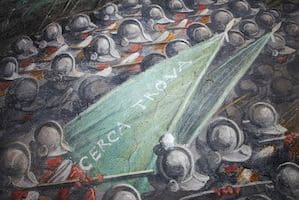
The clue, if it is a clue, is almost absurdly small. High on Vasari’s own fresco, painted onto a tiny green battle flag amid the chaos of soldiers and horses, are two words in barely legible white script: “Cerca, trova” — seek, and you shall find. For centuries it went unnoticed, dismissed as an inconsequential decorative detail if it was noticed at all.
In the early 2000s, the art diagnostician Maurizio Seracini — whose decades-long investigation into the mystery would later be referenced in Dan Brown’s The Da Vinci Code — used thermographic imaging, radar, and ultrasound to examine the wall more closely. His scans identified a genuine cavity behind Vasari’s fresco, a gap of one to four centimetres running along sections of the east wall, entirely inconsistent with standard sixteenth-century construction technique. In 2012, working with the permission of Florence’s cultural authorities, Seracini’s team drilled several small probes through existing cracks and areas of prior damage in Vasari’s fresco — deliberately avoiding any undamaged original paint — and extracted microscopic samples from the cavity behind it. Laboratory analysis found pigment traces, including a black material consistent with the specific organic compounds Leonardo is known to have used in his experimental technique.
An Unresolved Mystery, By Design
The findings were, and remain, contested. Some scholars argue the pigment traces are far too small and ambiguous to prove anything conclusively; others note that fully verifying the theory would likely require damaging or destroying Vasari’s own celebrated fresco — itself a significant Renaissance masterpiece — a trade-off Florence’s cultural authorities have so far been unwilling to authorise. The investigation was ultimately suspended, and no further destructive testing has been permitted since.
So the mystery stands exactly where it has stood for decades: unresolved, and quite possibly unresolvable without a decision no one currently wants to make. Somewhere behind Vasari’s own battle scene, in the very hall the Medici transformed to declare their permanent dominance over Florence, there may be a masterpiece by Leonardo da Vinci that no living person has ever seen — hidden not by accident, but perhaps, if the theory holds, by the deliberate hand of one artist protecting another.
Standing in the Room Today
Visitors to the Salone dei Cinquecento today stand within metres of one of art history’s great unresolved questions, whether or not they know to look for it. Vasari’s own sprawling battle frescoes are worth the visit entirely on their own merits — but somewhere behind their surface, according to the physical evidence gathered so far, waits the possibility that Florence’s most famous unfinished masterpiece was never actually lost at all. It was simply hidden, in plain sight, exactly where “Cerca, trova” told anyone patient enough to look.