
The Renaissance Queen Who Shaped Florence’s Court
In the heart of Florence, amid the grandeur of palaces, gardens, and galleries, one figure stands out not merely for her beauty or status, but for her profound influence on the Medici court: Eleonora di Toledo. As the wife of Cosimo I de’ Medici, she was far more than a consort; she was a patron, a political strategist, and a cultural force whose presence helped define the social and artistic landscape of Renaissance Florence. To understand Eleonora is to see Florence not just as a city of art, but as a courtly world where intellect, diplomacy, and style intertwined.
From Spanish Nobility to Florentine Power
Born in 1522 to Don Pedro Álvarez de Toledo, viceroy of Naples, Eleonora entered Florence as a Spanish noblewoman steeped in political acumen and courtly sophistication. Her marriage to Cosimo I in 1539 was as much a union of power as of love — a strategic alliance that cemented Medici influence across the Italian peninsula. Florence, a city often defined by its male rulers, was immediately transformed by Eleonora’s presence. She brought Spanish refinement, disciplined elegance, and a keen sense of courtly order, establishing a model for Medici court life that blended political authority with cultural prestige.
Patron of Art and Architecture
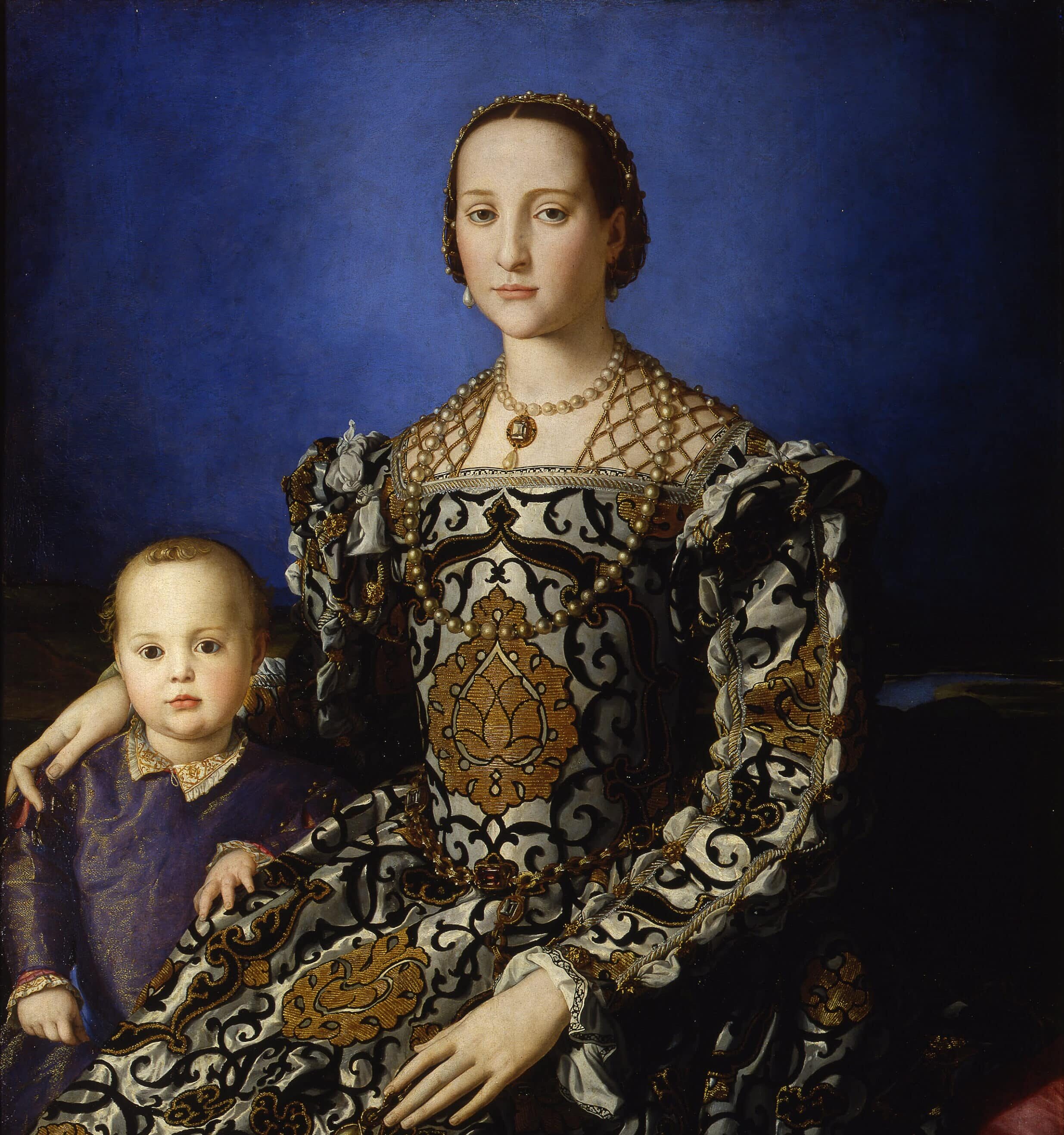
Eleonora’s legacy is deeply intertwined with Florence’s artistic flowering. She commissioned palaces, gardens, and chapels that reflected both her personal taste and political stature. Among her most celebrated projects is the Palazzo Pitti and its Boboli Gardens, where she influenced both design and decoration, establishing spaces for public display and private contemplation. Her patronage extended to painting and sculpture as well. Eleonora understood the power of imagery in shaping perception — portraits by Agnolo Bronzino, for example, present her not merely as a noblewoman, but as a figure of authority and grace. In these works, her gaze, posture, and attire communicate both dignity and the cultivated refinement expected of a Medici consort.
Political Acumen Behind the Veil
Eleonora’s influence extended far beyond aesthetics. In an era when female power was often exercised subtly, she navigated diplomacy, succession, and courtly politics with remarkable skill. She played a key role in arranging marriages, maintaining alliances, and ensuring the stability of Medici rule. Even as her public image celebrated beauty and elegance, behind the scenes she acted as a stabilizing force, safeguarding both her husband’s authority and her children’s future. Her son, Francesco I, and her daughter, Isabella, would inherit not only Medici blood but also Eleonora’s keen sense of courtly strategy.
A Fashion Icon and Cultural Trendsetter
Eleonora’s impact was also profoundly cultural. She brought Spanish fashion and ceremonial style to Florence, influencing everything from dress codes to garden etiquette. Her carefully chosen attire, often captured in portraits, blended opulent fabrics, intricate jewelry, and understated refinement — a style that would define the Medici court for decades. Beyond clothing, Eleonora shaped courtly rituals, social gatherings, and celebrations, creating an environment where power and elegance coexisted seamlessly. In her court, every gesture, every event, and every commissioned artwork communicated prestige and cultivated taste.
Motherhood and Dynastic Legacy
Eleonora’s role as mother was inseparable from her political and cultural influence. She bore eleven children, ensuring the continuity of the Medici line, while simultaneously supervising their education and social positioning. Her guidance produced heirs who were not only politically astute but also culturally literate, capable of sustaining Florence’s status as a Renaissance capital. Eleonora’s legacy, therefore, is measured not only in marble and canvas, but in the continuation of Medici authority and refinement across generations.
The Enduring Influence of Eleonora di Toledo
Today, Eleonora’s impact is visible across Florence: in palaces, gardens, and portraits; in ceremonial traditions and the very organization of the court. She exemplifies the power of intellect, taste, and strategy exercised quietly yet decisively, demonstrating how a consort could shape both a city and a dynasty. Visitors exploring Florence with a private guided tour of the Oltrarno or Medici palaces encounter her legacy not as history in a textbook, but as a living presence — in the grandeur of the Boboli Gardens, in the portraits of Bronzino, and in the enduring elegance of Medici ceremonial life. Eleonora di Toledo remains one of Florence’s most compelling figures: a woman whose vision, style, and intellect transformed the Medici court into a symbol of Renaissance sophistication, and whose influence continues to whisper through the city’s streets and palaces.