From the hills just south of Florence, on a clear day, you can see the dome of the Duomo rising over the rooftops. Galileo Galilei spent the last nine years of his life looking at exactly that view, from a villa he was forbidden to leave. The city that had made him famous was close enough to see and too dangerous for him to enter.
A Book That Went Too Far
By 1632, Galileo was already the most celebrated scientist in Europe, protected for decades by powerful patrons, including the Medici themselves and, for a time, his personal friend Pope Urban VIII. That friendship did not survive the publication of his Dialogue Concerning the Two Chief World Systems, a book that argued, unmistakably, in favour of the Copernican model: the sun at the centre, the earth in motion around it.
Galileo had permission to publish the book, provided it treated heliocentrism as a hypothesis rather than a fact. He did not entirely honour that condition, and the timing could not have been worse. The Church, deep in the tensions of the Counter-Reformation, was in no mood for scientific arguments that appeared to contradict scripture. Worse still, Urban VIII became convinced — probably wrongly — that a foolish character in the dialogue, nicknamed Simplicio, was a caricature of himself. A private disagreement about astronomy became a matter of papal pride.
Called to Rome
In October 1632, the Inquisitor of Florence informed Galileo that he was ordered to appear before the Holy Office in Rome. He was sixty-eight years old, in poor health, and asked for a delay. It was granted briefly, then refused again. In January 1633, ill and reluctant, he made the journey south.
What followed over the coming months has been debated by historians ever since — how coercive the process really was, how close Galileo came to physical torture, whether the threat alone was enough. What is not disputed is the outcome. On 22 June 1633, in the convent of Santa Maria sopra Minerva, Galileo knelt and formally renounced the Copernican theory he had spent decades defending. The Holy Office found him “vehemently suspected of heresy” — a charge one step short of heresy itself, but serious enough to end his public career as a scientist.
The Sentence Behind the Sentence
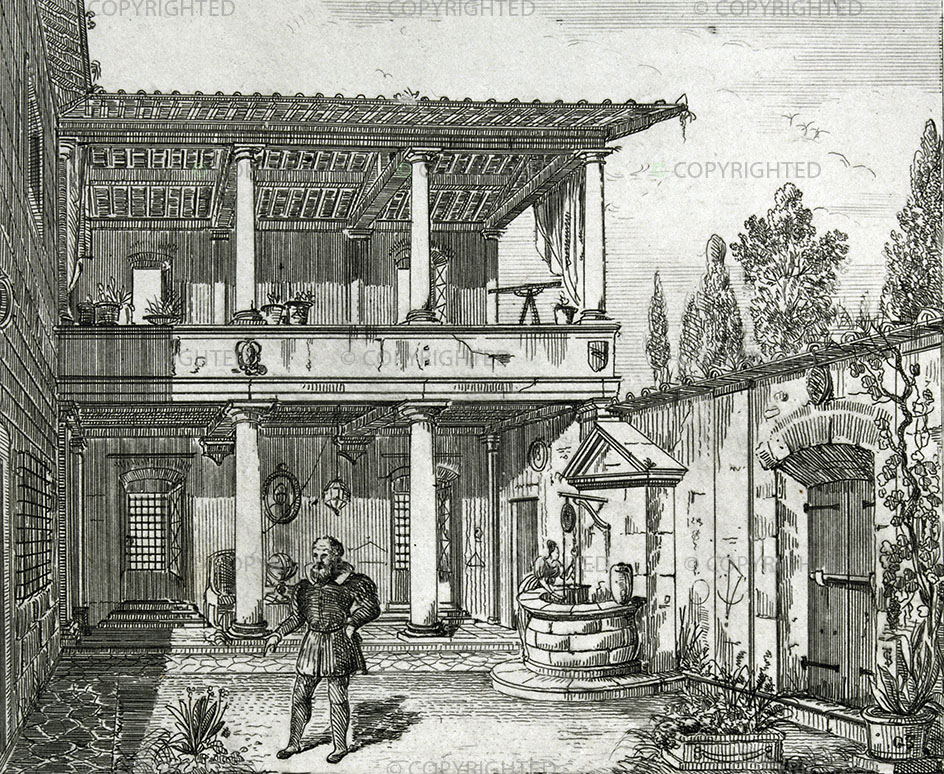
He was never imprisoned in the way the word suggests today. His initial sentence of indefinite confinement was commuted almost immediately: a few days at the Villa Medici in Rome, several months as a guest of the Archbishop of Siena, and then, from December 1633, permission to return home — to his own villa, Il Gioiello, on the hillside of Arcetri, just outside Florence.
“House arrest” in seventeenth-century Tuscany was not confinement to four walls. Galileo could walk his own grounds, receive some visitors with permission, and even leave occasionally to visit his daughter, a Poor Clare nun at the nearby convent of San Matteo. But he was barred from entering Florence itself, forbidden from discussing his condemned theories, and denied permission to publish new work in Catholic territory. The man who had spent his life looking outward, at the largest questions the universe could offer, was confined to a small radius of hillside for the rest of his days.
Working in the Dark
What Galileo did with those constrained years is, in some ways, more remarkable than the trial itself. Rather than retreat into silence, he turned to a different branch of science altogether — one the Church had shown no interest in policing. At Arcetri he wrote Two New Sciences, a foundational work on the physics of motion and the strength of materials, decades ahead of its time. Because he could not publish it in Italy, the manuscript had to be smuggled out of the country and printed in the Netherlands in 1638.
By then Galileo had gone completely blind, likely the cumulative damage of years spent staring at the sun through primitive telescope lenses, worsened by cataracts and glaucoma. He dictated his final ideas to two young assistants who came to study with him at the villa, Vincenzo Viviani and Evangelista Torricelli — both of whom would go on to become major scientists in their own right, carrying his methods forward into the next generation.
A Death Without a City
Galileo died at Il Gioiello on 8 January 1642, still formally condemned, still forbidden the full honours Florence wanted to give him. The Grand Duke’s plan for an elaborate public monument in Santa Croce had to be quietly abandoned under pressure from Rome; Galileo was buried instead in a modest side chapel, his remains only moved to a grand tomb in the main body of the basilica nearly a century later, in 1737 — by which point the controversy that had confined him had, at last, faded enough for Florence to honour him openly.
Visiting Arcetri Today
Villa Il Gioiello still stands on Via del Pian dei Giullari, privately owned but occasionally open for guided visits by appointment, in the same quiet hills where Galileo spent his final years staring at a city he could see but not enter. It is a short, striking detour from the more central stops of Florence’s scientific heritage — a reminder that the story of the man who reshaped how humanity understood the sky is inseparable from the story of how thoroughly, and how personally, that same understanding once put him at risk.