
Tragedy, Art, and the Moment the World Came to Help
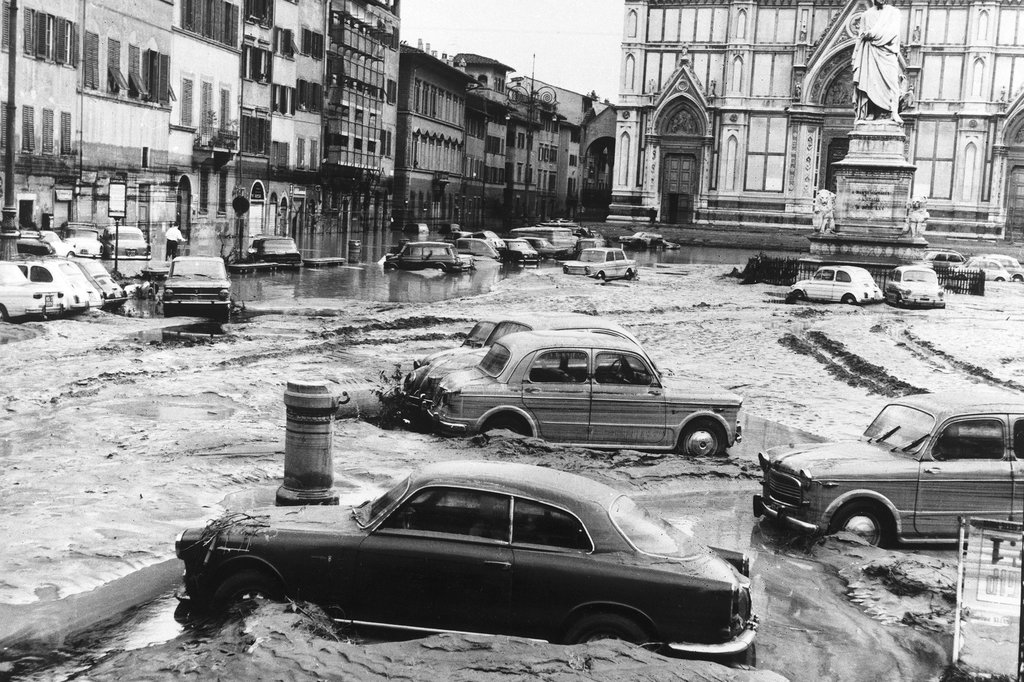
On the morning of November 4, 1966, Florence awoke to a silence heavy with dread. Overnight, relentless rain had caused the Arno River to burst its banks, sending a wall of water, mud, oil, and debris rushing through the historic center. Within hours, masterpieces, churches, libraries, and homes were submerged beneath meters of floodwater. What followed was not only one of the greatest cultural disasters of the 20th century, but also a defining moment in Florence’s relationship with the world — a tragedy that reshaped tourism, restoration, and global cultural responsibility.
Santa Croce Under Water
Among the hardest-hit sites was Santa Croce, Florence’s monumental Franciscan basilica and symbolic heart of the city. The floodwaters reached over five meters inside the church, damaging frescoes, sculptures, and priceless works of art. Cimabue’s crucifix — one of the most revered images of early Italian painting — was devastated, losing nearly 60% of its painted surface. Tombs of Florence’s great minds, ancient manuscripts, and stone pavements were all left coated in thick, toxic mud. Santa Croce became the visual emblem of the catastrophe: a place where Florence’s past appeared on the brink of disappearance.
The Day Tourism Stopped — and Then Changed Forever
In the immediate aftermath, Florence’s tourism industry collapsed. Hotels closed, museums shut their doors, and visitors vanished. The city, usually animated by art lovers and scholars, fell silent. Yet something unprecedented happened. News images of flooded churches and damaged masterpieces traveled across the globe. Florence was no longer just a destination — it became a cause. What emerged was a new form of cultural tourism: not consumption, but participation.
The Birth of the “Mud Angels”
Thousands of young volunteers arrived from all over the world to help salvage books, paintings, and sculptures. They became known as the “Mud Angels” — students, artists, and ordinary citizens who worked side by side with Florentines, often without training, driven only by urgency and love for art. For the first time, restoration was no longer an invisible scholarly activity. It became an international mission, observed, documented, and emotionally shared. Florence transformed into a living workshop of conservation. This moment marked the beginning of modern art restoration practices, prompting the creation of new laboratories, methods, and international collaborations that still shape conservation today.
Richard Burton, Zeffirelli, and Florence’s Emotional Stage
Among those drawn to Florence in those dramatic days was Richard Burton, accompanied by Franco Zeffirelli, the Florentine director whose love for his city was as intense as his theatrical vision. Burton, already a global icon, was deeply moved by the devastation. His presence in Florence during this period was not that of a distant celebrity, but of a witness — someone who understood the city not only as a backdrop for beauty, but as a living organism wounded yet resilient. Zeffirelli, who would later stage operas and films infused with Florentine grandeur, experienced the flood as a personal loss. Together, the two embodied the emotional connection between Florence and the international artistic community — a reminder that the city’s cultural heritage belonged not only to Italy, but to the world. Their presence symbolized a broader truth: Florence was no longer alone.
Restoration as Renaissance
In the years following the flood, Florence became the epicenter of a new Renaissance of restoration. Techniques developed in response to the disaster revolutionized conservation science, from fresco consolidation to manuscript recovery. Institutions such as the Opificio delle Pietre Dure gained global prominence, while Santa Croce itself became a case study in resilience. Each restored artwork carried scars — reminders of what had been lost and saved. Tourism gradually returned, but it had changed. Visitors no longer came only to admire perfection; they came to understand fragility, effort, and survival.
A Turning Point for Cultural Tourism
The flood of 1966 reshaped how Florence is experienced. It introduced the idea that heritage requires care, funding, and global awareness. Donations, foundations, and international partnerships became integral to the city’s preservation. For travelers today, especially those exploring Florence on a private guided experience, the story of the flood adds depth to every visit. Santa Croce is no longer just a monument; it is a survivor. Its stones, artworks, and silence speak of loss — and extraordinary recovery.
Why This Story Still Matters
Nearly sixty years later, the memory of the flood remains vivid in Florence’s collective consciousness. It is a reminder that beauty is not eternal unless protected, and that art can unite people across borders in moments of crisis. Standing in Piazza Santa Croce today, it is difficult to imagine the water, the mud, the devastation. Yet beneath the surface lies a powerful truth: Florence’s greatest strength is not only what it created, but how the world rallied to save it. The flood of 1966 transformed Florence from a city admired into a city defended — and in doing so, it changed the meaning of cultural tourism forever.