
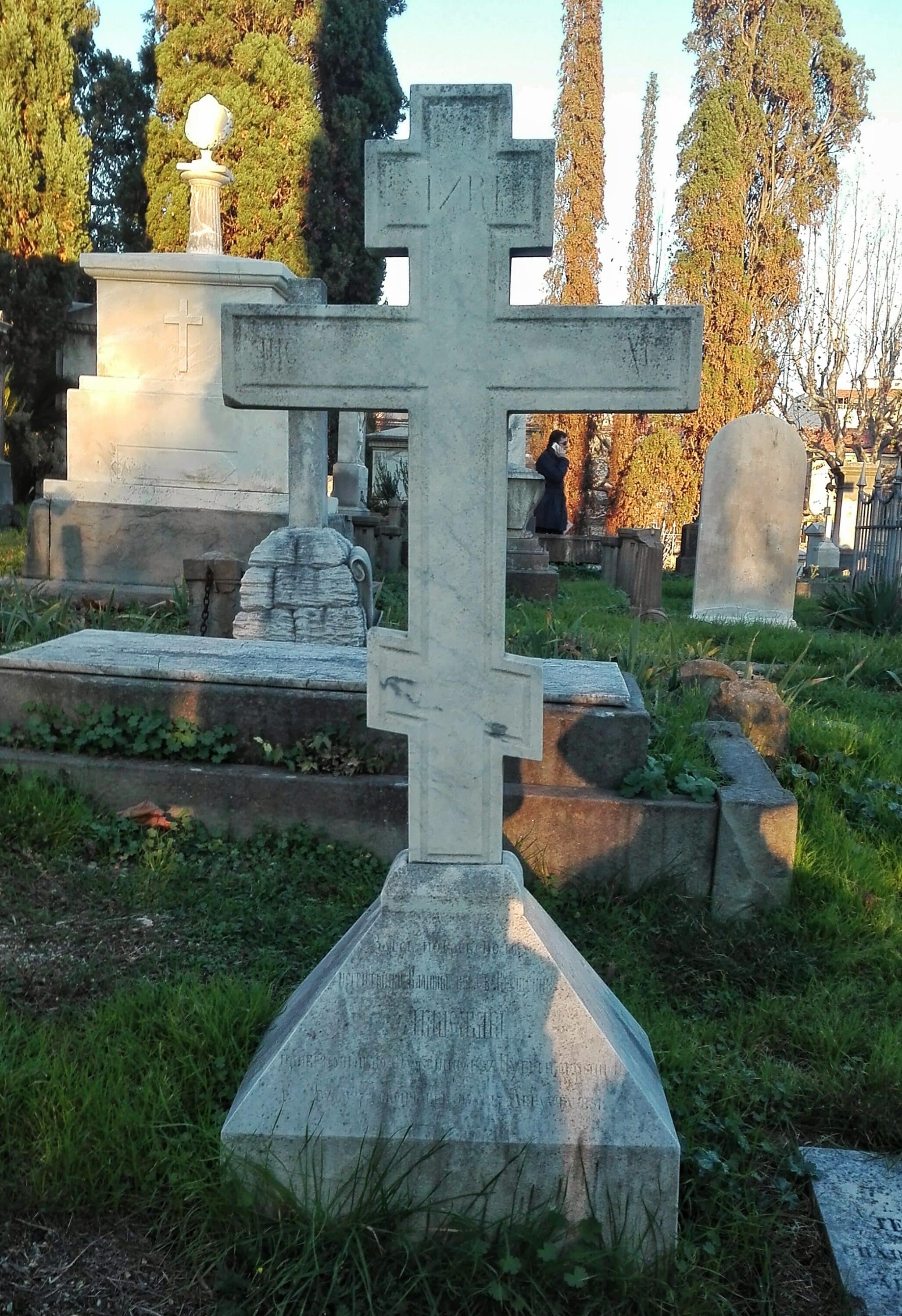
Among the thousand-plus graves crowded into Florence’s English Cemetery — poets, sculptors, exiled noblemen, abolitionist preachers — one small tomb stands apart for a reason visitors rarely notice at first: it is the only one in the entire cemetery marked with an Orthodox cross. Every other grave here carries a plain Latin cross, a rule strictly enforced by the Swiss Reformed Evangelical Church that administered the site. This single exception was made for a girl named Nadezhda, and her story is one of the most quietly extraordinary buried within these walls.
Taken from Nubia
Her life began far from Florence, and far from freedom. Sometime around 1827 or 1828, a girl of about fourteen — her birth name recorded only as Kalima — was enslaved in Nubia, the region along the Nile stretching through what is today southern Egypt and northern Sudan. She was brought north as part of the famous expedition led by the French scholar Jean-François Champollion, the man who had deciphered the Rosetta Stone, and his Italian collaborator Ippolito Rosellini, whose joint Franco-Tuscan mission to Egypt and Nubia was funded by the Grand Duke of Tuscany himself.
Expeditions of this kind, celebrated today for their contributions to Egyptology, moved through a world where slavery was still an unremarkable fact of daily life along much of the Nile. Kalima was one of the human beings caught up in that reality — brought along not as a member of the expedition, but as property.
A Ransom and a New Name
What happened next is what makes her story unusual enough to have survived at all. An uncle of Ippolito Rosellini, moved by her situation, purchased her freedom. She arrived in Florence no longer enslaved, and was baptised into the Russian Orthodox faith — the community into which she had, by whatever mixture of circumstance and choice, been welcomed. Her new name, Nadezhda, is Russian for “Hope.”
It is worth sitting with how deliberate that choice of name feels, whether it was chosen by her or given to her. A girl who had been carried a thousand miles from home as property was, on her baptism, renamed for the one thing that had apparently carried her through it.
Nadezhda lived out the rest of her short life in Florence as a free woman, absorbed into the city’s small but genuine Russian Orthodox community — the same expatriate world that would later produce grand plans for an Orthodox church elsewhere in the city. She died in her thirties, and was buried, with evident care and respect, in the English Cemetery: the multinational, multi-denominational burial ground the city’s foreign residents had built for themselves outside the old medieval walls.
The Only Cross of Its Kind
The Swiss Reformed Evangelical Church, which owned and administered the cemetery, maintained a strict visual uniformity across the site: Latin crosses only, regardless of the denomination of the person beneath them. Nadezhda’s tomb is the sole documented exception. Her gravestone bears an Orthodox cross, and, according to the cemetery’s own historical records, an inscription in Cyrillic — a small but unmistakable act of accommodation, allowing her true identity and faith to be marked in stone even within a cemetery built around imposed conformity.
It is a detail easy to miss and impossible to forget once pointed out. In a cemetery otherwise organised around a single visual language of mourning, one grave was allowed to speak differently — for a woman whose entire life had been defined by movement between worlds that did not naturally overlap: enslaved and free, Nubian and Florentine, a girl taken from home and a woman who, in the end, was given one.
A Life Among Very Different Neighbours
Nadezhda’s neighbours in death form an unlikely gathering. Buried within a short walk of her tomb are some of the era’s most outspoken opponents of slavery: the American Unitarian minister and abolitionist Theodore Parker, who died in Florence in 1860 having spent decades campaigning against slavery in the United States, and the historian Richard Hildreth, another committed American abolitionist who ended his life here as well. Elizabeth Barrett Browning, whose own tomb carries a carved broken shackle among its symbolic details, lies not far away. Frederick Douglass, the formerly enslaved American who became one of the most powerful abolitionist voices of the nineteenth century, is recorded as having visited these graves in person during his time in Italy.
Whether any of these figures ever knew Nadezhda’s story, or stood before her Orthodox cross and understood what it represented, is not something the historical record can confirm. But the proximity itself tells its own story: a cemetery built for foreigners who had made Florence their home unintentionally became a place where the global reality of nineteenth-century slavery — its victims, its survivors, and its fiercest opponents — ended up sharing the same quiet ground.
Visiting Her Grave Today
Nadezhda’s tomb is modest compared to the grand sculptural monuments nearby, easy to overlook without knowing what to look for. But once located, the small Orthodox cross rising among a sea of Latin ones becomes one of the most affecting details in the entire cemetery — a single, permitted exception standing in for an entire life that refused to fit neatly into the categories the world tried to place around it. Few places in Florence compress so much history, dignity, and quiet defiance into so small a space.