
A Hidden Renaissance Jewel in the Oltrarno
Just steps from the bustle of the Ponte Vecchio, on the quieter southern bank of the Arno, Florence reveals one of its most intimate and profound artistic experiences. Inside the ancient church of Santa Felicita, tucked away in the heart of the Oltrarno, lies the Barbadori–Capponi Chapel — a space where architecture, painting, and patronage converge to tell a story of artistic daring and spiritual intensity. Often missed by first-time visitors, this chapel rewards those who venture beyond Florence’s monumental icons. It is a place of silence and emotion, best discovered with time, context, and a discerning eye.
An Early Renaissance Vision by Brunelleschi
The origins of the chapel date to the early 15th century, when Florence was redefining the very language of art and architecture. Commissioned by the Barbadori family, the chapel was designed by Filippo Brunelleschi, the revolutionary architect who would soon change the skyline of Florence forever. Built between 1419 and 1423, the Barbadori Chapel represents one of Brunelleschi’s earliest architectural experiments. Its harmony of proportions, clarity of space, and restrained elegance anticipate the principles that would later culminate in his greatest achievement — the dome of Santa Maria del Fiore. For visitors today, the chapel offers a rare opportunity to encounter Brunelleschi not in monumental scale, but in an intimate, almost private setting, where architectural innovation unfolds quietly and with extraordinary refinement.
From Noble Patronage to Artistic Revolution
In the early 16th century, the chapel passed into the hands of the Capponi family, one of Florence’s most influential lineages. It was under their patronage that the space would become a turning point in the history of Florentine art. In 1525, Lodovico di Gino Capponi entrusted the decoration of the chapel to Jacopo Pontormo, a restless and visionary painter at the forefront of a new artistic sensibility. What Pontormo created here would challenge the ideals of balance and rationality that had defined the High Renaissance.
Pontormo’s “Deposition”: Emotion Without Gravity
At the heart of the chapel stands Pontormo’s celebrated Deposition from the Cross, one of the most powerful and enigmatic paintings of the 16th century. Gone is the stable geometry of traditional Renaissance compositions. In its place, Pontormo presents a suspended world where figures seem to float rather than stand, their bodies entwined in a slow, emotional spiral. The palette — luminous pinks, icy blues, and soft greens — heightens the sense of unreality, drawing the viewer into a space of pure feeling rather than physical logic. The absence of the cross itself is striking. Instead of focusing on the act of crucifixion, Pontormo invites us into a moment of shared grief, vulnerability, and transcendence. It is a work that speaks quietly, yet leaves a lasting impression.
Frescoes, Light, and Sacred Intimacy
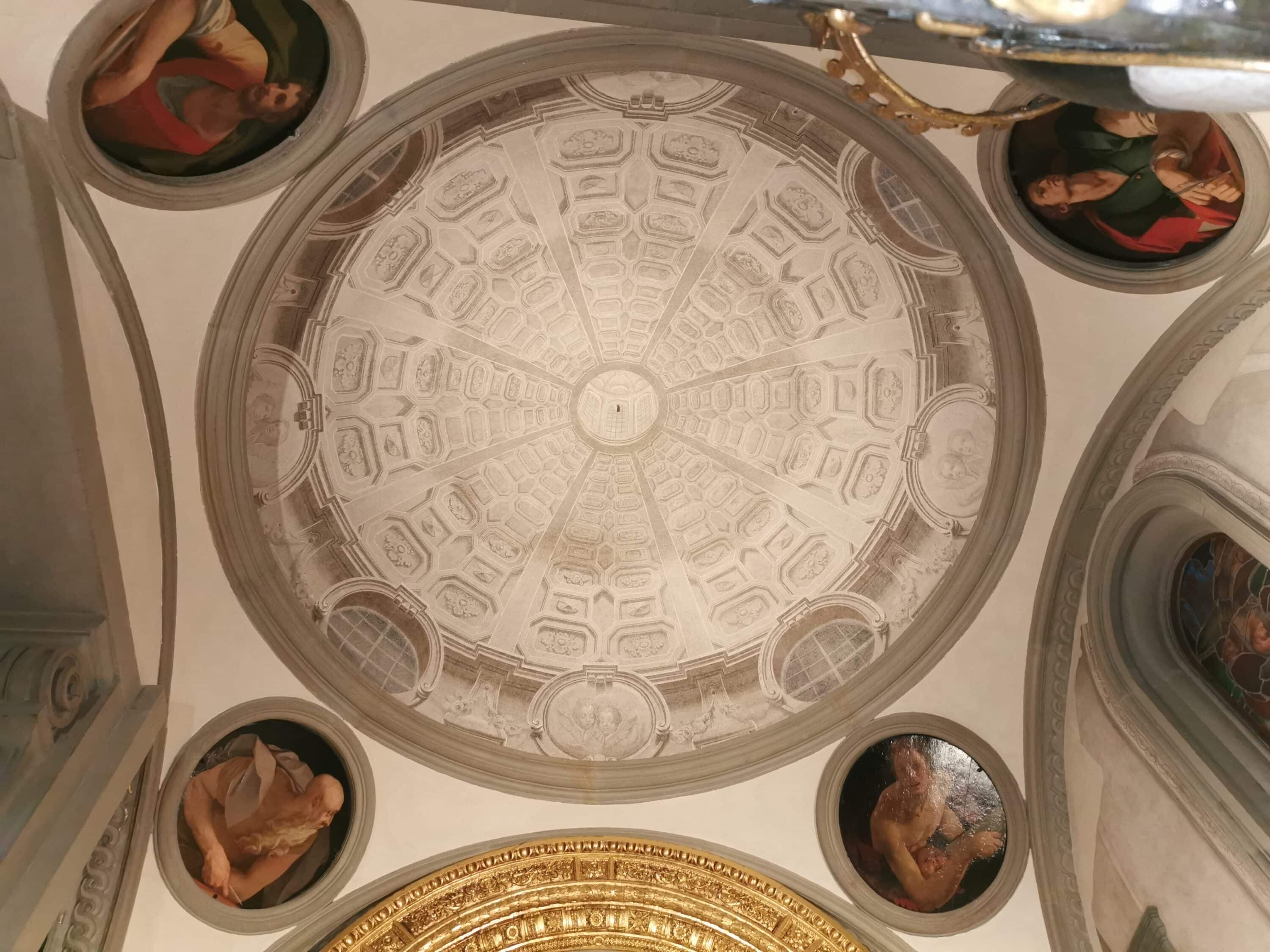
The emotional power of the altarpiece is echoed in the chapel’s frescoes. On the side walls, the Annunciation unfolds with unusual psychological tension: the Virgin and the Archangel Gabriel appear introspective, almost withdrawn, as if absorbed in an inner dialogue. Originally, these figures flanked a stained-glass window depicting the Journey to the Sepulchre, allowing natural light to interact with painted surfaces — a sophisticated interplay between architecture and painting that enhances the chapel’s contemplative atmosphere. Above, in the pendentives, the Four Evangelists watch over the space, executed with the assistance of a young Agnolo Bronzino, Pontormo’s most famous pupil. Their presence subtly bridges generations of Florentine art.
A Lost Dome and a Living Legacy
According to Giorgio Vasari, Pontormo once frescoed the chapel’s dome — a work now lost to time. Yet even in its absence, the Barbadori–Capponi Chapel remains a complete artistic statement. It tells a story of transition: from Early Renaissance harmony to Mannerist experimentation; from architectural clarity to emotional intensity. It is also a testament to Florence’s culture of enlightened patronage, where noble families used art to express devotion, prestige, and intellectual ambition.
Why the Chapel Matters Today
Carefully restored and preserved, the Barbadori–Capponi Chapel continues to captivate scholars, artists, and discerning travelers alike. It is not a space for crowds or hurried visits, but for those who seek depth — a place where Florence reveals one of its most personal artistic voices. For guests exploring the Oltrarno on a private guided tour, this chapel often becomes a highlight: a quiet revelation that encapsulates the soul of the neighborhood itself — refined, authentic, and profoundly human. In a city overflowing with masterpieces, the Barbadori–Capponi Chapel reminds us that some of Florence’s greatest treasures are not meant to impress at first glance, but to be discovered slowly, in silence, and with wonder.