
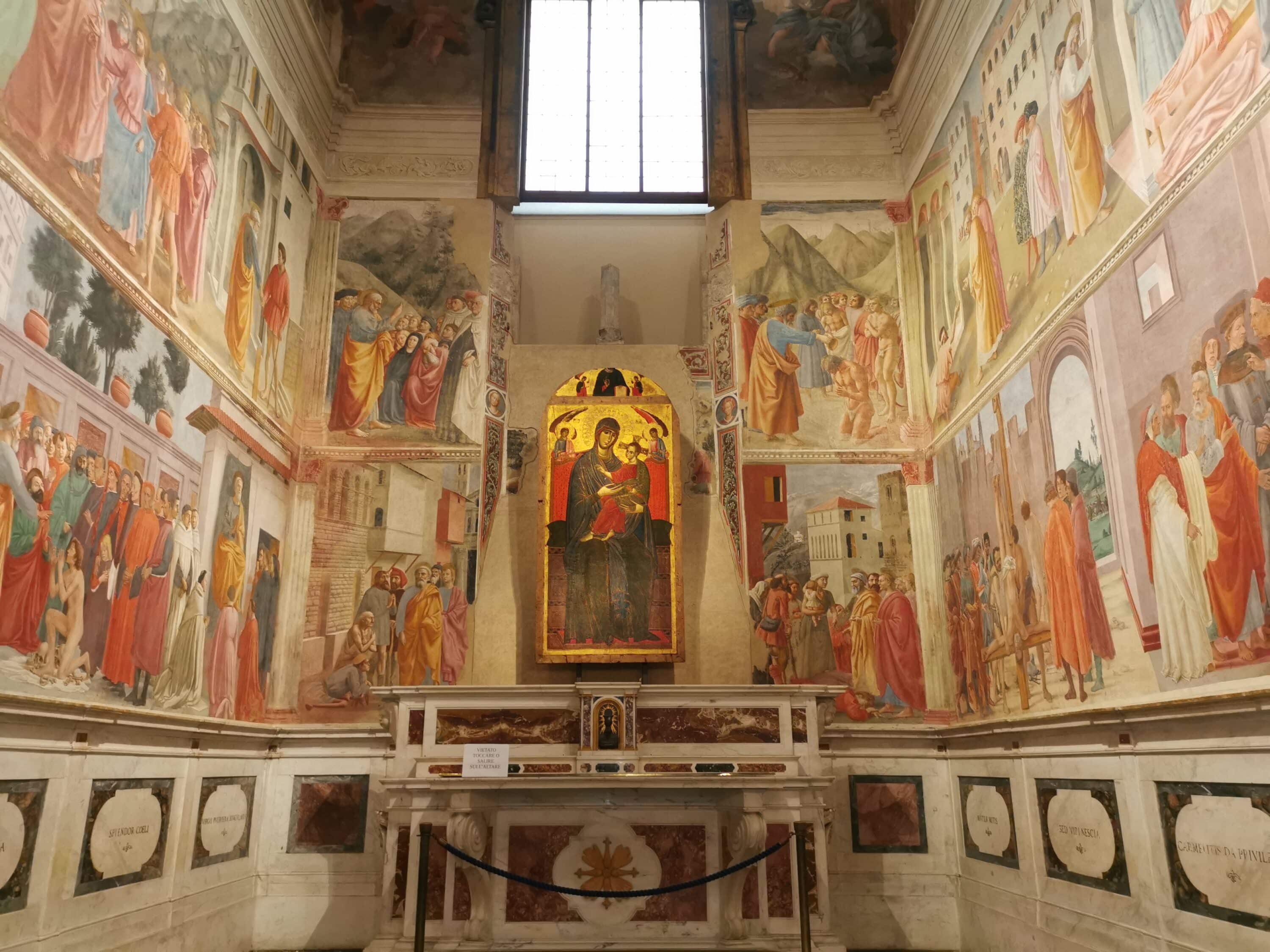
Florence’s “Sistine of the Early Renaissance”
In the heart of Florence’s Santa Maria del Carmine, behind the serene façade of a modest church, lies one of the city’s most transformative artistic spaces: the Brancacci Chapel. Often called the “Sistine of the Early Renaissance,” this intimate sanctuary houses a cycle of frescoes that would define the future of Florentine painting and inspire generations of artists from Michelangelo to Masaccio. Visiting the chapel is like stepping into a living laboratory of Renaissance art, where human emotion, narrative drama, and revolutionary technique converge in breathtaking harmony.
The Brancacci Family: Patrons of Vision
The story of the chapel begins with the Brancacci family, wealthy merchants who commissioned the space in the early 15th century. Their intent was both devotional and commemorative: a private chapel to honor their family, a place for prayer, and a canvas for cutting-edge artistic experimentation. It is remarkable that, even in the 1420s, the Brancacci family recognized the transformative power of art. By inviting Masaccio and Masolino, they ensured that the chapel would not merely decorate walls but tell a story — both sacred and human — with unprecedented realism.
Masaccio and the Dawn of Renaissance Painting
The Brancacci Chapel is primarily celebrated for the work of Masaccio, whose frescoes represent a radical departure from medieval conventions. Masaccio introduced linear perspective, volumetric figures, and naturalistic light into religious narrative for the first time. In the Expulsion of Adam and Eve from Eden, he conveys raw human emotion — shame, despair, and vulnerability — with a clarity that had never been seen on a wall. Eve’s hands cover her face, Adam turns in anguish: the figures are monumental, yet intimately human, their grief palpable across centuries. Masaccio’s innovations set the standard for realism in Florence, influencing artists from Filippino Lippi to Michelangelo, who would later study the frescoes obsessively. The chapel, in this sense, became both classroom and cathedral of the new Renaissance style.
Masolino and the Art of Graceful Elegance
Working alongside Masaccio was Masolino, whose approach was softer, more elegant, and grounded in Gothic traditions. His figures exude grace and serenity, balancing Masaccio’s dramatic intensity. The dialogue between the two artists — one revolutionary, one transitional — produces a rich tension that makes the chapel extraordinary. It is a visual conversation across styles: Masaccio’s realism confronts Masolino’s ethereal elegance, creating a space that is both innovative and harmonious.
A Tale of Light, Shadow, and Human Drama
Among the chapel’s most celebrated works is The Tribute Money, a fresco that demonstrates Masaccio’s mastery of perspective and narrative clarity. The scene unfolds in three moments across a single landscape, guiding the viewer’s eye with architectural precision. Figures interact naturally, shadows fall realistically, and the story becomes immediate, almost cinematic. This treatment of space and human form was revolutionary. Patrons, clergy, and fellow artists alike recognized the brilliance of Masaccio’s approach, which elevated the chapel from private devotion to artistic milestone.
Restoration and Rediscovery
Over centuries, the Brancacci Chapel suffered damage from humidity, neglect, and general wear. Yet its restoration in the 20th century revealed the brilliance of the frescoes in full clarity. Today, the chapel stands as a testament not only to Masaccio and Masolino’s genius but also to Florence’s commitment to preserving its artistic heritage. For visitors, the chapel is more than a collection of frescoes. It is a time capsule of the early Renaissance, offering insight into technique, patronage, and the philosophical shift that placed humanity at the center of art and faith.
Influence Across Centuries
The Brancacci Chapel’s impact cannot be overstated. Its lessons in perspective, anatomy, and narrative structure informed the work of countless artists: Filippino Lippi incorporated Masaccio’s volumetric realism into his own frescoes. Michelangelo, then a teenager, studied the chapel obsessively, drawing inspiration for both the Sistine Chapel and the Laurentian Library. Later, the chapel served as a model for countless Florentine fresco cycles, cementing its place in art history as a touchstone of Renaissance innovation. It is rare to encounter a single site that so completely redefines an era. The Brancacci Chapel is such a place.
Experiencing the Chapel Today
For visitors exploring Florence on a private guided tour of the Oltrarno, the Brancacci Chapel offers an unparalleled combination of intimacy and grandeur. Its relatively small scale invites reflection, while its monumental art engages the imagination. Walking through the chapel, one can sense the dialogue between past and present: the Brancacci family’s ambitions, Masaccio’s daring brush, and the countless artists who followed in his footsteps. It is a living narrative, where every shadow, every gesture, and every compositional choice tells a story.
Why the Brancacci Chapel Matters
In a city overflowing with masterpieces, the Brancacci Chapel remains uniquely influential. It is not merely a museum piece; it is a revolution in paint, a private chapel that became public inspiration. To stand within its walls is to witness the birth of Renaissance painting — to see the moment when art became not only a reflection of faith but also a reflection of humanity itself. For those willing to explore Florence beyond the obvious, the Brancacci Chapel is an essential discovery: a space where devotion, genius, and narrative mastery converge in a timeless dance of color, light, and human emotion.