
In January 1504, with Michelangelo’s David nearing completion, the city of Florence faced an unusual problem: what to do with a seventeen-foot marble giant that had grown too magnificent, and too important, to hide where it had originally been intended.
A Statue Meant for a Rooftop
The block of marble David was carved from had a long, difficult history before Michelangelo ever touched it. Quarried decades earlier, it had already been abandoned by two other sculptors who judged it too flawed and too narrow to work with. When Michelangelo took on the commission in 1501, the plan was modest in ambition if not in scale: the finished statue, along with a series of other prophets, was meant to stand along the roofline of Florence’s cathedral, viewed from the street far below.
Michelangelo carved accordingly. David’s head and hands are famously oversized relative to the rest of his body — not a miscalculation, but a deliberate adjustment for a viewer who would be looking sharply upward from ground level, where foreshortening would have corrected the proportions. But by the time the statue neared completion, it had become obvious to everyone in Florence that this was not going up onto a rooftop. It was too extraordinary to be seen only from a distance, and too heavy — nearly six tonnes — to safely hoist that high in the first place.
Thirty Florentines, Nine Possible Homes
So, on 25 January 1504, the city convened a committee: roughly thirty of Florence’s most prominent artists and citizens, gathered to decide where David should actually go. The guest list reads like a roll call of the Renaissance. Sandro Botticelli was there. So was Filippino Lippi, Piero di Cosimo, Giuliano da Sangallo, Andrea della Robbia — and Leonardo da Vinci, at the time arguably the most famous living artist in the city, and no admirer of the much younger sculptor whose reputation was about to eclipse his own.
Nine locations were floated, from the cathedral square to the courtyard of the Palazzo della Signoria. But the debate quickly narrowed to two real contenders, and the split between them was not really about aesthetics. It was about what kind of statue David was going to be allowed to become.
Leonardo’s Objection
Leonardo, together with Giuliano da Sangallo, argued for the cautious option: install David under the covered arches of the Loggia dei Lanzi, sheltered from the weather, set back into the shade against the wall. Their stated reason was technical — the marble had known imperfections, and an exposed outdoor position risked long-term damage. It was a reasonable argument from two men who understood stone.
But it was also, whether intended or not, a proposal that would have kept David as a beautiful object rather than a public statement: admired, protected, and tucked half out of sight beneath a portico, one more fine sculpture among the loggia’s collection rather than a landmark in its own right. Given the long, well-documented friction between Leonardo and Michelangelo — two men temperamentally opposed, competing for the same patrons and the same commissions in the same small city — it is difficult not to read at least some rivalry into the suggestion.
A Republic’s Herald Disagrees
The opposing camp wanted David out in the open, at the entrance to the Palazzo della Signoria itself — the seat of Florence’s civic government, the most politically charged square in the city. Among those pushing for this option was the city’s own herald, whose argument was less about the marble’s condition and more about what David was supposed to mean.
Florence in 1504 was a republic surrounded by more powerful, more autocratic neighbours, and increasingly nervous about the Medici family waiting in the wings to reclaim power. David — the underdog shepherd who defeated an armoured giant through faith and courage rather than brute force — was too perfect a symbol of defiant, embattled liberty to hide in a loggia. Tensions over the decision reportedly ran high enough that guards had to be posted to protect the statue at night while the argument continued.
Where Politics Won
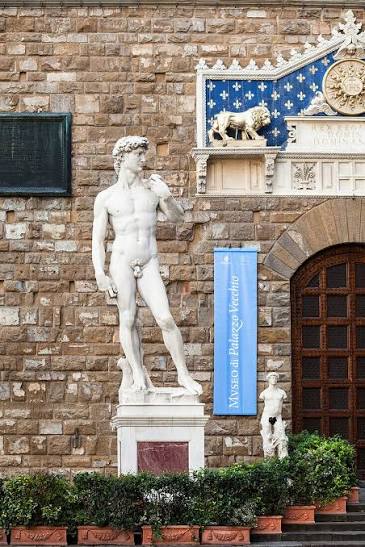
In the end, the herald’s camp prevailed. On 8 September 1504, David was unveiled at the entrance to the Palazzo della Signoria, replacing a bronze Judith and Holofernes by Donatello — another statue of underdog triumph, on the same spot. The move transformed the meaning of the work overnight: what had been conceived as a religious commission for a cathedral rooftop became, instead, the single most visible political statement in Florence, standing guard over the doorway of government itself.
David remained there for nearly 370 years, weathering exactly the exposure Leonardo had warned against, before finally being moved indoors to the Accademia Gallery in 1873 for its own protection — proving, in the end, that both sides of that January meeting had been right about something.