
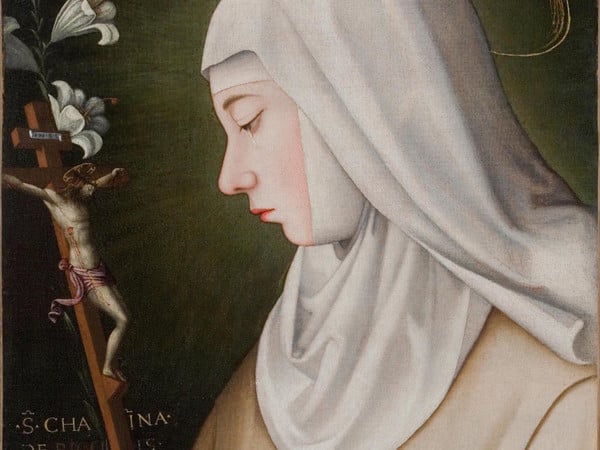
In 1538, a fourteen-year-old girl named Pulisena Margherita Nelli entered the Dominican convent of Santa Caterina da Siena in Florence, following her older sister into a life that had already been decided for her. Sending a daughter to a convent was, for many merchant families of the period, simply the cheaper of two options — marriage required a dowry; a religious vocation did not. What nobody could have predicted was that this arrangement, born of pure economics, would produce the first documented female painter in Florentine history.
From Illumination to an Entire Workshop
Inside the convent, the girl took the name Sister Plautilla. According to Giorgio Vasari — one of only four women he mentions at all in his Lives of the Artists — she began as a manuscript illuminator, likely taught by an older nun skilled in the craft, before moving on to panel and canvas painting. She had no access to the training male artists took for granted: no anatomy lessons, no life drawing from the male nude, none of the apprenticeship structures of a city guild. What she had instead was a substantial collection of drawings by the friar-painter Fra Bartolomeo, left to her convent after his death, which she studied and copied relentlessly to build the technical vocabulary no one would teach her directly.
What Nelli built from that starting point was extraordinary: not simply her own practice, but a functioning workshop of nuns working under her direction inside the convent walls. By the time she rose to become prioress — a role she held three separate times — Santa Caterina had become known across Florence as a genuine centre of artistic production, supplying paintings and polychrome sculpture to religious institutions and private patrons alike. Nearly a third of all documented women artists in Renaissance Italy were, like Nelli, Dominican nuns; Santa Caterina was where that pattern reached its fullest expression.
Thirteen Apostles, Painted Without Permission to Study a Single Male Body
Nelli’s most ambitious work remains her Last Supper, a canvas nearly seven metres wide, painted for the refectory where her sisters ate their meals together each day. The scale alone was audacious for any Renaissance woman to attempt — most refectory Last Suppers in Florence were done in fresco by established male workshops with formal training. Nelli worked in oil on canvas instead, populating the scene with thirteen life-size male figures rendered with striking anatomical attentiveness: visible tendons, veins traced across the hands, individually observed fingernails. She achieved this without ever being permitted to study the male anatomy directly, relying instead on close observation of existing artworks and, quite possibly, collaborative input from the wider network of artists she corresponded with.
The painting carries a distinctly domestic signature, too. Rather than an idealised biblical banquet, Nelli set her apostles’ table with food her own community actually ate: roasted lamb, bitter greens, fava beans — the convent’s own meals, on the convent’s own table, painted for the convent’s own dining hall. It is a quiet but unmistakable act of authorship: a nun asserting her own community’s daily reality into a scene normally rendered in generic biblical abstraction.
Rolled Up and Forgotten
Nelli’s reputation did not survive her own century intact. When Santa Caterina was suppressed under Napoleonic edict in the early 1800s, the Last Supper was transferred to the Basilica of Santa Maria Novella, where it remained on view for roughly a century. Then, in the early 1900s, it was taken down, removed from its stretcher, rolled up, and placed in storage — not lost outright, but effectively erased from public memory for decades. The 1966 flood that devastated Florence and damaged some fourteen thousand artworks swept past it in storage, adding water damage to years of accumulated neglect.
An American Foundation, and a Choir of Nuns Heard Again
Nelli’s rediscovery is itself a modern story worth telling. In 2009, the American philanthropist Jane Fortune founded a Florence-based non-profit, Advancing Women Artists, with a specific mission: locating and restoring artworks by women languishing forgotten in the city’s museums, churches, and storage depots. Nelli’s Last Supper became one of the organisation’s central projects, funded in part through a public “Adopt an Apostle” crowdfunding campaign that let ordinary donors sponsor the restoration of individual figures in the canvas.
The conservation effort, completed in 2019, removed centuries of grime, discoloured varnish, and a thick layer of dark overpainting that had further obscured the original work. When the restored canvas was unveiled at the Museum of Santa Maria Novella, Florence’s assistant mayor remarked that the city could finally hear Nelli’s voice again — though, as art historians studying the collaborative nature of convent painting have pointed out, it might be more accurate to say the city could finally hear the whole choir: Nelli and the community of nuns who worked alongside her, painting as they lived, together.
A Rare Presence in the Uffizi’s Own Story
Nelli’s growing recognition reached a significant milestone in 2017, when the Uffizi dedicated its first-ever monographic exhibition to a female artist — to Nelli herself. It was a striking acknowledgement from an institution built, room after room, around the male masters of the Renaissance: proof that the same walls capable of celebrating Michelangelo and Botticelli could also, four and a half centuries later, make room for the convent painter who had never been permitted to study a body she was nonetheless able to paint with startling conviction.
Visiting Her Work Today
Nelli’s restored Last Supper now hangs permanently in the Museum of Santa Maria Novella, while further works — including devotional panels and lunettes restored through the same ongoing conservation campaign — are on view in the Museum of San Marco, close to where her long-vanished convent once stood. Together they offer something increasingly rare in Florence’s crowded artistic landscape: not a single celebrated masterpiece, but a genuine body of work, recovered piece by piece, that lets a Renaissance workshop run