
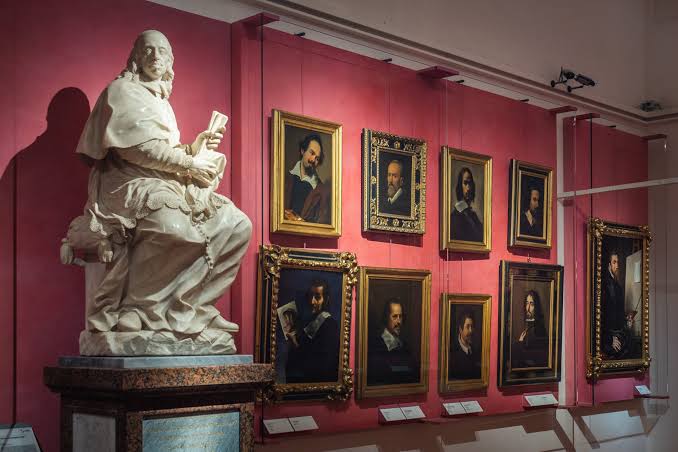
There is a particular kind of vertigo that comes from being looked at by hundreds of dead artists at once.
Walk the Vasari Corridor today and you walk through what was, for nearly four centuries, the most exclusive gallery in Europe — a private hallway lined not with commissioned masterpieces, but with something stranger and more intimate: the faces its owners chose to paint of themselves.
A Cardinal’s Obsession
The story begins not with Cosimo I, the corridor’s original architect of secrecy, but with his great-grandson, Cardinal Leopoldo de’ Medici. In the 1660s, a century after Vasari had raced to finish the passageway in five months for a royal wedding, Leopoldo turned his attention to a different kind of monument — one built not of stone, but of faces.
He began collecting self-portraits. Not portraits commissioned by the Medici of the Medici, as the family had done for generations, but portraits artists made of themselves, for themselves, then offered — or sold — to Florence’s most powerful patrons. It was an unusual thing to want. A self-portrait is not a flattering diplomatic tool or a record of lineage; it is an artist’s own account of how they wished to be remembered, unmediated by a patron’s demands. Leopoldo seems to have understood that this made the collection more valuable, not less.
Painting Your Way Into the Medici’s House
What followed was one of the more curious arrangements in art history. To have a self-portrait hanging in the Vasari Corridor was to be permanently present in the private route of the rulers of Florence — to occupy, quite literally, the wall space of power. Artists understood this. Many painted themselves not as tradesmen at an easel, but as they wished posterity to see them: composed, dignified, sometimes surrounded by the tools of their trade like a coat of arms.
The collection grew for centuries, well past the fall of the Medici themselves. Painters offered self-portraits almost as calling cards left in the house of history. The roster that eventually filled the corridor’s walls reads like an impossible dinner party: Filippo Lippi beside Rembrandt, Velázquez near Delacroix, later Chagall and Ensor added to a guest list that had begun with Renaissance masters and never quite stopped growing. At its height, the collection numbered in the hundreds — by some counts, well over a thousand works, more than the corridor’s walls could ever display at once.
A Private Hall of Mirrors
What makes the collection unsettling, in the best sense, is its intimacy. These are not the grand narrative paintings the Medici usually commissioned to assert dynastic power — battle scenes, allegories, saints. These are faces. Individual, specific, often unguarded. Walking the corridor once meant walking a gauntlet of eye contact with three centuries of artistic ego and anxiety, each painter making a private case for their own genius, hung a few meters from where princes once hurried unseen between their palace and their government.
There is something almost confessional about it. A self-portrait cannot hide behind commission or convention the way other paintings can. It is, by definition, the one subject the artist could never lie about — even when they tried.
What Remains
The corridor’s long restoration, completed in December 2024, changed the collection’s arrangement: many of the self-portraits once packed onto these walls have since found new homes among the Uffizi’s main galleries, freed from the corridor’s narrow, crowded hang. But the idea the collection embodies — that this elevated passage was never only a route for escaping danger, but also a stage for immortality — remains woven into every stone of it.
Walking the Vasari Corridor today, between the round windows that once let the Medici spy on the city below, visitors are still walking through a space built on two very different appetites for power: the political kind, exercised in stone and secrecy, and the quieter, more enduring kind — the wish, shared by painter after painter across four centuries, to be remembered.