
At the end of a tour built around telescopes, astrolabes, and the mathematics of the stars, Florence Unveiled’s science trail closes somewhere unexpected: a perfumery. It seems, at first, like a shift in subject — from astronomy to fragrance, from the Medici’s scientific academies to bottled scent. In fact, it is the same story, told through a different sense.
A Garden Behind the Cloister
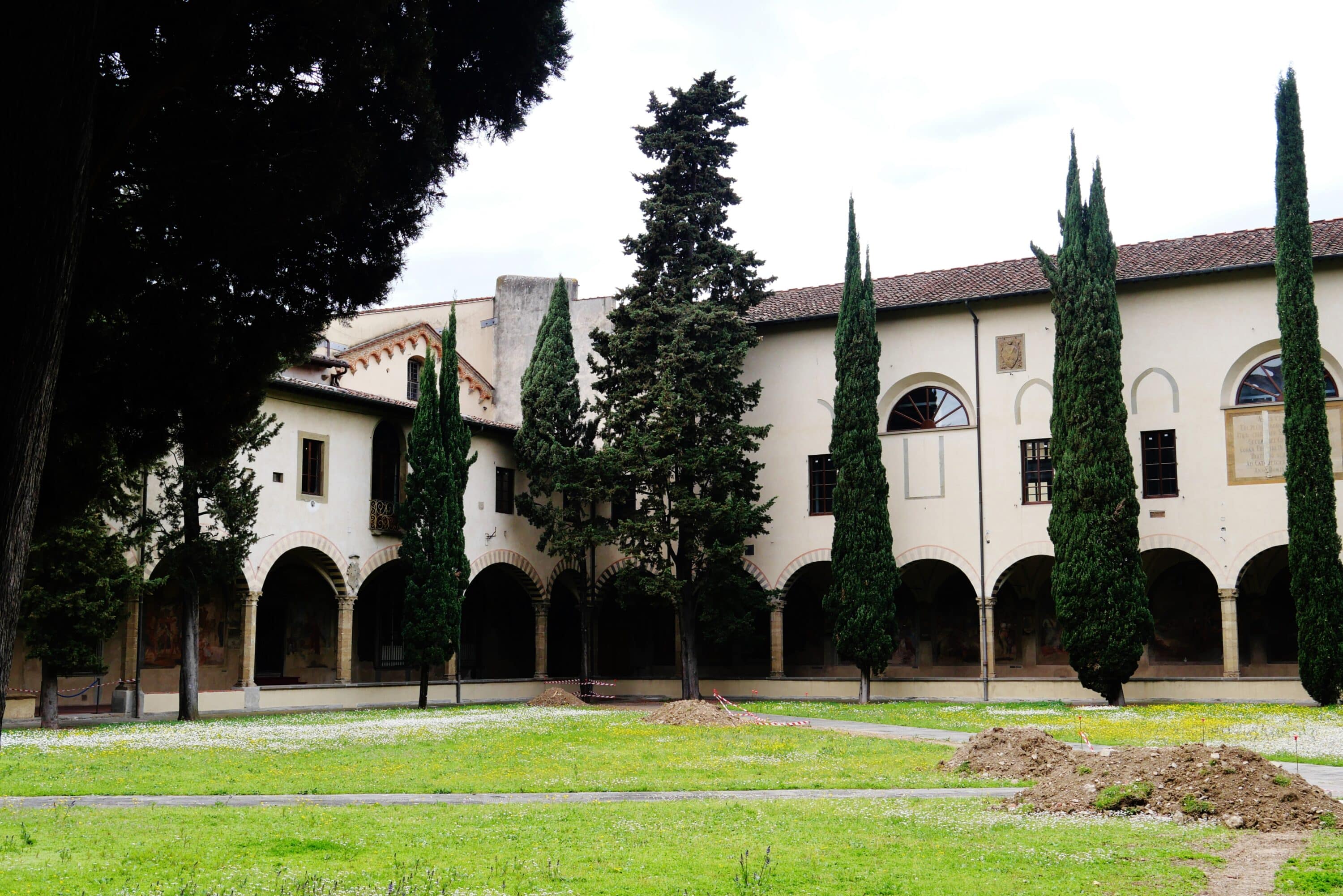
The story begins in 1221, when Dominican friars arrived in Florence and founded the convent of Santa Maria Novella. Like most religious communities of the period, they kept a garden of medicinal plants — what Florentines called the semplici, the “simples,” the raw botanical ingredients of pre-modern medicine. From that garden, the friars distilled herbs and flowers into essences, elixirs, ointments, and balms, first for their own infirmary, then for the wider community.
By 1381, records show the friars were already selling rose water as a disinfectant, used across the city during outbreaks of plague. This was not perfumery in the decorative sense. It was applied chemistry, built on centuries of accumulated observation about what worked, what didn’t, and why — the same experimental instinct, in miniature, that would eventually produce Galileo’s method and the Medici’s Accademia del Cimento three centuries later. Long before Florence became known for telescopes, it was quietly becoming known for distillation.
A Perfumer at the Court of France
The Officina’s most famous chapter begins in 1533, with a fourteen-year-old bride. Caterina de’ Medici was leaving Florence to marry Henry, Duke of Orléans — the future King Henry II of France — and among the retinue accompanying her was a young perfumer named Renato Bianco, raised and trained within the aromatic tradition of the Dominican friars. According to the Officina’s own long-preserved history, it was for this occasion that Bianco created a citrus-based fragrance meant to carry the elegance of Florence with the young queen into an unfamiliar court: the Acqua della Regina, the “Water of the Queen.”
What makes the fragrance historically significant is not only its royal origin story, but its formula. Acqua della Regina is widely credited as one of the first perfumes built on an alcohol base rather than the oil or vinegar bases that had dominated earlier fragrance-making — a genuine technical innovation, not just a romantic gift. Bianco went on to serve the French court as “René le Florentin,” carrying Florentine perfumery techniques into France and helping to seed the French perfume industry that would later become world-famous. The fragrance itself, remarkably, is still produced today, under the same name, nearly five centuries later.
From Convent Apothecary to Grand Ducal Institution
For its first three centuries, the Officina operated essentially as a closed monastic laboratory, serving the friars and the community around them. That changed in 1612, when the convent formally voted to open a public pharmacy, appointing a lay director, Simone Marchi, to run it alongside the friars. Grand Duke Cosimo II recognised the operation, and under his successor Ferdinando II, the Dominican pharmacist Fra’ Angiolo Marchissi — remembered as a serious scholar of both medicine and alchemy — was granted the title Fonderia di Sua Altezza Reale, Foundry of His Royal Highness. The line between medieval alchemy and Medici-sponsored science, so often treated as separate stories, runs directly through this one pharmacy.
It was another Dominican, Fra’ Cosimo Bucelli, working in the following century, who began deliberately pairing medicinal effectiveness with pleasing scent — a shift that pushed the Officina’s identity from strictly pharmaceutical toward something closer to what we would now call perfumery, without ever abandoning its scientific roots. The formulas themselves, preserved in the friars’ own manuscripts, form an unbroken written record stretching back centuries: recipes as historical documents, as legible today as any astronomical treatise from the same era.
Why This Belongs on a Science Trail
It is tempting to file this story under craft, tradition, or luxury retail, and move on to the telescopes. But that misses what made Renaissance Florence so distinctive in the first place: the porousness between disciplines that we now keep carefully separate. The friars distilling rose water against plague were doing empirical medicine. The alchemists mixing pigments for Botticelli’s workshop and the alchemists distilling scent for Caterina de’ Medici were drawing on the same body of chemical knowledge. Galileo’s insistence on testing, observing, and retesting — provando e riprovando, as the Medici’s own Accademia del Cimento would later put it — has a quieter cousin in centuries of friars adjusting formulas, generation after generation, based on what demonstrably worked on the human body.
Perfume, in this context, is not a detour from the science trail. It is one of its oldest branches — chemistry practiced in a mortar and pestle instead of an observatory, its results measured in scent and relief rather than in the motion of the stars, but built on exactly the same instinct: observe carefully, record precisely, and refine relentlessly.
Walking Into the Sala Vendita Today
The Officina’s historic sales room — once one of the convent’s chapels, later transformed into a soaring neo-Gothic hall for Grand Tour visitors — remains open on the same site the friars first cultivated eight centuries ago. Walking in today, past display cases of fragrances whose formulas have barely changed since the Medici era, visitors are not stepping outside the story of Florentine science. They are arriving at one of its oldest and most enduring laboratories, one that happens to smell extraordinary.