
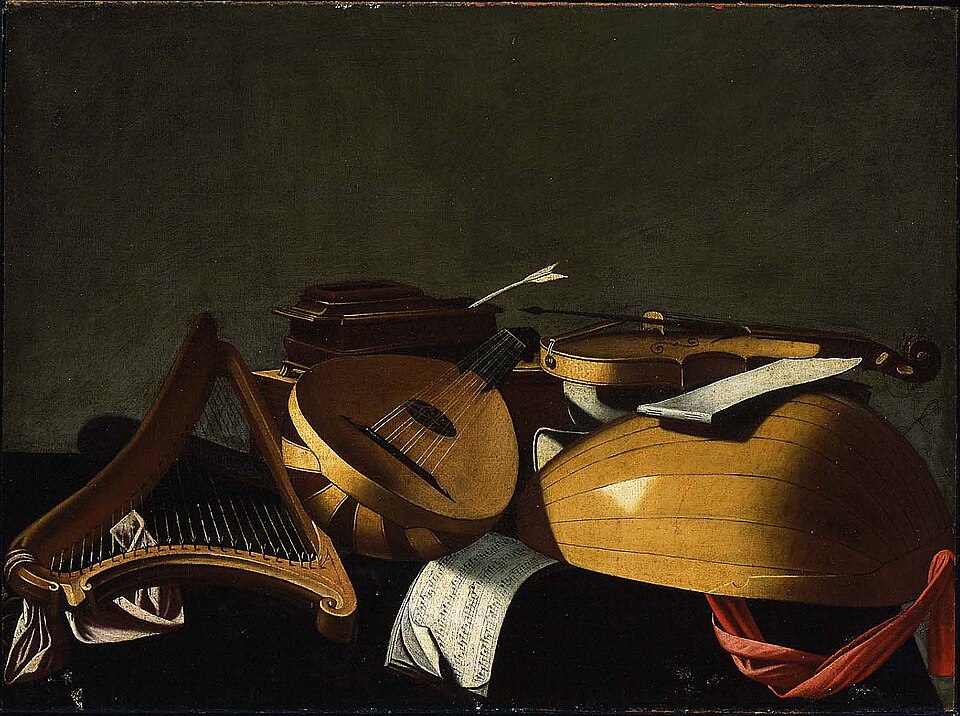
In 1700 a clerk in Palazzo Pitti was making an inventory of the musical instruments of the Grand Prince Ferdinando de’ Medici. Among the harpsichords, lutes and viols he wrote down a curious entry: an arpicimbalo, “newly invented” by the court instrument maker Bartolomeo Cristofori, which could play both soft and loud. It is the earliest written record of the piano.
Florence is rarely the first city we associate with music. Yet in the space of a century and a half it gave the world opera, the piano and the horseshoe-shaped theatre, and it was the first Italian stop for composers from Handel to Mozart. This is the story of how, from the Medici to the Lorraine, music became one of the city’s quiet powers.
Music as the Language of Power
For the Medici, music was never simply entertainment. It was a way of announcing to Europe who they were. Nothing shows this better than the wedding of Grand Duke Ferdinando I and Christine of Lorraine in 1589, celebrated with six spectacular intermedi, musical interludes performed between the acts of a comedy, La pellegrina. Bernardo Buontalenti designed the sets and costumes, and the performances took place in the Medici Theatre, which he had remodelled for the occasion at the Uffizi. Among the singers was a young Jacopo Peri, whose name we will meet again.
The Birth of Opera
Behind these spectacles stood a more intellectual current. In the last decades of the sixteenth century a group of humanists, poets and musicians gathered at the house of Count Giovanni de’ Bardi, in what became known as the Camerata de’ Bardi. Its members included Vincenzo Galilei, father of the astronomer, and the singer-composer Giulio Caccini. They were convinced that Greek tragedies had been sung in their entirety, and they dreamed of reviving that lost art in a modern form.
Peri and the poet Ottavio Rinuccini put the idea into practice with Dafne, performed in 1598 at the palace of the nobleman Jacopo Corsi, on Via Tornabuoni. Only fragments of its music survive. The decisive moment came on 6 October 1600, when Peri’s Euridice was staged in Palazzo Pitti to celebrate the wedding of Maria de’ Medici and Henry IV of France. Peri himself sang Orpheus, and Rinuccini gave the myth a happy ending, more suitable for a wedding. It is the oldest opera whose score has come down to us, and from Florence the new genre travelled to Venice, Rome and the rest of Europe. Florentine women took part too: in 1625 Francesca Caccini, Giulio’s daughter, composed La liberazione di Ruggiero, often considered the first opera by a woman.
A Harpsichord That Could Whisper
The second Florentine invention is quieter and more familiar. Bartolomeo Cristofori, born in Padua in 1655, was hired in 1688 by the Grand Prince Ferdinando, heir to Cosimo III and the most musical of the late Medici, to look after his collection of some seventy-five instruments. A harpsichord, whose strings are plucked, cannot vary its volume with the touch of the player. Cristofori found a way: a mechanism in which hammers strike the strings and then fall back, so that a gentle touch gives a soft sound and a strong one a loud sound.
The 1700 inventory records the invention, and in 1711 the writer Scipione Maffei described it in a journal, calling it a gravicembalo col piano e forte, a harpsichord “with soft and loud”: the name from which “pianoforte” was born. By 1711, according to Maffei, Cristofori had built three: the Medici had given one to Cardinal Ottoboni in Rome, and two had been sold in Florence. Three of his pianos survive today, dated 1720 (now in the Metropolitan Museum of Art in New York), 1722 (Rome) and 1726 (Leipzig). The Florentine court did not immediately grasp the importance of what it had, and the invention was slow to spread in Italy, but Queen Maria Barbara of Spain, a pupil of Domenico Scarlatti, bought several. Cristofori died in Florence in 1731, six years before the end of the Medici dynasty.
Ferdinando’s court was a magnet for musicians. Alessandro Scarlatti wrote operas for the theatre of his villa at Pratolino, and a young Handel, invited by the prince, staged his first Italian opera, Rodrigo, in Florence.
The Pergola: A Theatre That Changed Europe
A third legacy is made of wood and velvet. The Teatro della Pergola was built in 1656 by the architect Ferdinando Tacca for the Accademia degli Immobili, an association of nobles under the patronage of Cardinal Giovan Carlo de’ Medici. Its inaugural production was a comic opera by Jacopo Melani, Il potestà di Colognole. It is generally considered the first Italian-style theatre, with its horseshoe-shaped hall and tiers of private boxes, a model that would be copied across Europe. Opened to the paying public in 1718, it became in the nineteenth century a temple of melodrama: under the impresario Alessandro Lanari it hosted Bellini and Donizetti, and on 14 March 1847 it saw the world premiere of Verdi’s Macbeth. It was also among the first Italian theatres to stage the operas of Mozart.
The Lorraine and a Young Mozart
When Gian Gastone, the last Medici, died in 1737, the grand duchy passed to the House of Lorraine, and with it Florence acquired a more international musical life. The Grand Duke Pietro Leopoldo, who ruled from 1765, welcomed in March 1770 a fourteen-year-old guest. Wolfgang Amadeus Mozart and his father Leopold arrived in Florence on 30 March, coming from Bologna, where the young musician had been examined by Padre Martini.
The Mozarts were received at Palazzo Pitti on 1 April by a grand duke who remembered them from Vienna and asked after Wolfgang’s sister Nannerl. The next day Mozart played at the Villa di Poggio Imperiale, alongside the court violinist Pietro Nardini, whom the family had first met in Augsburg in 1763. And in Florence he found a friend: Thomas Linley, a young English violinist of exactly his age, who was studying with Nardini. Leopold praised Linley’s playing, and the English historian Charles Burney later bracketed the two boys as the most promising geniuses of their age. The Mozarts left Florence on 6 April. Linley, nicknamed the “English Mozart”, would die in a boating accident at twenty-two.
A City You Can Hear
Much of this history can still be seen, if you know where to look: the palace where Euridice was first heard, the gilded boxes of the Pergola, and the Museum of Musical Instruments in the Galleria dell’Accademia, which preserves Medici and Lorraine instruments, including a viola and a cello by Stradivari. We follow some of these threads in our guided tour, where music appears as what it always was in Florence: not just an art, but a way of thinking about the world.