
Rivalry, Innovation, and the Birth of a Genius
In Florence, even acts of devotion can become acts of competition. Hidden behind the city’s marble façades and gilded altars lies a quieter, more intimate story — one carved in wood, shaped by rivalry, and charged with youthful ambition. It is the story of Michelangelo’s wooden Crucifix, and of a silent contest with two towering masters of the Renaissance: Donatello and Filippo Brunelleschi. To encounter this work is to step into a moment when Florence was not only the cradle of genius, but also a crucible of artistic challenge.
A City That Measured Genius Through Rivalry
Florence in the 15th century was a city obsessed with excellence. Artists did not merely work alongside one another; they measured themselves against their peers, constantly pushing boundaries in pursuit of perfection. Sculpture, especially sacred sculpture, was a proving ground. Among the most demanding subjects was the Crucifix — a form that required not only technical mastery of anatomy, but profound theological sensitivity. To sculpt Christ’s body was to interpret suffering, divinity, and humanity all at once. By the time Michelangelo Buonarroti approached the theme, Florence had already seen two radically different interpretations by Donatello and Brunelleschi — works that would set the terms of an unspoken competition.
Brunelleschi and Donatello: The First Challenge
According to Giorgio Vasari, the rivalry began with Donatello’s wooden Crucifix for Santa Croce. Donatello’s Christ is raw, human, almost painfully real — a body marked by weight, strain, and suffering. When Brunelleschi saw it, legend has it that he criticized the figure for resembling “a peasant on the cross.” To prove his point, Brunelleschi carved his own Crucifix for Santa Maria Novella. The result could not be more different: balanced proportions, idealized anatomy, and a serene dignity that reflects classical harmony rather than physical agony. These two works established a fundamental tension in Renaissance art: expressive realism versus ideal beauty. And into this tension stepped a teenage Michelangelo.
Michelangelo’s Wooden Crucifix: A Work of Youth and Defiance
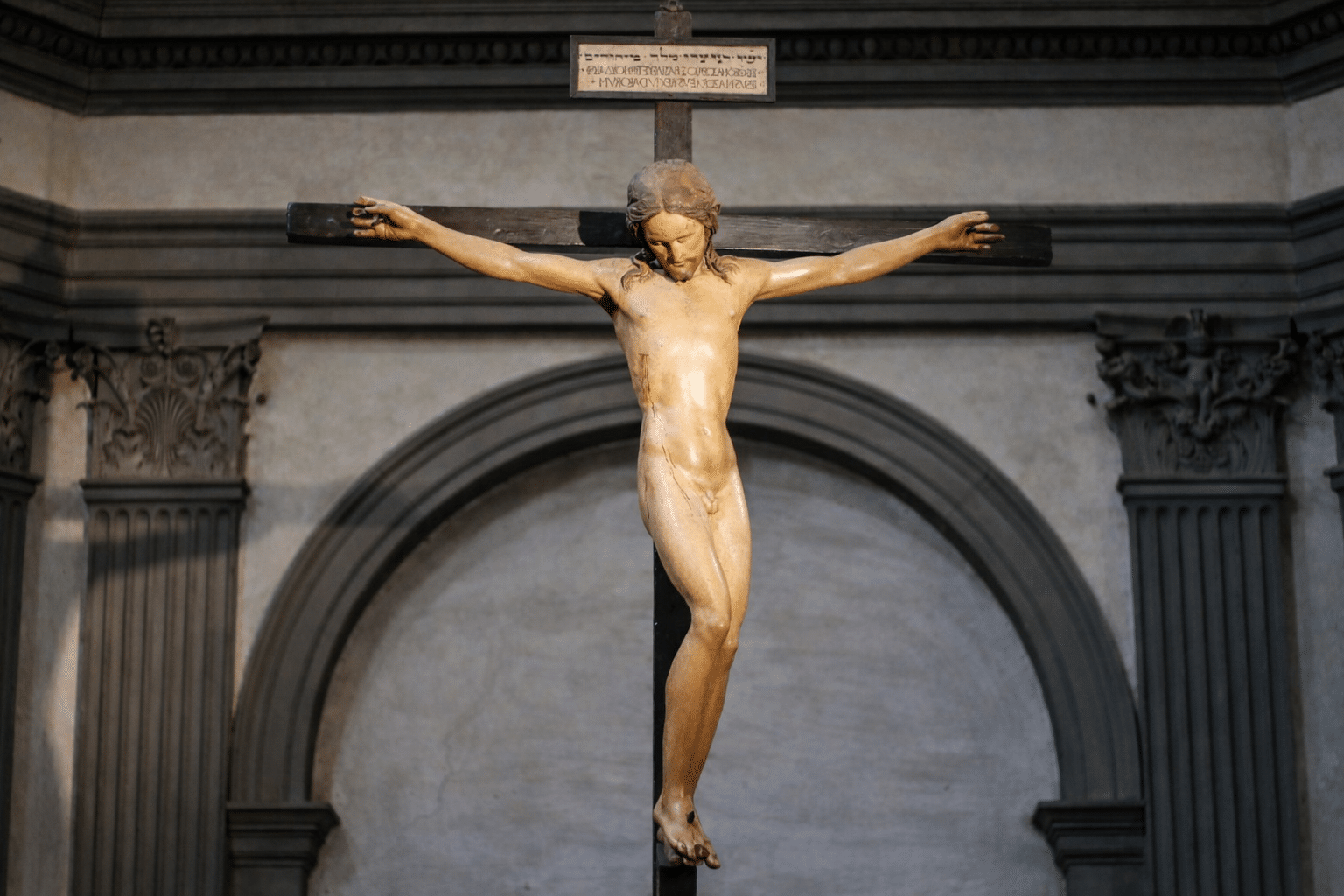
Around 1492–1493, Michelangelo — barely in his late teens — carved a wooden Crucifix now housed in the Sacristy of Santo Spirito. Unlike marble commissions that would later make him immortal, this was a work born of study, humility, and daring. Michelangelo was granted access to the convent’s hospital, where he reportedly dissected human cadavers to deepen his understanding of anatomy. This knowledge is evident in the Crucifix: the body is slender, youthful, and anatomically precise, yet softened by a sense of quiet vulnerability. Unlike Donatello’s suffering Christ or Brunelleschi’s idealized savior, Michelangelo presents a fully human Christ, suspended between physical realism and spiritual grace. The figure does not cry out in pain, nor does it retreat into abstract perfection. Instead, it breathes.
A Radical Choice: The Nude Christ
One of the most striking aspects of Michelangelo’s Crucifix is its nudity. Unlike earlier depictions that discreetly covered Christ’s body with a loincloth, Michelangelo chose to represent the figure fully nude — a bold, controversial decision. This was not provocation for its own sake. For Michelangelo, nudity was truth. It allowed him to explore the body as God’s perfect creation, unmediated and unashamed. In this sense, the Crucifix becomes not only a devotional object, but a manifesto — an early declaration of the artist’s lifelong belief in the sacredness of the human form. It is a choice that sets Michelangelo apart from both Donatello and Brunelleschi, signaling a new artistic horizon.
Wood as an Intimate Medium
That Michelangelo chose wood is also significant. Unlike marble, wood demands immediacy. It does not allow for endless revision; each cut is final. The material lends warmth, fragility, and intimacy to the sculpture — qualities perfectly suited to the young artist’s vision. In the quiet sacristy of Santo Spirito, the Crucifix feels almost private, as though intended for contemplation rather than display. It invites closeness, not awe — a relationship rather than reverence from afar.
Competition Without Winners — Only Evolution
Rather than producing a clear “winner,” the dialogue between the three Crucifixes reveals something far more important: the evolution of Renaissance thought. Donatello emphasizes suffering and humanity. Brunelleschi seeks harmony and divine order. Michelangelo unites anatomy, emotion, and spiritual intensity into a single vision. Together, these works chart Florence’s journey from medieval devotion to Renaissance humanism — and beyond.
Why This Story Matters Today
For visitors exploring Florence beyond its most famous monuments, the story of these wooden Crucifixes offers a deeper understanding of the city’s artistic soul. They are not just sculptures; they are conversations across generations. Michelangelo’s Crucifix, in particular, allows us to witness the birth of a genius — not yet the creator of the Sistine Chapel, but a young artist listening, responding, and daring to surpass his masters. On a private exploration of the Oltrarno, this story gains even greater resonance. Away from crowds and grand narratives, Florence reveals itself through quieter masterpieces — works that whisper rather than shout, yet remain unforgettable. In a city built on competition, it was not rivalry alone that shaped greatness, but the courage to reinterpret tradition. And in wood, rather than marble, Michelangelo carved one of the most intimate statements of faith and artistry the Renaissance would ever know.