
In 1911 three men boarded a train in Milan with a simple purpose: to settle a quarrel with their fists. Filippo Tommaso Marinetti, Umberto Boccioni and Carlo Carrà were the loudest voices of Futurism, and they were furious with a Florentine critic, Ardengo Soffici, who had mocked their exhibition in the review La Voce. They reached Florence, walked into the Caffè Giubbe Rosse, and assaulted Soffici and his colleagues. The feud was later settled by the painter Gino Severini, sent to make peace: the “Peace of Florence”, as Boccioni called it.
It is a comic story, until you remember where the movement was heading. Within eight years Marinetti would be among the founders of the first Fascist organisation, and Florence, a city of museums the Futurists had promised to destroy, would become one of the places where Fascist violence was most intense. To understand how art and politics met here, we have to begin at that café table.
Marinetti’s Manifesto and a City of the Past
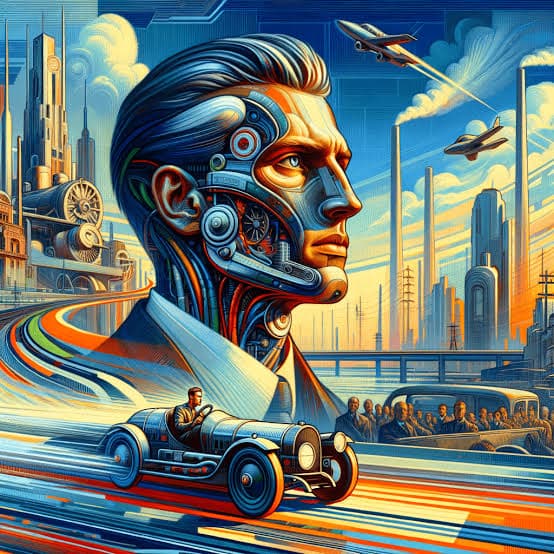
Futurism was born in 1909, when Marinetti published his manifesto in the Paris newspaper Le Figaro. It celebrated speed, machines, youth and violence, and it glorified war, which it called “the world’s only hygiene”. Its home was industrial Milan. Florence, with its Renaissance monuments and its reverence for tradition, looked like the natural enemy. The scholar Luca Somigli has called it “past-loving” Florence, and yet it proved tempted by Futurism all the same.
Soffici was the ideal go-between. He had spent seven years in Paris, where he knew Picasso, Braque and Apollinaire, and when he returned to Florence he brought Cubism with him. He distrusted Futurist rhetoric and love of publicity, yet he acknowledged that, for all its faults, it was a movement of renewal.
On 1 January 1913 Giovanni Papini and Soffici founded Lacerba, a Florentine review that from March of that year opened its pages to Marinetti and the Futurists, and within a few issues it supported them wholeheartedly. The Giubbe Rosse became the movement’s Tuscan headquarters, and the circle drew in a very young painter from the Oltrarno, Ottone Rosai, who joined the group in 1913 and exhibited with it the following year.
A Quarrel in Florence, a Call to War
The alliance did not last. In February 1914 Papini began attacking Marinetti’s unquestioning faith in progress, and an article signed by Aldo Palazzeschi, Papini and Soffici, “Futurism and Marinettism”, proclaimed the three Florentines the only authentic Futurists and dismissed the Milanese as mere “Marinettists”. By the end of that year the two groups had parted ways.
Yet on one point they agreed. Both camps pushed Italy towards the First World War, and Lacerba, by then a loud voice for intervention, published its last issue on 22 May 1915, just before Italy entered the conflict. Many Futurists volunteered. Boccioni and the architect Antonio Sant’Elia did not return. Rosai enlisted in the Arditi, the assault troops, and won medals for valour, then wrote a book about his experience, Il libro di un teppista, in 1919.
From the Futurist Party to the First Fascists
The war ended, but the Futurists’ appetite for action did not. In 1918 Marinetti founded the Futurist Political Party, with its own newspaper, Roma Futurista, and local Futurist political groups, the fasci politici futuristi, appeared in Milan, Rome, Florence and other cities. The programme was radical and, on paper, left-leaning: it was anticlerical and republican, and it courted war veterans, especially the Arditi.
On 23 March 1919, in a hall in Milan’s Piazza San Sepolcro, Benito Mussolini founded the Fasci Italiani di Combattimento. The Futurists were there. Marinetti became a member of the movement’s central committee, and scholars note that the first Fascist programme drew heavily on the Futurist Party’s own. In the elections of November 1919 an Arditi, Futurist and Fascist list, which included Mussolini and Marinetti, failed badly.
The relationship, in other words, was never simple. In May 1920 Marinetti and his fellow Futurist Mario Carli walked out of a Fascist congress, denouncing it as “reactionary”, as it drifted away from the radical, anticlerical positions of its early days. Some Futurists left Fascism for good; others, with Marinetti among them, returned. Marinetti himself, who had walked out in 1920, ended up as an academician of the regime. What had been planted, however, was a shared language of youth, violence and contempt for parliamentary politics.
When Ideas Became Squads
In Florence that language soon turned into action. The city became one of the main stages of Fascist squadrismo, the paramilitary violence that carried Mussolini to power. On 27 February 1921, after a bomb exploded during a patriotic parade, a Fascist squad entered the Florentine headquarters of the railwaymen’s union and shot Spartaco Lavagnini, the communist union leader. The next day Giovanni Berta, a young Fascist, was killed on the Ponte Sospeso, and the violence only ended when the army intervened. The regime made him a martyr almost at once: the city’s football stadium took his name, and a section of the bridge parapet from which he fell was displayed in the Exhibition of the Fascist Revolution. By the mid-1920s, under the local boss Tullio Tamburini, Florence had become a testing ground for attacks on socialist newspapers, cooperatives and workers’ associations.
The Painters Who Stayed
The Florentine avant-garde followed very different paths. Soffici, who after the war turned from Futurism towards tradition and the Tuscan landscape, signed the Manifesto of the Fascist Intellectuals in 1925, and after Mussolini’s fall in 1943 pledged loyalty to the Italian Social Republic.
Rosai’s story is more complex. He later recalled that when the Futurists invited him to join them, he considered himself a militant Futurist from that very day, and a regular at the Giubbe Rosse. Born in 1895 in San Frediano, in the Oltrarno, the son of a carpenter and carver, he painted the working-class Florence he knew, and from 1934 worked in a studio in Via San Leonardo. An early supporter of Fascism, he was dismayed by the Lateran Pacts of 1929, in which the regime made peace with the Church: he felt it had betrayed the anticlerical ideals of its first years.
Why This Story Still Matters
The Florentine Futurists remind us that the avant-garde is not automatically on the side of freedom. A movement that worships speed, youth and war can find, in the first Fascist squads, something that looks like its own programme made flesh. And the regime, in turn, was happy to embrace modernity when it suited it: the Santa Maria Novella railway station, a masterpiece of Italian Rationalism, was inaugurated in 1935 with Mussolini’s personal approval.
This is the thread we follow in our walking tour Florence in War and Flood, which begins at that very station and ends in the Oltrarno, the neighbourhood of Rosai and, in August 1944, of the partisans. Here the history of the twentieth century is not a lesson learned from books, but something you can read in the streets, one step at a time.